
Hawaiian mantle plume has been getting hotter for 47 million years
For decades, geologists believed mantle plumes gradually cooled as they aged, producing less magma over time. New research suggests the opposite happened beneath Hawaiʻi. Scientists found the Hawaiian mantle plume became about 250°C (480°F) hotter over the past 47 million years, a shift that fueled two major pulses of volcanism and produced some of Earth’s largest volcanoes.
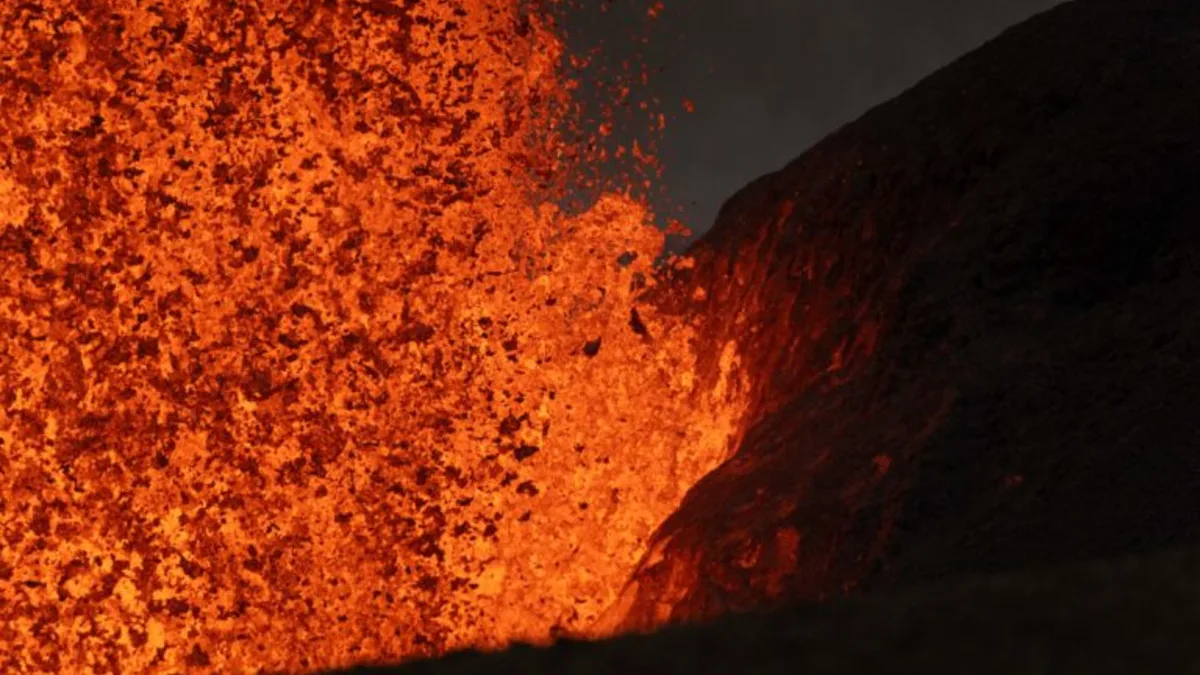
Telephoto view of the north vent lava fountain during episode 49 on June 14. 2026, showing the incandescent lava landing on and illuminating the Halema‘uma‘u crater wall. Credit: USGS photo by T. Paladino
Each eruption at Kīlauea offers a glimpse of magma rising from deep within Earth’s mantle, but new research suggests the source feeding Hawaiʻi’s volcanoes has undergone an unexpected transformation over tens of millions of years.
For decades, geologists believed mantle plumes gradually cooled as they aged, reducing magma production through time. A study published in Earth and Planetary Science Letters now turns that idea on its head, finding that the mantle plume beneath Hawaiʻi has instead heated by about 250°C (450°F) over the past 47 million years.
The research, led by Michael O. Garcia of the University of Hawaiʻi at Mānoa School of Ocean and Earth Science and Technology, concludes that changes in mantle temperature, rather than tectonic plate motion, lithosphere thickness or mantle composition, best explain the dramatic variations in volcanic output along the Hawaiian Ridge.
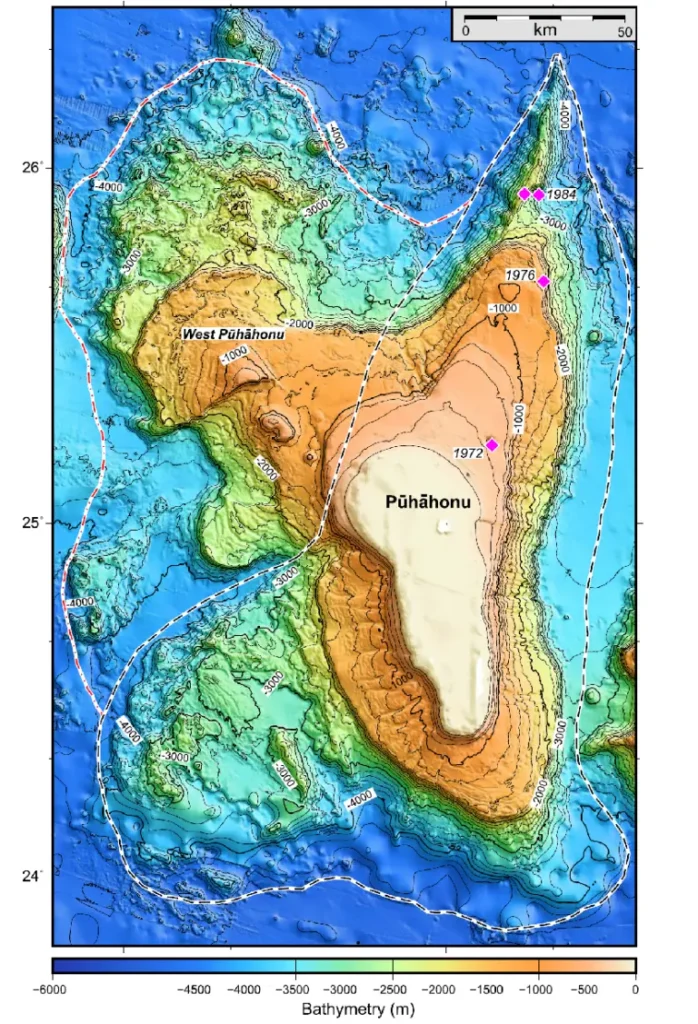
The Hawaiian-Emperor chain extends roughly 6 000 km (3 728 miles) across the Pacific and contains more than 120 volcanoes formed during the past 82 million years as the Pacific Plate moved over a relatively stationary mantle hotspot. Within that chain, the Hawaiian Ridge records the past 47 million years of volcanic activity and includes 65 volcanoes stretching approximately 3 500 km (2 175 miles).
Geologists have known for a long time that volcanic output increased dramatically along the ridge through time. What remained unresolved was why.
Garcia’s team examined 33 lava samples from 16 volcanoes, including 14 extinct volcanoes along the Northwest Hawaiian Ridge, together with Mauna Loa and Mauna Kea. Rather than relying on a single method, the researchers compared multiple established geochemical models, including the mantle potential temperature approaches developed by Herzberg et al. (2023) and Lee et al. (2009), together with Putirka’s (2016) modified olivine-liquid thermometer.
Before applying the models to Hawaiian lavas, the team tested them against laboratory experimental melts to determine which produced the most accurate mantle temperature estimates. They then combined those results with updated bathymetric mapping, new volcano volume calculations and new radiometric age determinations to compare mantle temperatures with volcanic growth through time.
The results revealed a clear relationship between mantle temperature and volcano size.
Only volcanoes exceeding roughly 70 000 km³ (16 800 mi³) were associated with mantle potential temperatures of at least 1 600°C (2 912°F). Statistical analysis showed that volcanic volume increased by approximately 289 ± 78 km³ for every 1°C increase in mantle potential temperature, providing one of the strongest quantitative links yet identified between deep mantle heat and volcanic construction.
“It was a major surprise to find such a strong, direct correlation between mantle temperatures and volcano size,” Garcia said. “Other potential explanations simply failed to explain the data.”
The researchers systematically evaluated four competing explanations for the enormous differences in volcano size along the Hawaiian Ridge.
Lithosphere thickness was ruled out because the Pacific Plate beneath the ridge remained consistently old and thick throughout most of the volcanoes’ formation history. Plate motion also failed to explain the pattern. Although the Pacific Plate accelerated from roughly 57 km (35 miles) to 87 km (54 miles) per million years about 25 million years ago, volcano size showed no corresponding increase.
The team also found little evidence that changes in mantle source composition controlled volcanic growth. Most Northwest Hawaiian Ridge volcanoes shared similar geochemical signatures despite their vastly different sizes. Even unusual volcanoes such as Daikakuji and West Nīhoa, which display Loa-like mantle characteristics, remained relatively small, demonstrating that mantle composition alone could not account for the observed variations.
With the other explanations eliminated, mantle temperature emerged as the only factor consistently matching volcanic output.
The study identified two major pulses of heating and magma production.
The first occurred between about 20 and 14 million years ago, producing Pūhāhonu, the largest shield volcano formed on Earth during the past 60 million years. According to the researchers, elevated mantle temperatures probably sustained the volcano’s shield-building phase for more than 1.8 million years, allowing it to reach an extraordinary size.
A second pulse began within the past 6 million years, giving rise to the modern Hawaiian Islands, including Mauna Loa, Mauna Kea, and Kīlauea.
Rather than steadily cooling through time as conventional models predict, the Hawaiian hotspot appears to have delivered progressively greater amounts of heat and magma during much of its recent geological history. The findings also support the idea that mantle plumes may behave as pulsating systems, with periodic increases in heat and magma supply instead of a simple long-term decline.
Because many global hotspot models assume mantle plumes gradually cool with age, the Hawaiian record forces geologists to reconsider how these deep mantle upwellings evolve beneath volcanic chains worldwide.
What drives this long-term heating remains uncertain. The researchers propose that slowly drifting thermochemical domains near the core-mantle boundary may periodically feed additional heat into the Hawaiian plume. If confirmed, the finding would suggest Earth’s deepest interior is far more dynamic than previously thought and that the evolution of mantle plumes may be controlled by processes occurring nearly 2 900 km (1 800 miles) beneath the surface.
References:
1 Garcia, M. O., Putirka, K. D., Tree, J. P., & Jicha, B. R. (2026). Taking the temperature of the Hawaiian plume using multiple geochemical approaches: Evidence for secular heating from 47 Ma to present. Earth and Planetary Science Letters, 657, 120055. https://doi.org/10.1016/j.epsl.2026.120055
2 Study reveals Hawaiian hotspot is getting hotter – University of Hawaiʻi at Mānoa – July 13, 2026

I’m a science journalist and researcher at The Watchers, contributing to the Epicenter edition, where I cover peer-reviewed scientific research and emerging discoveries across Earth and space sciences. With a background in astronomy and a passion for environmental science, I’ve worked in shark and coral conservation in Fiji, conducting reef and shark-behavior research, contributing to mangrove restoration, and earning PADI Open Water and Coral Reef Certifications. I bring a blend of scientific rigor and storytelling to illuminate the discoveries shaping our planet and beyond.

Commenting rules and guidelines
We value the thoughts and opinions of our readers and welcome healthy discussions on our website. In order to maintain a respectful and positive community, we ask that all commenters follow these rules.