
Faintest exoplanet imaged from Earth hid in Beta Pictoris data for 11 years
Two independent teams announced the discovery of Beta Pictoris d on July 15, 2026, a gas giant orbiting the 23-million-year-old Beta Pictoris system about 63 light-years from Earth. The planet is the faintest exoplanet ever directly imaged from Earth after correcting for distance; a VLT team traced it through observations spanning 11 years, while a JWST team independently identified it through the molecular signature of its atmosphere.
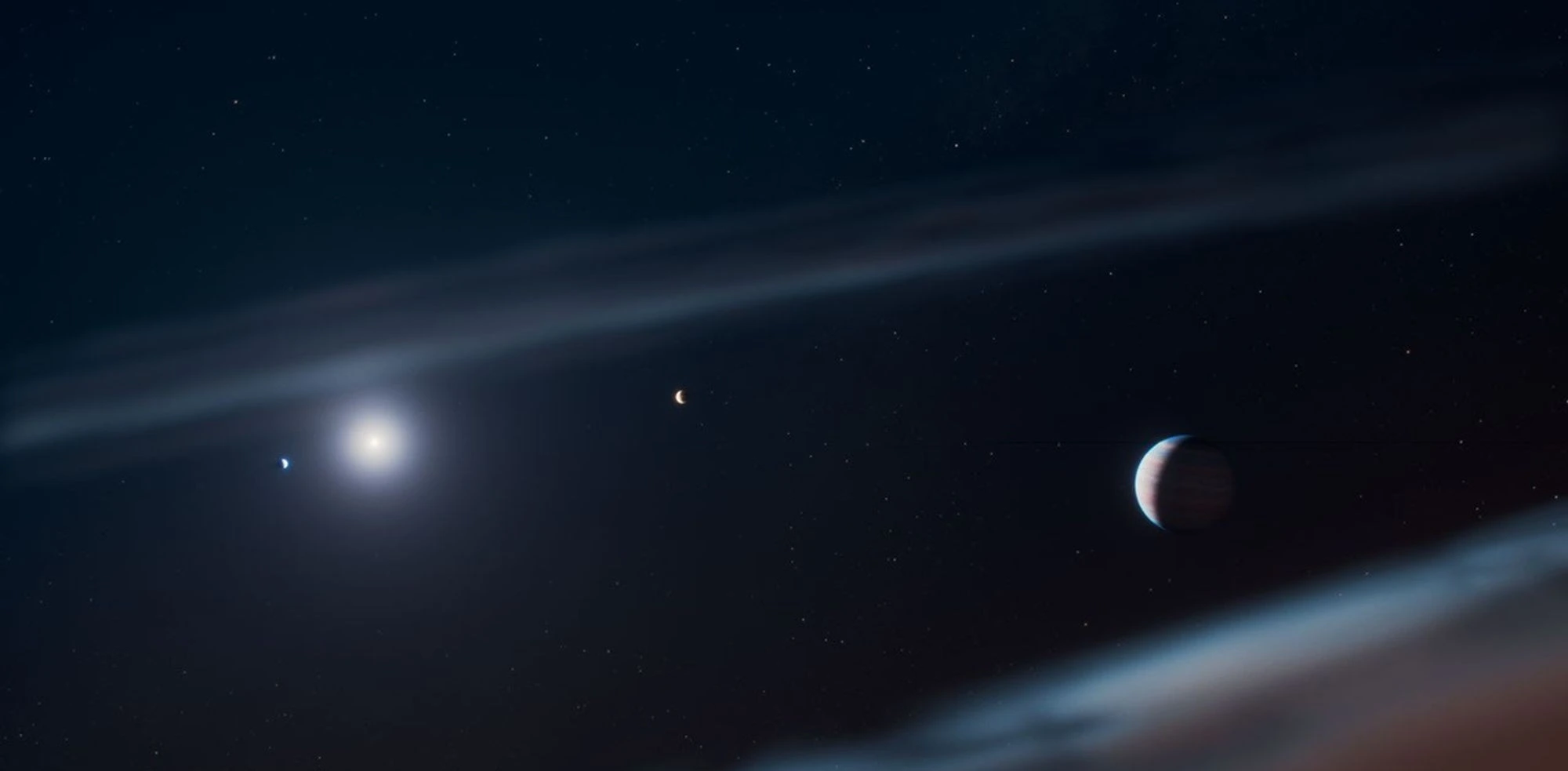
This artist’s concept shows the Beta Pictoris system with the discovered giant exoplanet Beta Pictoris d at the right. It has the widest orbit of the known three exoplanets within the system. Credit: NASA, ESA, CSA, STScI, Ralf Crawford (STScI)
The JWST detection represents the first discovery of a directly imaged planet primarily through moderate-resolution spectroscopy. Instead of relying only on a visible point source, the team identified atmospheric absorption features and measured their Doppler shift, allowing it to distinguish the planet from disk structures and confirm that it was associated with the Beta Pictoris system.
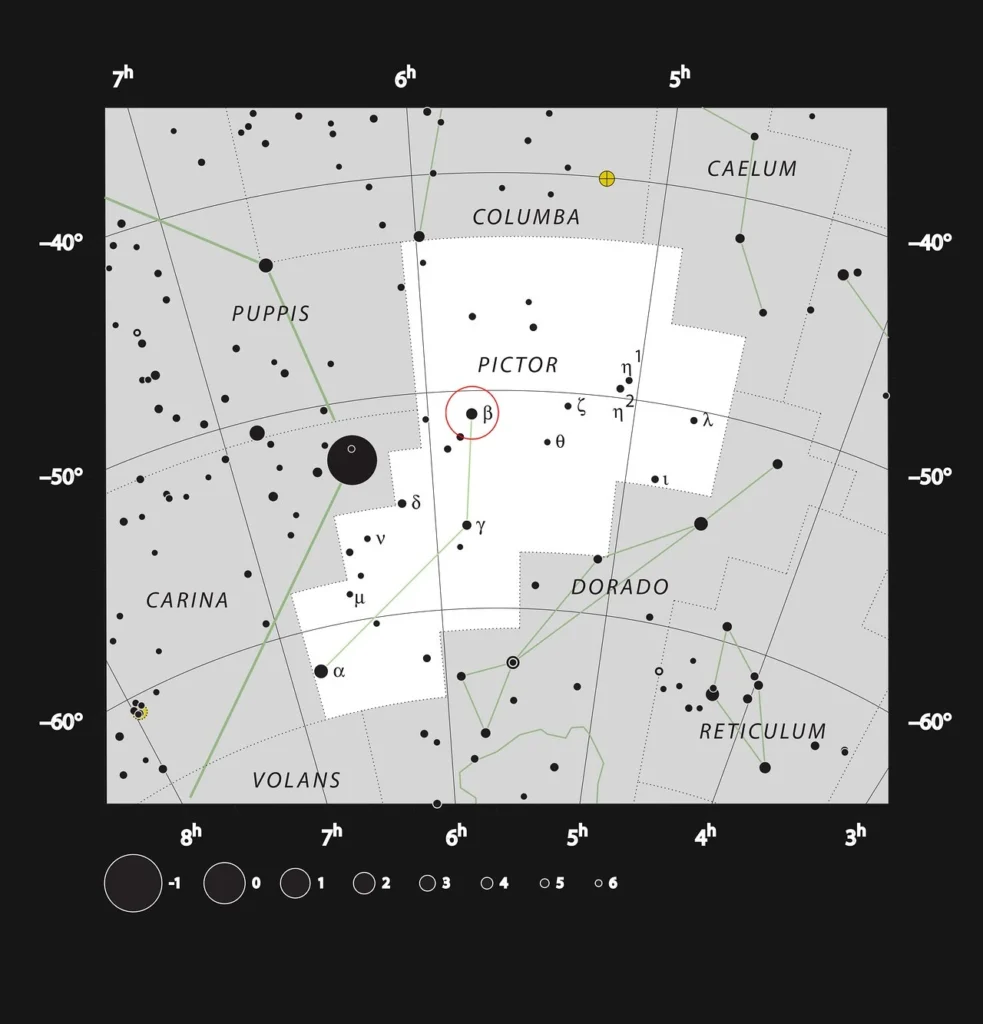
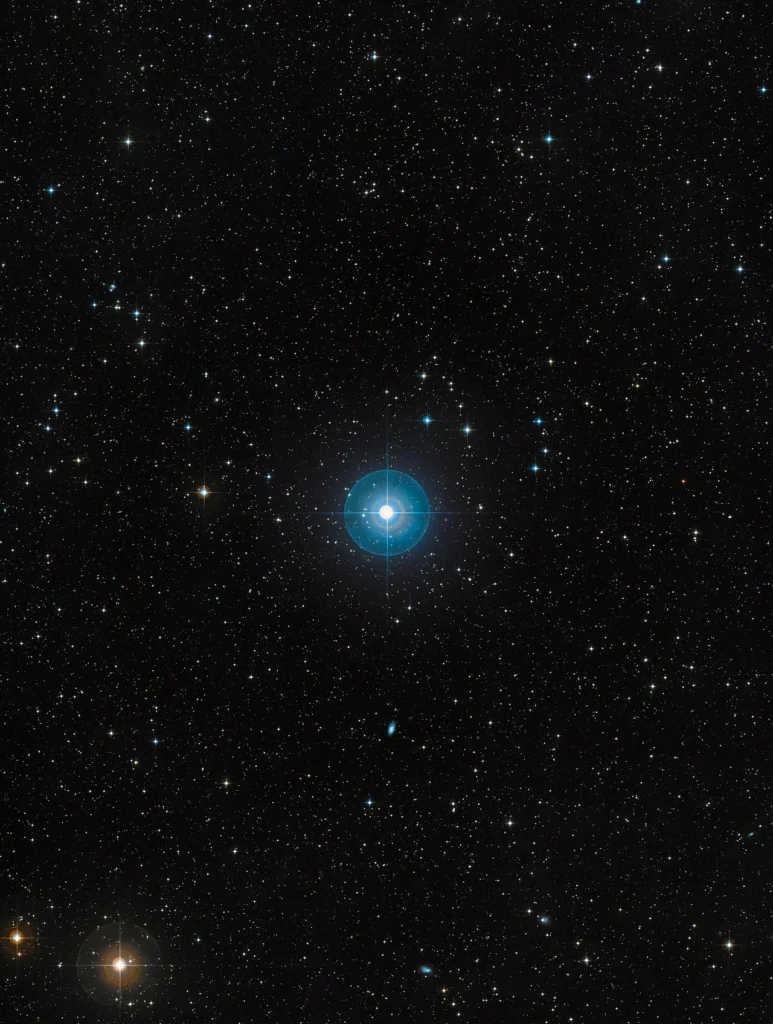
Beta Pictoris, located about 63 light-years away in the constellation Pictor, has long served as one of astronomy’s premier laboratories for studying how planetary systems form.
At just 23 million years old, the star is surrounded by one of the brightest debris disks known and was already famous for hosting two directly imaged giant planets, Beta Pictoris b and c. The discovery of Beta Pictoris d makes it only the second planetary system, after HR 8799, where astronomers have directly imaged three planets orbiting the same star.
The discovery unfolded independently on opposite sides of the Atlantic.
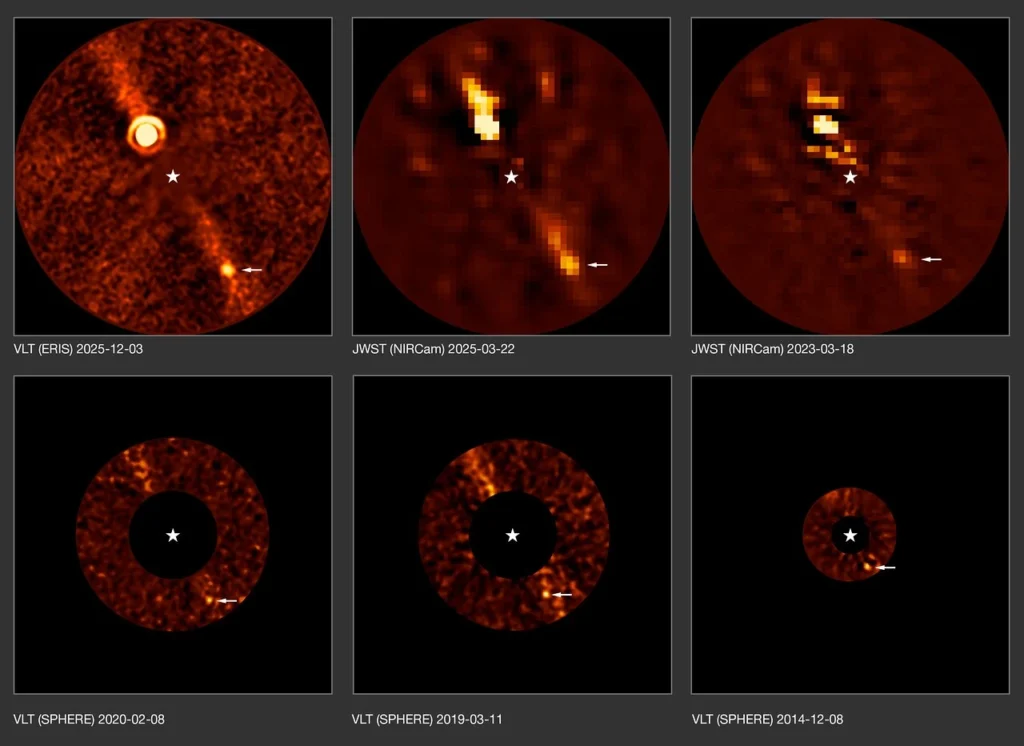
A team led by Ben Sutlieff of the University of Edinburgh and Markus Bonse of the European Southern Observatory was monitoring Beta Pictoris b with the ERIS instrument on ESO’s Very Large Telescope to study how the known planet varied over time.
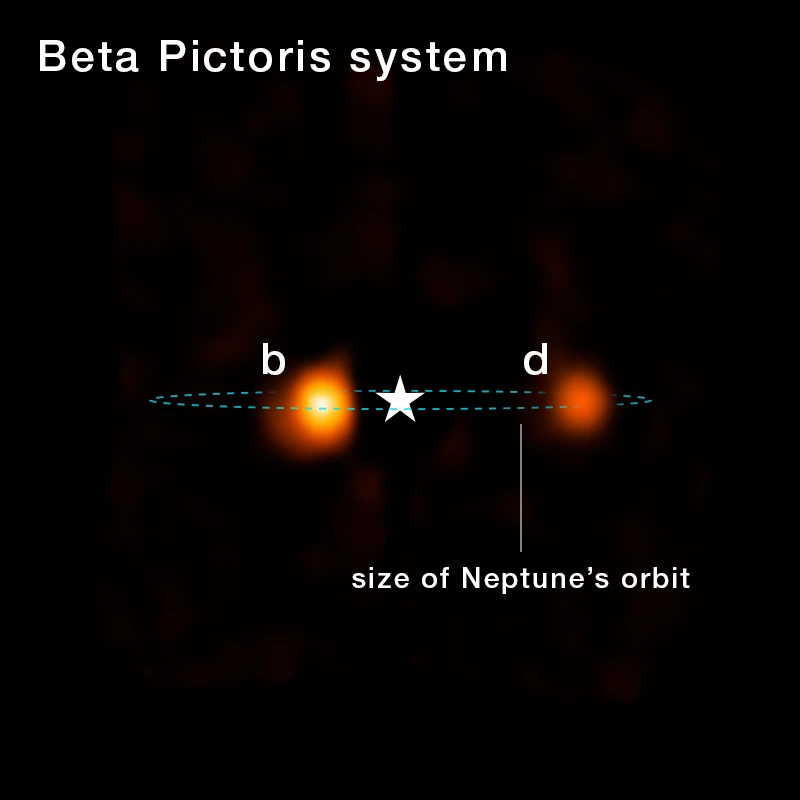
“We initially wanted to look more at a known planet in the system, Beta Pictoris b, to see how it changed over time,” Sutlieff said. Instead, while analyzing the images, the team noticed something else entirely.
Searching through more than a decade of archived VLT observations revealed that the object had been quietly appearing in images dating back 11 years. It had simply remained buried beneath the glare of the much brighter Beta Pictoris b.
“Planet d, it seems, has been playing a game of hide-and-seek with us for over a decade and only now can we say ‘found you!'” said University of Oxford astronomer Jayne Birkby, a co-author of the study.
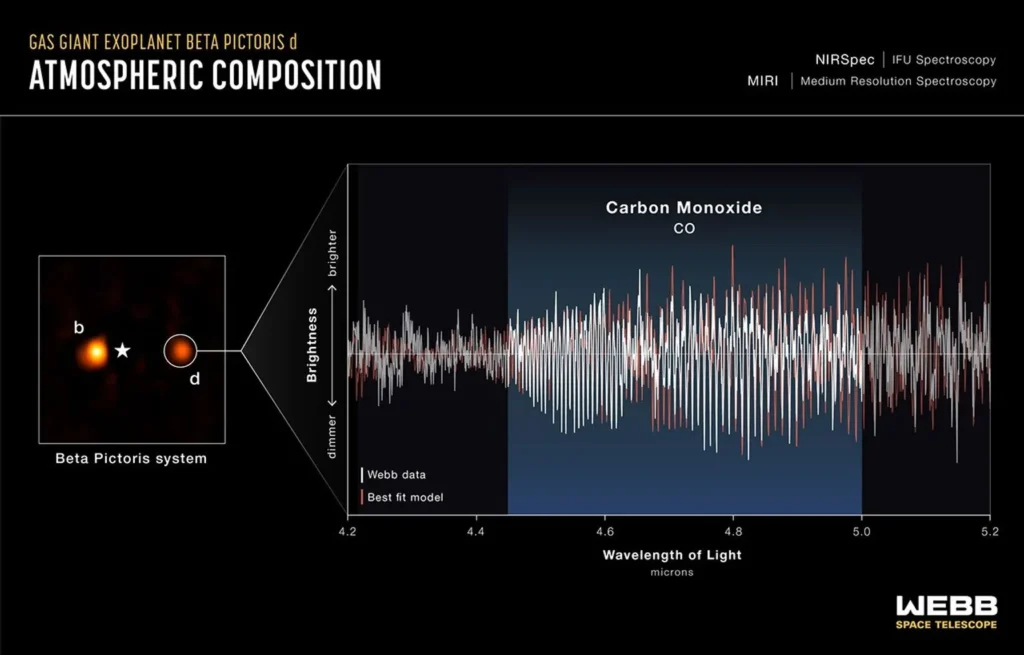
At almost the same time, a completely independent team led by Aidan Gibbs at the University of California, San Diego encountered the same planet while analyzing JWST observations of Beta Pictoris b. They were not searching for another world.
“We weren’t looking for a new planet,” Gibbs said. “We were trying to understand one we already knew existed. Then, this telltale signal appeared in the data where we didn’t expect it.”
Rather than discovering the planet as a bright point of light, the Webb team identified a distinctive series of carbon monoxide absorption lines in its atmosphere. The molecular pattern acted like a barcode, allowing astronomers to distinguish the planet from surrounding dust, background stars, and instrumental artifacts.
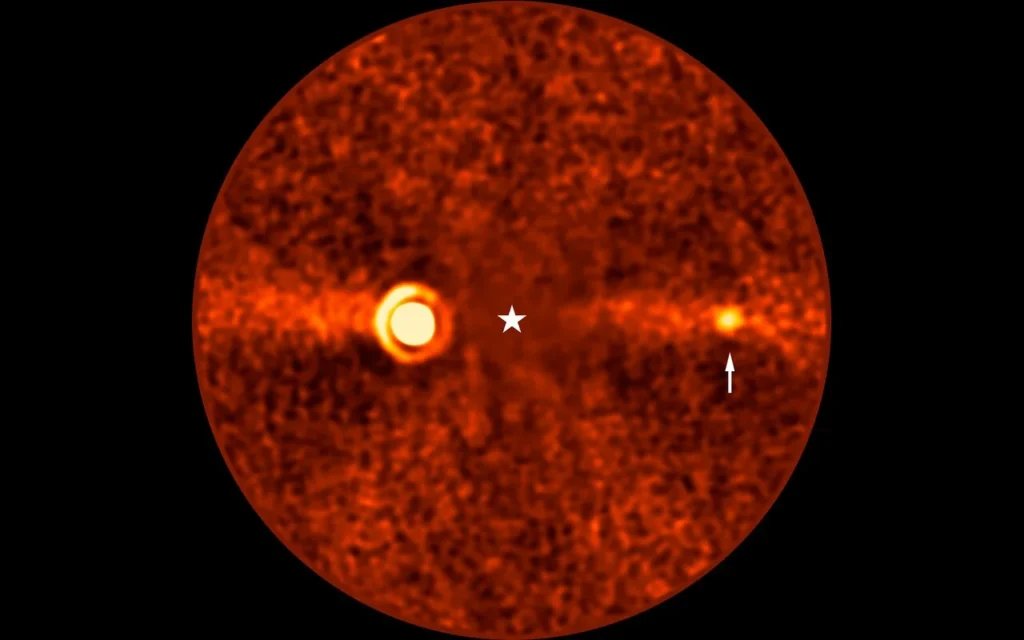
“There was an unexpected bright source of light within the Integral Field Unit imaging, but we’ve learned not to trust bright blobs in images,” said Jean-Baptiste Ruffio of the University of California, San Diego. “By obtaining a spectrum at the same time as the image, we were able to quickly confirm our suspicions.”
That approach proved especially powerful because Beta Pictoris is embedded within one of the brightest debris disks known. The enormous disk scatters starlight like a dense cosmic fog, making conventional direct imaging extremely difficult. Spectroscopy effectively ignored the scattered dust, isolating only the narrow molecular signatures unique to a planetary atmosphere. Researchers later confirmed the discovery using additional JWST observations that detected methane and water vapor in the planet’s atmosphere.
The complementary discoveries demonstrate two different paths to finding hidden worlds. The VLT showed that extremely faint planets can still be recovered through improved image processing and archival observations, while JWST demonstrated that moderate-resolution spectroscopy can reveal planets even when conventional imaging struggles against overwhelming dust and glare.
Beta Pictoris d is a gas giant, but it is markedly different from its larger siblings. Whereas Beta Pictoris b and c each contain roughly ten times Jupiter’s mass, the new planet is estimated to be about 2.4 Jupiter masses by the VLT team, while the JWST analysis suggests a mass of roughly two to four Jupiter masses. Atmospheric modeling indicates temperatures of approximately 327–527°C (620–980°F), making it substantially cooler and intrinsically fainter than most directly imaged exoplanets.
Corrected for distance, Beta Pictoris d is about 100 times fainter than Beta Pictoris b, making it the faintest exoplanet ever directly imaged from Earth in terms of intrinsic luminosity.
Its orbit is still being refined. Current solutions place its semi-major axis at roughly 26 astronomical units, although dynamical modeling suggests the planet occupies a region comparable to or beyond Neptune’s orbit, helping maintain the stability of the system. The planet follows the widest orbit of the three known giants while remaining inside the debris disk’s sharply defined inner edge.
That location may solve one of the longest-running mysteries surrounding the Beta Pictoris system.
For years, astronomers suspected that another unseen planet was sculpting the inner boundary of the debris disk and producing several unusual structures observed throughout it. Both teams found that Beta Pictoris d has almost exactly the mass and orbital location required to explain those features.
The discovery may also provide new clues about how giant planets form. While Beta Pictoris b and c are consistent with the bright, rapidly formed “hot-start” population of giant planets, the much lower luminosity of Beta Pictoris d may point toward a colder formation history, although researchers caution that additional observations will be needed to distinguish between competing formation models.
The planet also appears remarkably similar to the directly imaged exoplanet 51 Eridani b, making it only the second known mid-T-type exoplanet observed through direct imaging. Because both planets formed within stellar associations of nearly identical age, astronomers now have an unusually valuable opportunity to compare how giant planets with similar temperatures and masses evolve under different conditions.
“Systems with multiple directly imaged exoplanets are the holy grails of discoveries,” Sutlieff said. “They can teach us a lot about what different exoplanets are like in the same formation environment.”
It took two independent teams using entirely different techniques to finally pull the faint world out of the data, proving that many more overlooked planets may still be hiding in plain sight deep within astronomical archives.
References:
1 Faintest planet ever imaged from Earth found after more than 10 years of hide-and-seek – ESO – July 15, 2026
2 Sutlieff, B. J., Bonse, M. J., Christiaens, V., Fontanive, C., Matthews, E. C., Parker, L. T., Pearce, T. D., Birkby, J. L., Biller, B. A., et al. (2026). Direct imaging discovery of giant exoplanet β Pictoris d: A decade-long game of hide-and-seek. The Astrophysical Journal Letters. https://doi.org/10.3847/2041-8213/ae80a0
3 Gibbs, A., Ruffio, J.-B., Bidot, A., Barman, T. S., Do Ó, C. R., Konopacky, Q. M., Perrin, M. D., et al. (2026). Discovery of an exterior third planet orbiting β Pictoris. The Astrophysical Journal Letters. https://iopscience.iop.org/article/10.3847/2041-8213/ae801b
4 NASA’s Webb Discovers Hidden Planet in Famous Star System – NASA – July 15, 2026

I’m a science journalist and researcher at The Watchers, contributing to the Epicenter edition, where I cover peer-reviewed scientific research and emerging discoveries across Earth and space sciences. With a background in astronomy and a passion for environmental science, I’ve worked in shark and coral conservation in Fiji, conducting reef and shark-behavior research, contributing to mangrove restoration, and earning PADI Open Water and Coral Reef Certifications. I bring a blend of scientific rigor and storytelling to illuminate the discoveries shaping our planet and beyond.

Commenting rules and guidelines
We value the thoughts and opinions of our readers and welcome healthy discussions on our website. In order to maintain a respectful and positive community, we ask that all commenters follow these rules.