
Scientists identify rare jet-forced wind pattern behind 2025 Los Angeles urban firestorm
When powerful northerly winds swept through Los Angeles on January 7, 2025, they unleashed one of the most destructive urban firestorms in U.S. history. A new study attributes those winds to a rare “jet-forced Santa Ana” pattern — a collision of upper-level atmospheric forces that produced gusts over 35 m/s (80 mph), destroyed more than 16 000 structures, and killed 31 people. The event struck ahead of the first winter rain, after months of near-record dryness that left vegetation tinder-dry.
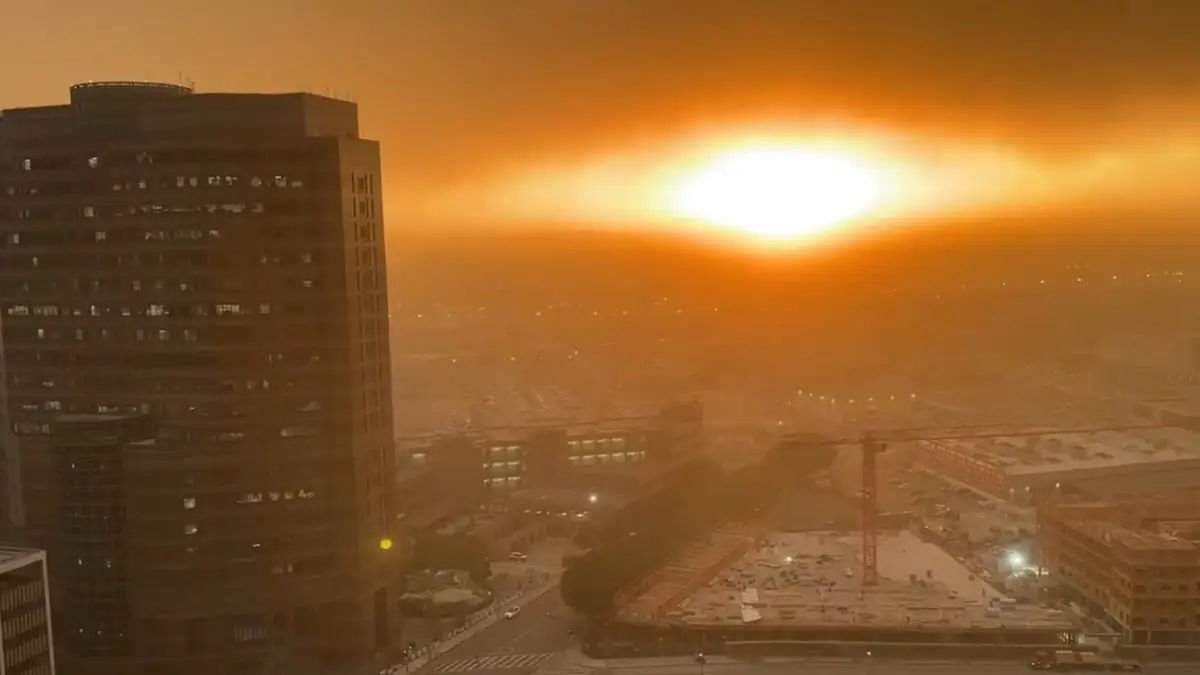
Image credit: LAFD/Erik Scott
A rare “jet-forced Santa Ana” wind pattern can turn a routine dry season into a fast-moving urban inferno. Researchers say recognizing these upper-level atmospheric setups could give California valuable extra weeks to prepare for extreme fire weather.
Researchers from the Center for Western Weather and Water Extremes (CW3E) at the Scripps Institution of Oceanography have identified the atmospheric and surface mechanisms that led to the catastrophic January 2025 Los Angeles urban firestorm, one of the most destructive fire disasters in U.S. history.
The study, published in npj Natural Hazards, defines the event as a jet-forced Santa Ana — a previously unclassified subtype characterized by intense upper-level jet dynamics that enhance surface pressure gradients and accelerate downslope winds.
The analysis links the disaster to an amplified ridge over the West Coast and a retrograding trough extending from the central to eastern United States, producing a steep meridional pressure gradient and strong northerly flow over California.
At 500 hPa, northerly winds averaged 27 m/s, ranking in the 97th percentile of the 76-year record. Large-scale subsidence exceeded the 99th percentile, promoting adiabatic warming and drying through the lower troposphere.
This configuration generated mountain-wave activity along the San Gabriel and Santa Monica Mountains, where vertical oscillations in potential temperature and alternating bands of ascent and descent intensified local turbulence. These waves created hazardous conditions for aircraft and forced the suspension of aerial firefighting operations.
Surface winds reached sustained speeds of 16–22 m/s (36–50 mph) with gusts surpassing 34 m/s (75 mph) at Burbank, Henninger Flats, and Malibu Hills stations. The strongest downslope acceleration occurred near Altadena and Pacific Palisades, where the Eaton and Palisades Fires transitioned from wildland ignition zones into dense residential neighborhoods. The Eaton Fire destroyed thousands of structures in West Altadena, while the Palisades Fire burned 9 600 ha (23 707 acres).
Although the surface winds were not record-breaking, their timing was highly unusual. By January 7, Southern California had received only about 4% of the typical October–January precipitation. The first wetting rain did not arrive until January 28, marking the second-latest onset since 1948.
Live fuel moisture in chamise and similar chaparral species fell below 60 %, the critical ignition threshold, ranking in the lowest 15th percentile of the 2001–2025 record. These factors left the foothills and canyons of Los Angeles exceptionally flammable.
The National Weather Service (NWS) issued Fire Weather Watches as early as January 3 and upgraded to a “particularly dangerous situation” warning on January 6 — terminology reserved for the most severe windstorms. Forecasts predicted damaging gusts up to 45 m/s (100 mph) and “life-threatening, destructive winds” driven by strong upper-level support and mountain-wave activity.
Despite these alerts, response systems were overwhelmed as embers ignited structures far from the original ignition sites. Sustained turbulence grounded aircraft while ground crews faced rapidly changing fire fronts.
The authors compared the January 2025 Firestorm’25 with the December 1, 2011 Windstorm’11, which shared a similar ridge–trough configuration but occurred after early-season rainfall, preventing major fires. Pressure anomalies during Firestorm’25 were extreme, with a Los Angeles–Bakersfield difference of −7.2 hPa and a Los Angeles–San Francisco difference of −8.2 hPa (near the 5th percentile), indicating an atypically strong north–south gradient distinct from canonical Santa Ana patterns.
The study’s methods combined surface data from the Automated Surface Observing System (ASOS) and Remote Automated Weather Stations (RAWS), upper-air fields from NCEP/NCAR Reanalysis and ERA5, and live-fuel measurements from the Fuel Moisture Repository Web Portal.
Forecast and warning texts were retrieved from the Iowa Environmental Mesonet, while structural damage data originated from the CAL FIRE Damage Inspection Database (DINS).
The paper also notes preliminary reports that the Eaton Fire may have started from electrical utility infrastructure within Eaton Canyon, and it references ongoing investigations and criticism of delayed or uneven evacuation orders.
The authors argue that identifying jet-forced Santa Ana configurations is essential for long-range hazard forecasting. Similar jet-reinforced upper-level structures were present during other destructive California fire, including the Camp, Tubbs, Thomas, and Woolsey events, each occurring under delayed precipitation and critically dry fuels.
According to Guirguis and colleagues, incorporating such upper-level pattern recognition into operational meteorology could improve preparedness windows from days to weeks. In a state facing increasing hydroclimate variability and continued expansion of the wildland–urban interface, these compound atmospheric setups pose one of the most complex challenges for modern hazard management.
References
1 Compound atmospheric drivers of the catastrophic 2025 Los Angeles urban firestorm – Kristen Guirguis, Benjamin Hatchett, Rachel Clemesha, Rosana Aguilera, Alexander Gershunov, Ian Campbell, Daniel Cayan & Mark Merrifield – npj Natural Hazards – December 11 2025 – DOI: https://doi.org/10.1038/s44304-025-00155-7 – OPEN ACCESS

I'm a dedicated researcher, journalist, and editor at The Watchers. With over 20 years of experience in the media industry, I specialize in hard science news, focusing on extreme weather, seismic and volcanic activity, space weather, and astronomy, including near-Earth objects and planetary defense strategies. You can reach me at teo /at/ watchers.news.

Commenting rules and guidelines
We value the thoughts and opinions of our readers and welcome healthy discussions on our website. In order to maintain a respectful and positive community, we ask that all commenters follow these rules.