
High-altitude blue aurora defies predictions of ionospheric models
A study published in Geophysical Research Letters reveals that blue auroral emissions over Kiruna, Sweden, on October 21, 2023, reached an altitude of 200 km (124 miles), far exceeding predictions from established atmospheric models.

Image credit: Noel Bauza
The aurora borealis is typically known for its green and red hues, produced by atomic oxygen at altitudes between 100–300 km (62–186 miles). Blue auroras, caused by nitrogen molecular ions (N2+), were believed to appear much lower, near 110–130 km (68–81 miles).
That long-held assumption has now been challenged. During morning twilight in October 2023, a team of Japanese scientists recorded an unusually high blue emission over Kiruna in northern Sweden. Instead of the expected altitude, the emission reached 200 km (124 miles), nearly twice as high as predicted by theoretical models.
At this height, the atmosphere is so thin that only complex plasma interactions can sustain visible light. The finding indicates that N2+ ions either survive or are regenerated in upper layers where sunlight begins to interact with the auroral plasma.
This observation also suggests that traditional models such as the Global Airglow (GLOW) model, which place the emission peak near 120–160 km (75–99 miles), are incomplete. There must be additional processes lifting or producing N2+ ions well above the levels previously understood.
Such a discovery fundamentally changes how scientists view energy and matter exchange between the ionosphere and near-Earth space.
A new way to see the aurora
The team achieved this result using the HyperSpectral Camera for Auroral Imaging (HySCAI), developed by the National Institute for Fusion Science in Japan. Installed at the Swedish Space Corporation’s Esrange site near Kiruna, the system records full spectral data across hundreds of wavelengths, allowing precise separation of auroral light from sunlight during twilight.
HySCAI’s strength lies in its ability to detect faint emission lines with high spectral resolution between 0.73 and 2.1 nm. Unlike conventional cameras that use filters, it captures detailed color spectra across the entire sky, providing both spatial and spectral information simultaneously.
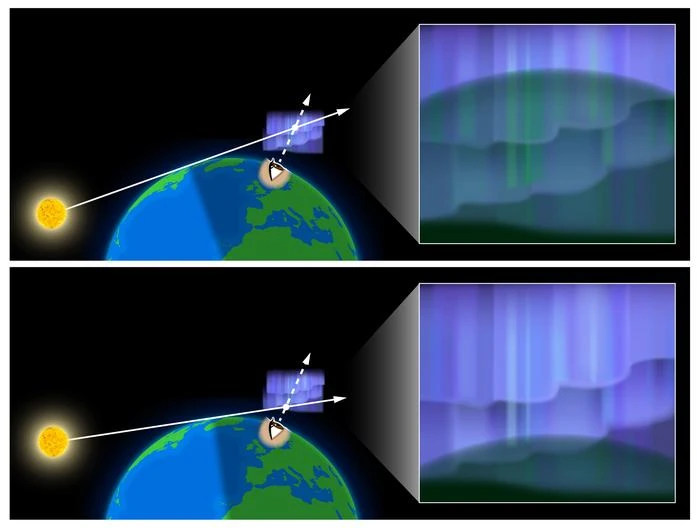
On October 21, 2023, between 02:21–03:59 UTC, HySCAI observed the blue aurora as the Sun’s rays gradually illuminated higher altitudes. The emission first appeared on the eastern horizon and moved toward the magnetic zenith as twilight advanced.
By analyzing how quickly the 427.8 nm emission brightened as sunlight reached lower layers, the researchers determined the altitude of maximum resonance scattering. The strongest signal appeared when the Sun’s shadow descended to 200 km (124 miles), indicating the precise layer where the blue aurora formed.
The method, inspired by diagnostic techniques used in laboratory plasma research, effectively turns the rising sunlight into a scanning probe for the upper atmosphere.
Why it matters for ionospheric physics
The 200 km (124 miles) emission peak marks a shift in understanding how nitrogen ions behave in the ionosphere. At such altitudes, direct electron impact cannot explain the observed brightness, meaning other mechanisms must be responsible.
One likely explanation is charge exchange, where neutral nitrogen interacts with excited oxygen ions (O+ in ²P or ²D states) to form N2+. This reaction, predicted to occur at 200–210 km (124–130 miles), aligns closely with the observed altitude.
Another possible process is ion upflow, where electric fields push molecular ions upward from lower atmospheric layers. These upflows are known to occur during geomagnetic disturbances, redistributing plasma into higher regions.
Both mechanisms suggest that the upper ionosphere is far more dynamic than once believed. If N2+ ions are routinely present at these altitudes, they could influence space weather by altering the composition of outflowing plasma that interacts with Earth’s magnetic field.
The discovery also means that resonance scattering, a process where sunlight energizes existing ions, plays a greater role in auroral brightness than previously modeled, especially during twilight conditions.
Twilight as a natural laboratory
Auroral studies traditionally avoid twilight because sunlight complicates measurements. However, this research shows that twilight can act as a diagnostic window for upper-atmospheric physics.
As the Sun rises below the horizon, its light progressively reaches different altitudes, creating a moving boundary between illuminated and shadowed regions. By watching how auroral emissions change across this moving line, scientists can track how ions respond to sunlight at each altitude.
During the Kiruna observations, the researchers noticed that blue emissions strengthened first in the east, then spread westward, following the motion of the sunlit zone. This time-based variation allowed them to infer vertical structure directly from a single site, an achievement once thought impossible without multiple cameras.
The approach effectively transforms the atmosphere into a three-dimensional spectrographic experiment. Each minute of twilight provides a different “slice” of altitude, enabling scientists to reconstruct ion distributions with precision.
This principle, borrowed from charge-exchange spectroscopy in fusion research, demonstrates how laboratory plasma techniques can illuminate natural processes in Earth’s upper atmosphere.
Implications for future research
Detecting strong N2+ resonance scattering at 200 km (124 miles) opens new directions in both auroral and ionospheric science. It implies that molecular ions, once thought confined to denser lower layers, may influence electrical and thermal balance far above the conventional auroral zone.
These ions could play a role in ion outflow, the gradual escape of charged particles from the upper atmosphere into space. Understanding this outflow is critical because it shapes how Earth’s magnetosphere evolves and interacts with solar wind conditions.
If similar high-altitude blue emissions occur during magnetic storms or polar substorms, they could serve as sensitive indicators of ion acceleration and upflow. HySCAI’s success, therefore, points to the need for coordinated global observations combining hyperspectral cameras, radar systems such as EISCAT, and satellite instruments.
Future deployments of such cameras across the Arctic and Antarctic would create a network capable of mapping auroral emissions in three dimensions, tracking how sunlight, electric fields, and plasma transport interact across altitudes from 100–400 km (62–249 miles).
Beyond auroral physics, this discovery also supports broader space-weather modeling by refining how ion composition and sunlight-driven chemistry affect communication systems, satellite drag, and atmospheric coupling.
A new chapter in auroral science
The Kiruna observation represents a milestone: the first precise altitude measurement of blue aurora using a single hyperspectral camera. It not only challenges models of how nitrogen ions behave but also expands the toolkit for studying Earth’s upper atmosphere.
By proving that sunlight-driven resonance scattering can reveal altitude information, researchers have turned twilight from a limitation into a powerful diagnostic.
This advance demonstrates how interdisciplinary science, combining plasma physics, spectroscopy, and atmospheric research, can yield transformative insights into long-standing mysteries.
As technology improves, instruments like HySCAI may become central to understanding how energy flows from space into Earth’s atmosphere, shaping everything from polar lights to space weather impacts.
The blue aurora seen 200 km (124 miles) above Kiruna is more than a beautiful spectacle; it is a clue to the hidden dynamics of our planet’s boundary with space.
References:
1 Estimate of N2+ Altitude Profile Using Blue Auroral Resonant-Scattering 427.8 nm Emission Observed With HySCAI During Astronomical Twilight – K. Ida et al. – Geophysical Research Letters – November 5, 2025 –https://doi.org/10.1029/2025GL118375 – OPEN ACCESS
2 First precise altitude distribution observation of blue aurora using hyperspectral camera – National Institutes of Natural Sciences – November 5, 2025

I’m a science journalist and researcher at The Watchers, contributing to the Epicenter edition, where I cover peer-reviewed scientific research and emerging discoveries across Earth and space sciences. With a background in astronomy and a passion for environmental science, I’ve worked in shark and coral conservation in Fiji, conducting reef and shark-behavior research, contributing to mangrove restoration, and earning PADI Open Water and Coral Reef Certifications. I bring a blend of scientific rigor and storytelling to illuminate the discoveries shaping our planet and beyond.

Commenting rules and guidelines
We value the thoughts and opinions of our readers and welcome healthy discussions on our website. In order to maintain a respectful and positive community, we ask that all commenters follow these rules.