
Hidden ancient magma systems reshaped Mars’ evolution
Mars may have been far more geologically sophisticated than scientists once believed. A study published in Nature Astronomy on June 26, 2026 concludes that the Red Planet once sustained enormous interconnected magma plumbing systems capable of recycling and evolving molten rock throughout its crust, despite never developing Earth’s plate tectonics. The findings challenge one of the long-standing assumptions in planetary science and suggest that rocky planets may be able to build complex crust, and potentially environments favourable for life, without following Earth’s geological blueprint.
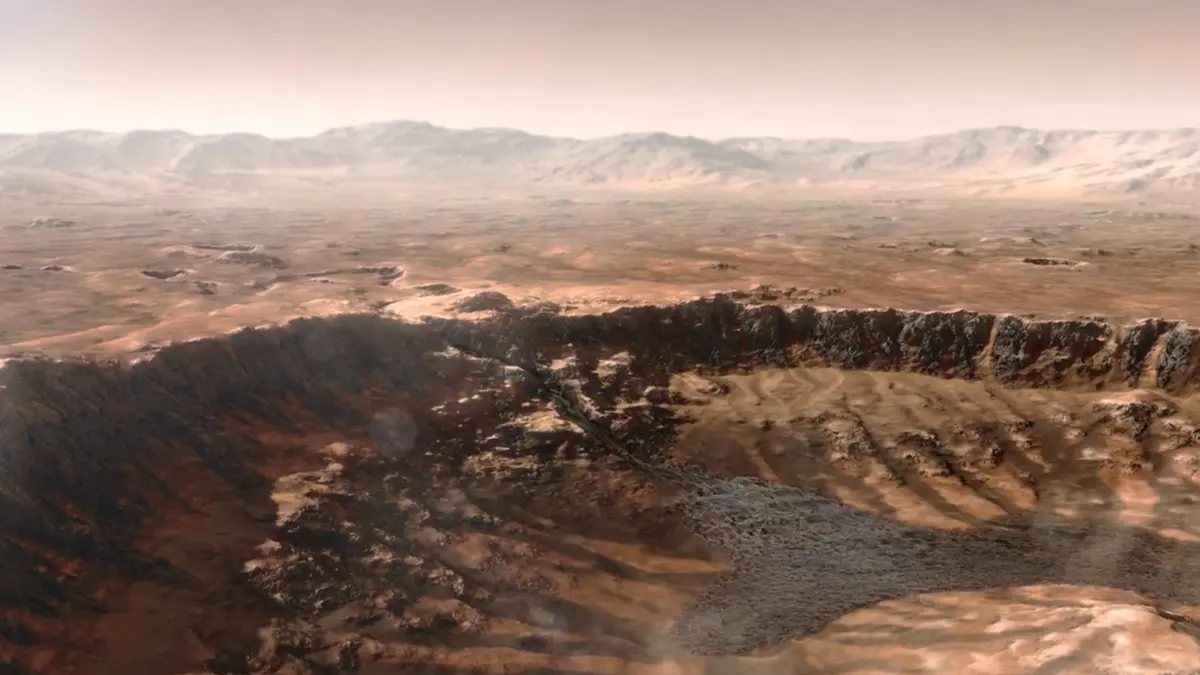
Artist's depiction of water rushing into Mars' Jezero Crater, which billions of years ago was the site of a delta. Image credit: NASA/JPL-Caltech
For decades, planetary scientists regarded plate tectonics as the driving force behind the formation of complex planetary crust. Earth’s moving tectonic plates recycle crust, fuel volcanism and ultimately help build continents. Mars, by contrast, has long been considered a stagnant-lid planet, meaning its outer shell remained as a single rigid plate instead of breaking into moving tectonic plates.
Researchers led by the University of Oxford now argue that ancient Mars developed an alternative pathway. Rather than relying on plate tectonics, the planet appears to have hosted enormous transcrustal magmatic systems, vast interconnected networks where magma pooled, circulated, separated into different compositions and evolved chemically throughout much of the crust. Similar magma plumbing systems exist beneath volcanic regions on Earth and play a central role in producing increasingly evolved crust.
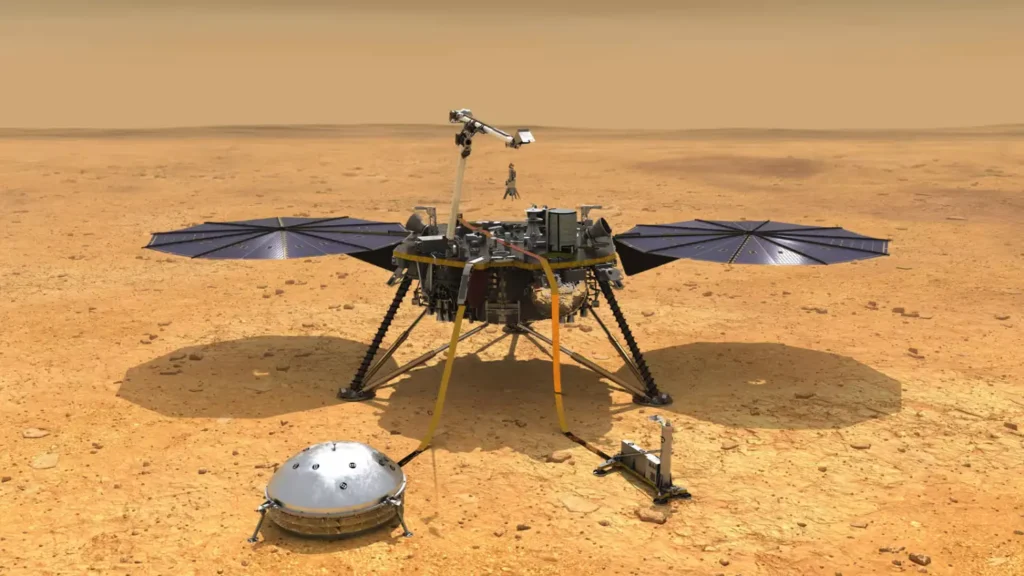
The discovery is based on seismic data collected by NASA’s InSight lander, which operated on Mars between 2018 and 2022. By analysing seismic waves generated by marsquakes and meteoroid impacts, the team investigated a long-standing mystery, a seismic boundary located about 24 km (15 miles) beneath the Martian surface that previous studies had detected but could not explain.
Researchers compared hundreds of possible Martian rock compositions with the seismic observations using thermodynamic modelling and statistical analysis. Rocks above the boundary matched mafic compositions, rocks containing relatively higher amounts of silica, whereas rocks below matched ultramafic compositions, denser rocks rich in iron and magnesium.
The study concludes that this lower layer represents the heavy crystalline residue left behind after lighter magma repeatedly separated and rose through the crust. The researchers estimate this melt-depleted cumulate layer is about 14 km (8.7 miles) thick. Rather than marking the crust-mantle boundary, it occupies the lowest part of the crust. The actual crust-mantle boundary lies deeper, at approximately 38 km (24 miles) beneath the surface.
The researchers also suggest that this ancient ultramafic layer may extend laterally for hundreds or even thousands of kilometres beneath Mars’ northern hemisphere. If correct, it would indicate that Mars once hosted regional-scale interconnected magma systems instead of isolated volcanic centres, a style of crustal evolution previously thought to be unique to Earth.Lead author Dr. Tobermory Mackay-Champion said the findings overturn the traditional view of Martian volcanism.
He added that such geological systems commonly generate major metal deposits on Earth, raising the possibility that Mars contains significantly greater near-surface mineral resources than previously recognised. Those deposits could become important for future robotic exploration, crewed missions and, eventually, permanent human settlements.
Geological recycling influences how planets develop atmospheres, oceans and long-term cycles of water and other volatile elements. Because plate tectonics has often been considered essential for creating those conditions, the new findings suggest rocky planets may be capable of producing complex crust and potentially habitable environments through more than one geological pathway.Co-author Associate Professor Jon Wade said the results broaden the search for habitable worlds.
The study builds on discoveries made possible by NASA’s InSight mission, which placed the first seismometer on Mars in 2018 and revealed the planet’s interior in unprecedented detail. Although the mission ended in 2022, its seismic archive continues to reshape scientists’ understanding of how Mars evolved and may ultimately influence how researchers assess the geological evolution and habitability of rocky planets throughout the Solar System and beyond.
References:
1 Seismic evidence for a melt-depleted lower crust and transcrustal magmatism on Mars – Mackay-Champion, T., Anderson Loake, M., Palin, R. et al. – Nature Astronomy – June 26, 2026 – https://doi.org/10.1038/s41550-026-02907-5
2 New evidence suggests vast hidden magma systems inside Mars – Oxford University – June 26, 2026

I’m a science journalist and researcher at The Watchers, contributing to the Epicenter edition, where I cover peer-reviewed scientific research and emerging discoveries across Earth and space sciences. With a background in astronomy and a passion for environmental science, I’ve worked in shark and coral conservation in Fiji, conducting reef and shark-behavior research, contributing to mangrove restoration, and earning PADI Open Water and Coral Reef Certifications. I bring a blend of scientific rigor and storytelling to illuminate the discoveries shaping our planet and beyond.

Commenting rules and guidelines
We value the thoughts and opinions of our readers and welcome healthy discussions on our website. In order to maintain a respectful and positive community, we ask that all commenters follow these rules.