
NASA study finds near-Earth “asteroid” is actually a comet, offering new clues for planetary defense
For nearly three decades, (875163) 1998 SH2 appeared to be an ordinary near-Earth asteroid, showing no visible tail, no surrounding coma and no obvious signs of cometary activity. That changed with a study published in Nature Astronomy on July 10, 2026, which revealed that the object is actually a weakly active comet. The discovery resolves a long-standing mystery surrounding its unusual motion and marks the first time astronomers predicted an object’s cometary nature from subtle orbital perturbations before confirming it through direct observations, providing a new approach for identifying hidden comets among Earth’s near-Earth object population while strengthening future planetary defense efforts.
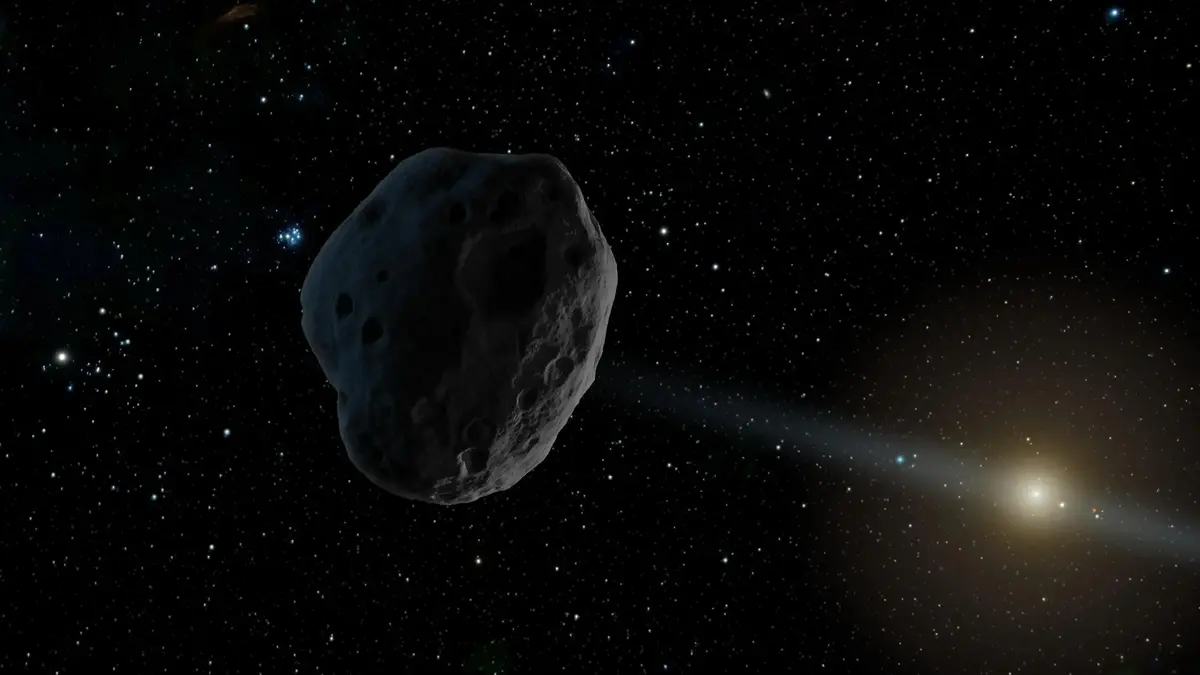
This artist’s concept depicts a near-Earth asteroid with an elongated orbit. A few objects such as these can exhibit significant perturbations in their motion around the Sun and, like the asteroid 1998 SH2, could turn out to be regular comets with a weak tail and coma (the gas and dust around a comet’s nucleus). Credit: NASA/JPL-Caltech
The object completes one orbit around the Sun approximately every 4½ years and had long been classified as an asteroid because repeated observations failed to detect the defining features of a comet. Its true identity only began to emerge during a close approach to Earth in late August 2025, when researchers at NASA’s Jet Propulsion Laboratory encountered an unexpected problem while preparing planetary radar observations.
Scientists had calculated the object’s position using observations spanning nearly three decades while accounting for the gravitational influence of the Sun, planets, and other major bodies. Yet when NASA’s Deep Space Network attempted to observe the object with planetary radar, 1998 SH2 was not where astronomers expected it to be.
Rather than pointing to an error in the calculations, the discrepancy suggested that another force was slowly altering the object’s trajectory.
Researchers returned to optical astrometry, making highly precise measurements of the object’s position against background stars. Those observations revealed subtle nongravitational accelerations that could not be explained by the Yarkovsky effect — the weak force produced when an asteroid absorbs sunlight and later re-emits that energy as heat. Instead, the measurements pointed toward an entirely different explanation: weak cometary outgassing.
“After we measured the nongravitational perturbations affecting the motion of 1998 SH2 and recognized they weren’t compatible with the object being an asteroid, we suspected the object could be an active comet,” said Davide Farnocchia, navigation engineer at NASA’s Center for Near-Earth Object Studies (CNEOS) and lead author of the study.
The team proposed that sunlight was warming buried ice beneath the object’s surface, allowing small amounts of gas to escape into space. Although the activity would be far weaker than that seen in most comets, even a minute amount of escaping gas can generate enough thrust over many years to gradually alter an object’s orbit.
To test the hypothesis, astronomers obtained deep observations using the 3.6-meter (11.8-foot) Canada-France-Hawaii Telescope on Maunakea, the 1.54-meter (5.1-foot) Danish Telescope at La Silla Observatory in Chile, and the European Southern Observatory’s 8.2-meter (26.9-foot) Very Large Telescope at Cerro Paranal.
Those observations revealed exactly what orbital calculations had predicted: a faint dust tail extending more than 20 arcseconds from the nucleus, together with a weak coma surrounding the object — the unmistakable signatures of cometary activity. Following the discovery, the Minor Planet Center assigned the object an additional comet designation, P/1998 SH2.
“The images we collected from these observatories showed a weak but clear tail, thus confirming that 1998 SH2 is, in fact, a comet,” said Olivier Hainaut, an astronomer at the European Southern Observatory and co-author of the study.
Unlike the spectacular comets that develop bright comae and tails visible even through small telescopes, 1998 SH2 remains remarkably subdued. Its activity is so weak that astronomers first detected its cometary nature through decades of orbital measurements rather than direct imaging, making it the first known object whose cometary identity was successfully predicted from orbital perturbations before being confirmed observationally.
Radar observations indicate the object measures approximately 380 ± 57 m (1,250 ± 190 ft) in diameter, making it the smallest comet ever observed by planetary radar. Measurements also indicate that it has a dark, porous surface with physical characteristics more consistent with known comet nuclei than with typical near-Earth asteroids.
The 1998 SH2 discovery also helps explain a mysterious class of Solar System bodies known as dark comets. These objects experience measurable nongravitational accelerations despite displaying little or no obvious coma or tail. Researchers currently recognize two distinct populations: larger bodies following Jupiter-family comet-like orbits and smaller objects orbiting much closer to the Sun. Since the first dark comet was identified in 2016, only about a dozen examples have been discovered.
The authors suggest many of the larger dark comets may ultimately prove to be ordinary comets whose activity is simply too weak for previous generations of telescopes to detect. Precision astrometry combined with deep imaging may therefore uncover additional hidden comets currently cataloged as near-Earth asteroids.
The distinction matters for planetary defense. Unlike asteroids, whose trajectories are governed primarily by gravity and relatively small thermal forces such as the Yarkovsky effect, active comets experience additional acceleration as escaping gas acts like a natural thruster. Even weak outgassing can gradually shift an object’s orbit over time, complicating long-term impact predictions and influencing how future deflection missions are planned. Because comets and asteroids differ in both composition and internal structure, correctly identifying an object’s true nature is essential for accurate hazard assessments and mitigation strategies.
NASA’s upcoming Near-Earth Object Surveyor mission is expected to expand that capability. Designed as the agency’s first space telescope dedicated to planetary defense, the observatory will search for difficult-to-detect near-Earth asteroids and weakly active comets, including dark, low-reflectivity objects that remain challenging for visible-light surveys.
Among the more than 2 000 known near-Earth objects that follow Jupiter-family comet-like orbits, many remain classified as potentially hazardous asteroids. If additional objects exhibit the same subtle orbital perturbations observed for 1998 SH2, astronomers may discover that a significant fraction of Earth’s near-Earth asteroid population is actually composed of dormant or weakly active comets hiding in plain sight.
Such discoveries would not only improve understanding of the Solar System’s evolution but also refine future impact-risk assessments by revealing which objects behave like asteroids and which are quietly propelled by escaping gas.
References:
1 Farnocchia, D., Hainaut, O.R., Seligman, D.Z. et al. Non-gravitational acceleration indicative of cometary activity of near-Earth object. Nat Astron (2026). https://doi.org/10.1038/s41550-026-02913-7
2 NASA Study Finds Near-Earth Asteroid Is Actually Comet – NASA – July 16, 2026

I’m a science journalist and researcher at The Watchers, contributing to the Epicenter edition, where I cover peer-reviewed scientific research and emerging discoveries across Earth and space sciences. With a background in astronomy and a passion for environmental science, I’ve worked in shark and coral conservation in Fiji, conducting reef and shark-behavior research, contributing to mangrove restoration, and earning PADI Open Water and Coral Reef Certifications. I bring a blend of scientific rigor and storytelling to illuminate the discoveries shaping our planet and beyond.

Commenting rules and guidelines
We value the thoughts and opinions of our readers and welcome healthy discussions on our website. In order to maintain a respectful and positive community, we ask that all commenters follow these rules.