
Noctilucent cloud season begins: How glowing night clouds form near the edge of space
Noctilucent cloud season is underway across the Northern Hemisphere, bringing one of Earth’s most unusual atmospheric phenomena back to twilight skies. Composed of microscopic ice crystals suspended near the edge of space, these clouds shine with a distinctive silver-blue glow when conditions in the upper atmosphere become cold enough for them to form.
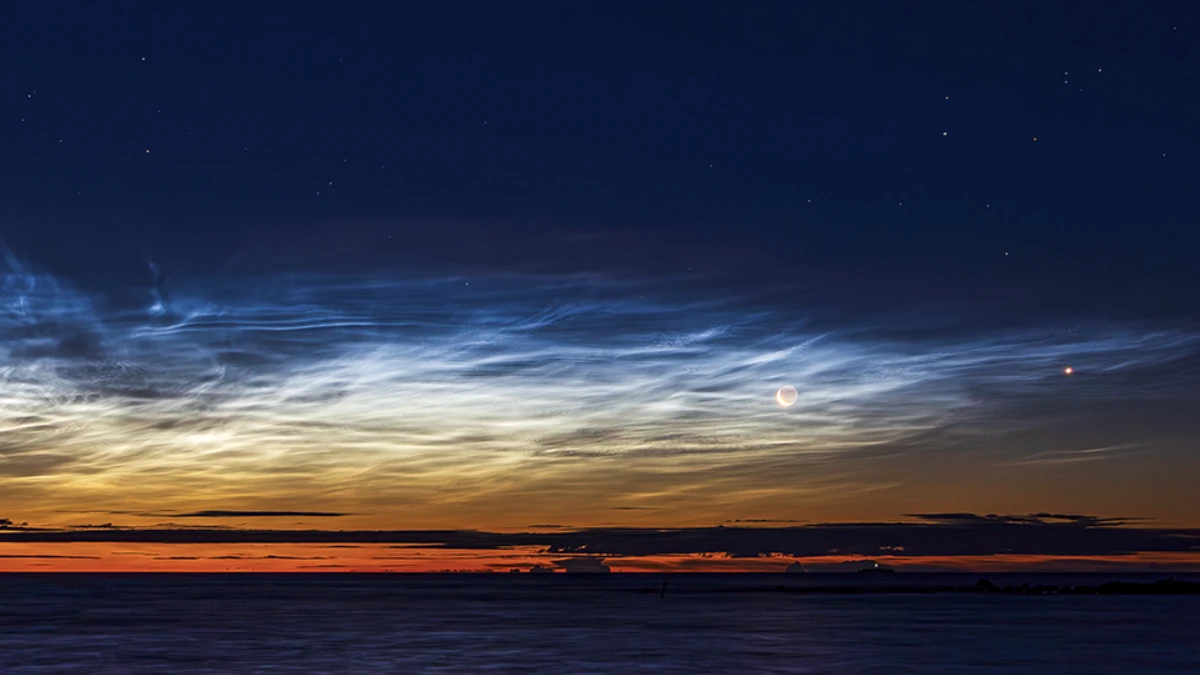
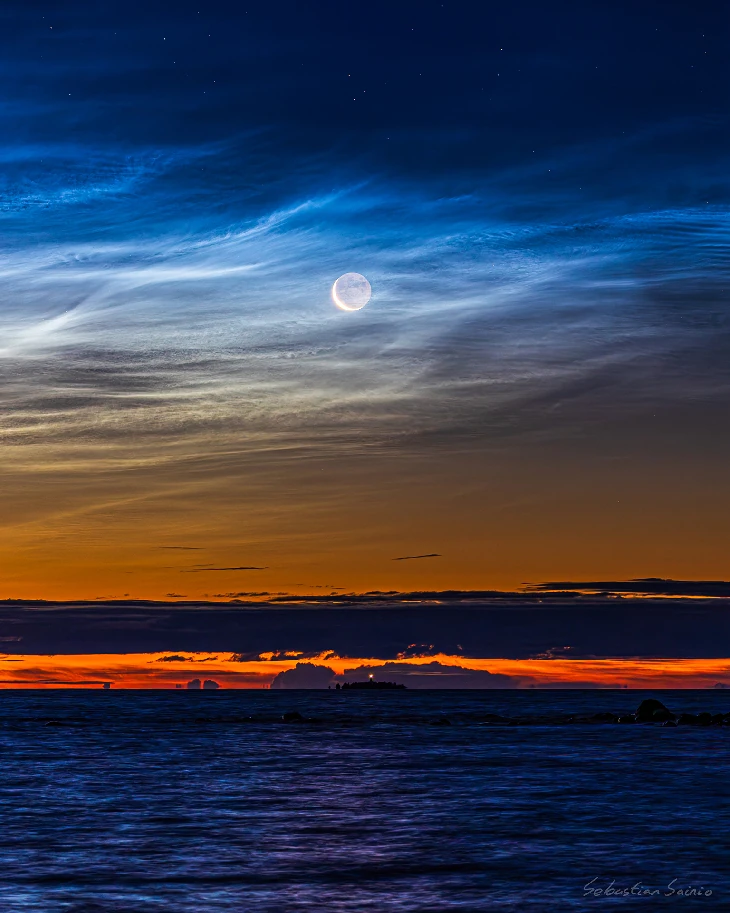
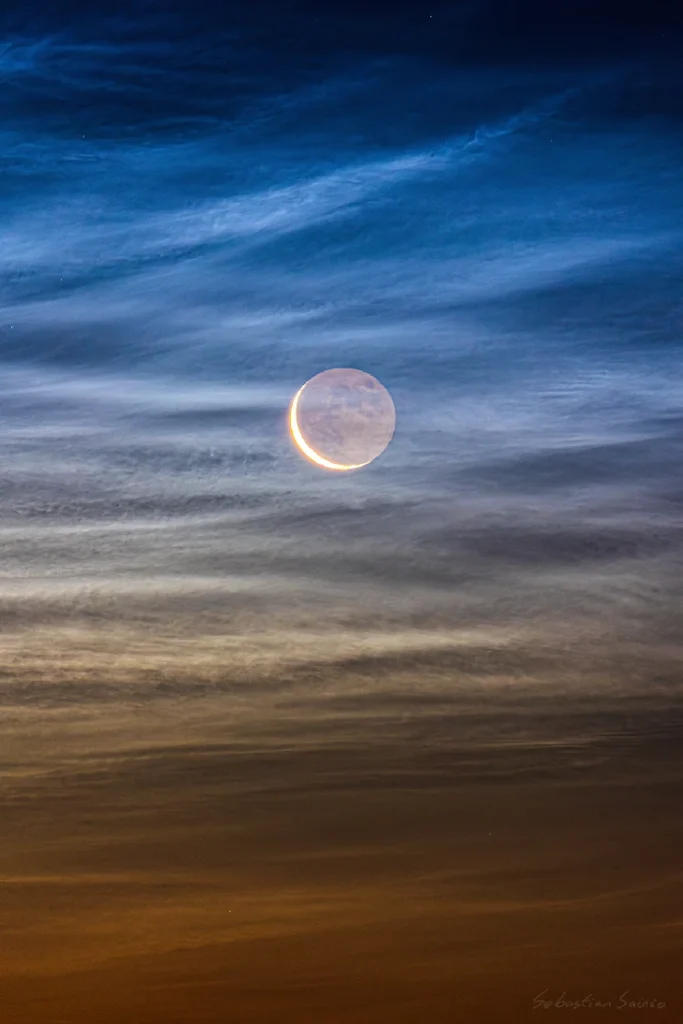
Late season noctilucent clouds and the crescent moon seen from Björköby (Korsholm municipality), Finland on August 21st 2025. Credit: Sebastian Sainio/Spaceweather.com
The season of rarest form naturally forming clouds has begun to peak, with sightings being reported in Finland and Northern Ireland.
These rare clouds form at altitudes of about 76 to 85 km (47 to 53 miles) in the mesosphere, making them the highest clouds in Earth’s atmosphere.
Unlike ordinary clouds, which form in the troposphere where Earth’s weather takes place, noctilucent clouds develop much higher in the atmosphere. Temperatures in the summer mesosphere can fall below approximately -120°C (-184°F), cold enough for tiny ice crystals to form despite the warm conditions experienced at the surface during summer.
The name noctilucent comes from Latin and means “night-shining.” The clouds earn this name because they remain lit by the Sun when it is several degrees below the horizon. At that time, people on the ground are already in darkness, while the clouds high above are still illuminated by direct sunlight. This creates their distinctive silver-blue glow.
How noctilucent clouds form
Noctilucent clouds are made of microscopic ice crystals that form around tiny particles suspended in the upper atmosphere. Scientists have identified meteoric dust, sometimes called meteor smoke, as one of the main ingredients needed for their formation.
When small meteoroids enter Earth’s atmosphere, they vaporize and leave behind extremely fine particles. Water vapor can freeze onto these particles, creating the ice crystals that make up noctilucent clouds.
Another important ingredient is extremely cold air. Although summer brings warmer temperatures at Earth’s surface, the upper mesosphere behaves differently. Atmospheric circulation causes air to rise at high latitudes during summer. As the air rises, it expands and cools, allowing temperatures to drop low enough for ice crystals to develop.
When and where can noctilucent clouds be seen
In the Northern Hemisphere, the season usually runs from late May through August. In the Southern Hemisphere, they appear during the austral summer.
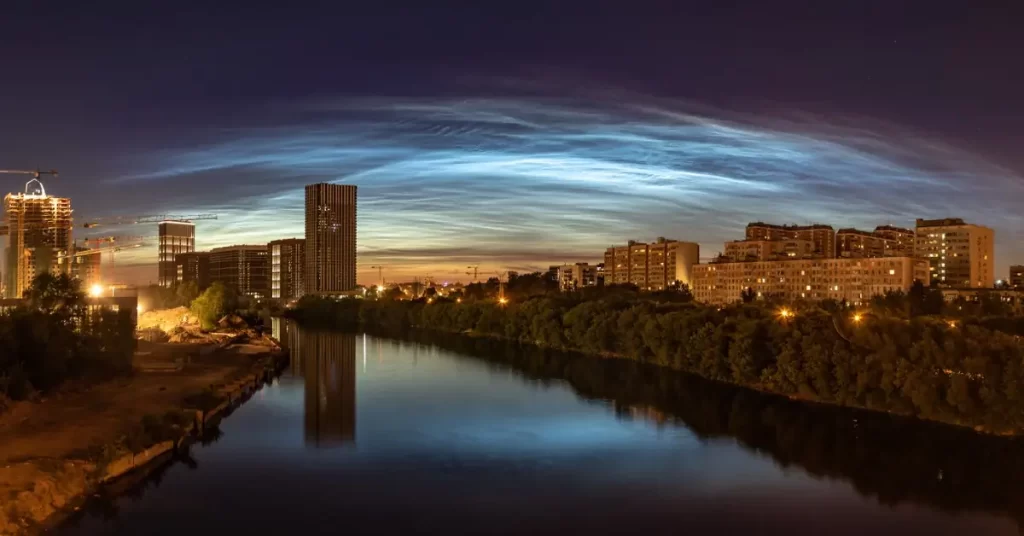
The best time to look for them is during deep twilight, about 30 to 90 minutes after sunset or before sunrise.
From the ground, they often appear as delicate bands, ripples, waves, and filaments stretching across the horizon. Their bright blue-white color helps distinguish them from lower clouds, which usually become dark after sunset.
How space traffic influences noctilucent clouds
In 2022, a team of researchers led by Michael Stevens of the Naval Research Lab in Washington, DC, analyzed data from 15 years of observations from NASA’s AIM satellite.
After examining data collected between 2007 and 2021 by the spacecraft, they found a strong correlation between the number of rockets launched each July and the increased formation of clouds in the mesosphere.
This is because rockets use hydrogen as fuel, which reacts with oxygen to form water vapor, which is released into the atmosphere. The water becomes the fuel for the formation of noctilucent clouds in the upper atmosphere.
Studies show that a typical orbital launch can release over 700 tons of water vapor directly into the atmosphere, while clouds in these regions of the atmosphere barely have a few tons of ice crystals. This abundance of raw material can significantly boost noctilucent cloud formation in the mesosphere.
This phenomenon is not new, as scientists have long known of this correlation. The increasing number of rocket launches every year has increased the frequency of this phenomenon significantly.
References:
1 Stevens, M. H., Randall, C. E., Carstens, J. N., Siskind, D. E., McCormack, J. P., Kuhl, D. D., & Dhadly, M. S. (2022). Northern mid-latitude mesospheric cloud frequencies observed by AIM/CIPS: Interannual variability driven by space traffic. Earth and Space Science, 9, e2022EA002217. https://doi.org/10.1029/2022EA002217
2 Noctilucent cloud season starts now – Spaceweather.com – May 31, 2026

I am an Assistant Editor and Severe Weather & Science Journalist at The Watchers, specializing in real-time severe weather coverage, geophysical event reporting, and research-driven scientific analysis. You can reach me at rishav(at)watchers(.)news.

Commenting rules and guidelines
We value the thoughts and opinions of our readers and welcome healthy discussions on our website. In order to maintain a respectful and positive community, we ask that all commenters follow these rules.