
Stress along Southern California faults reaches highest level in 1 000 years
More than 160 years after the M7.9 Fort Tejon earthquake, tectonic stress along Southern California’s two dominant fault systems has reached record levels, according to a new study that reconstructs 1 000 years of earthquake activity across the southern San Andreas and San Jacinto faults.
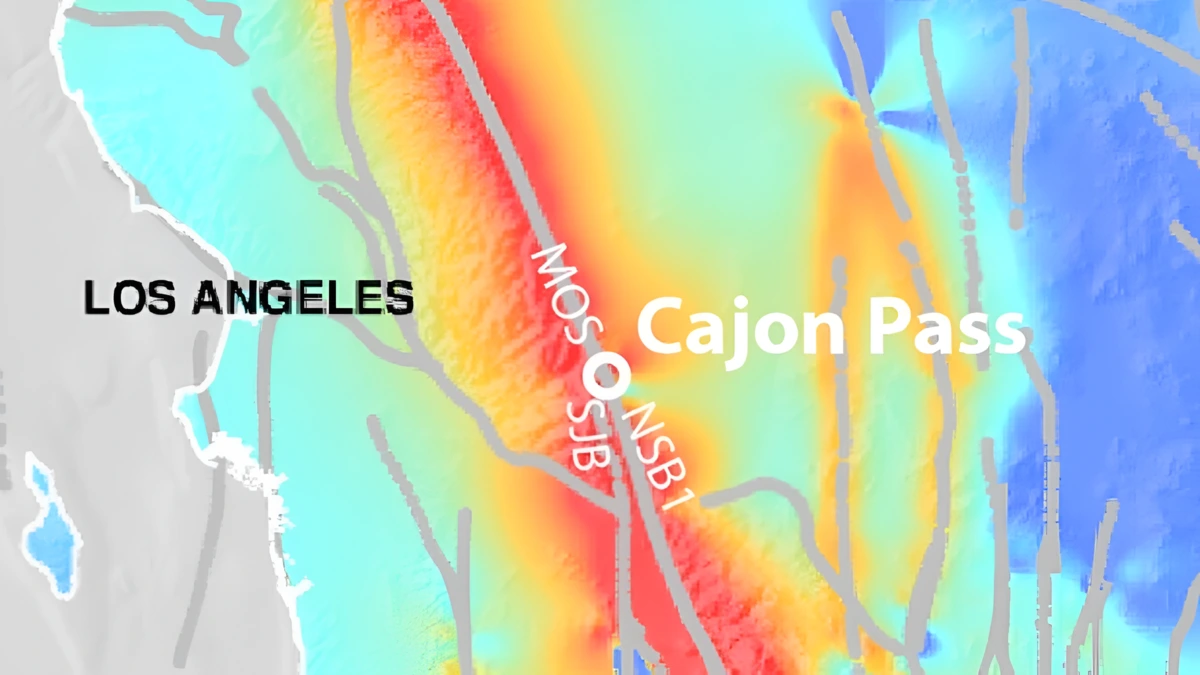
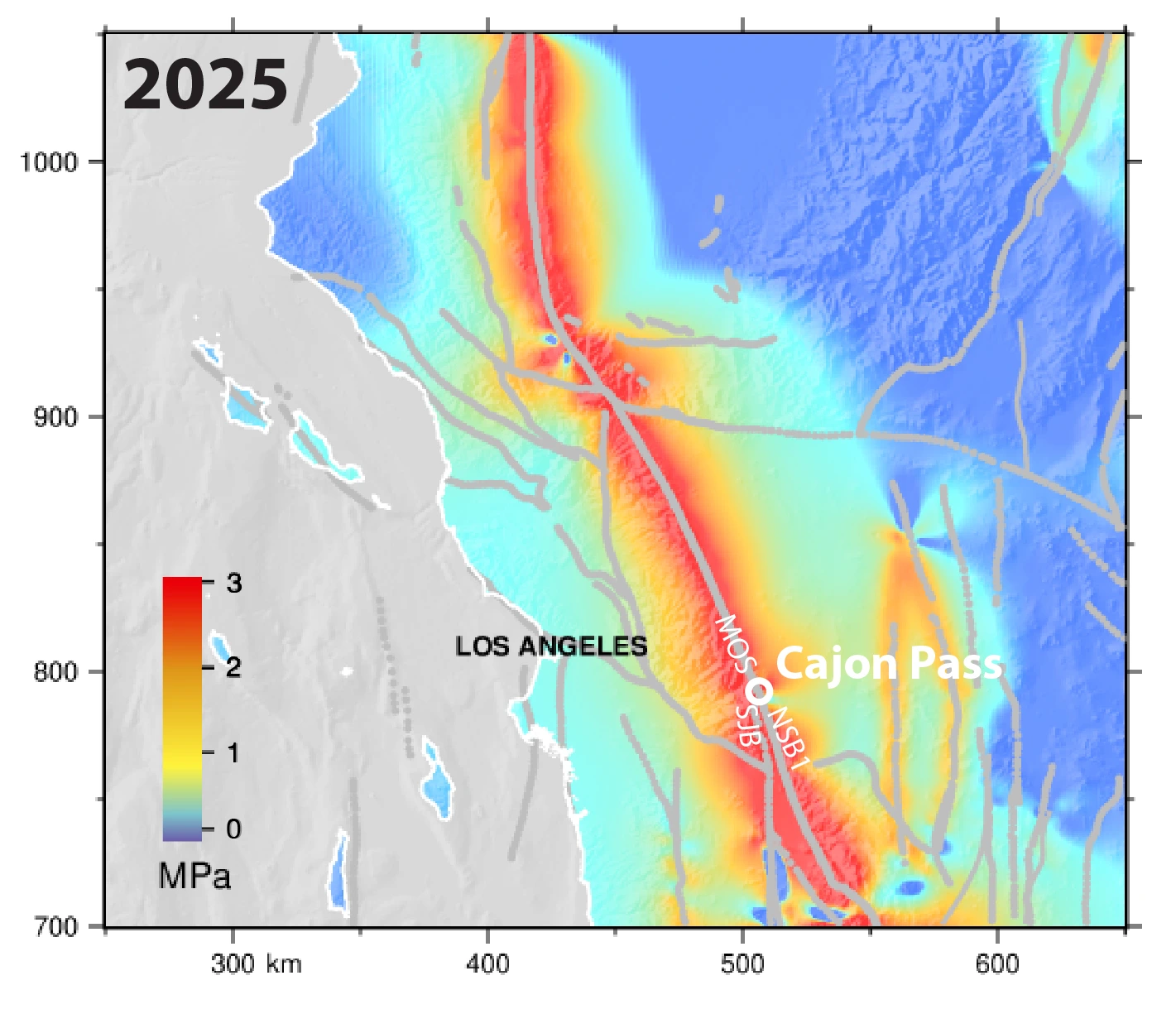
Present day modeled coulomb streess accumulation of southern San Andreas Fault System in regional context. Credit: Liliane Burkhard
A new study of Southern California’s major fault systems has found that tectonic stress is now at its highest level in at least 1 000 years, raising new questions about how future large earthquakes could unfold near Los Angeles.
Researchers modeled 1 000 years of earthquake history along the San Andreas Fault and San Jacinto Fault and found that stress has continued to build since the last major rupture to affect the wider Los Angeles region — the M7.9 Fort Tejon earthquake in 1857.
Their results suggest that a key fault junction known as Cajon Pass may play a critical role in determining whether a future earthquake remains on a single fault or spreads across multiple fault systems.
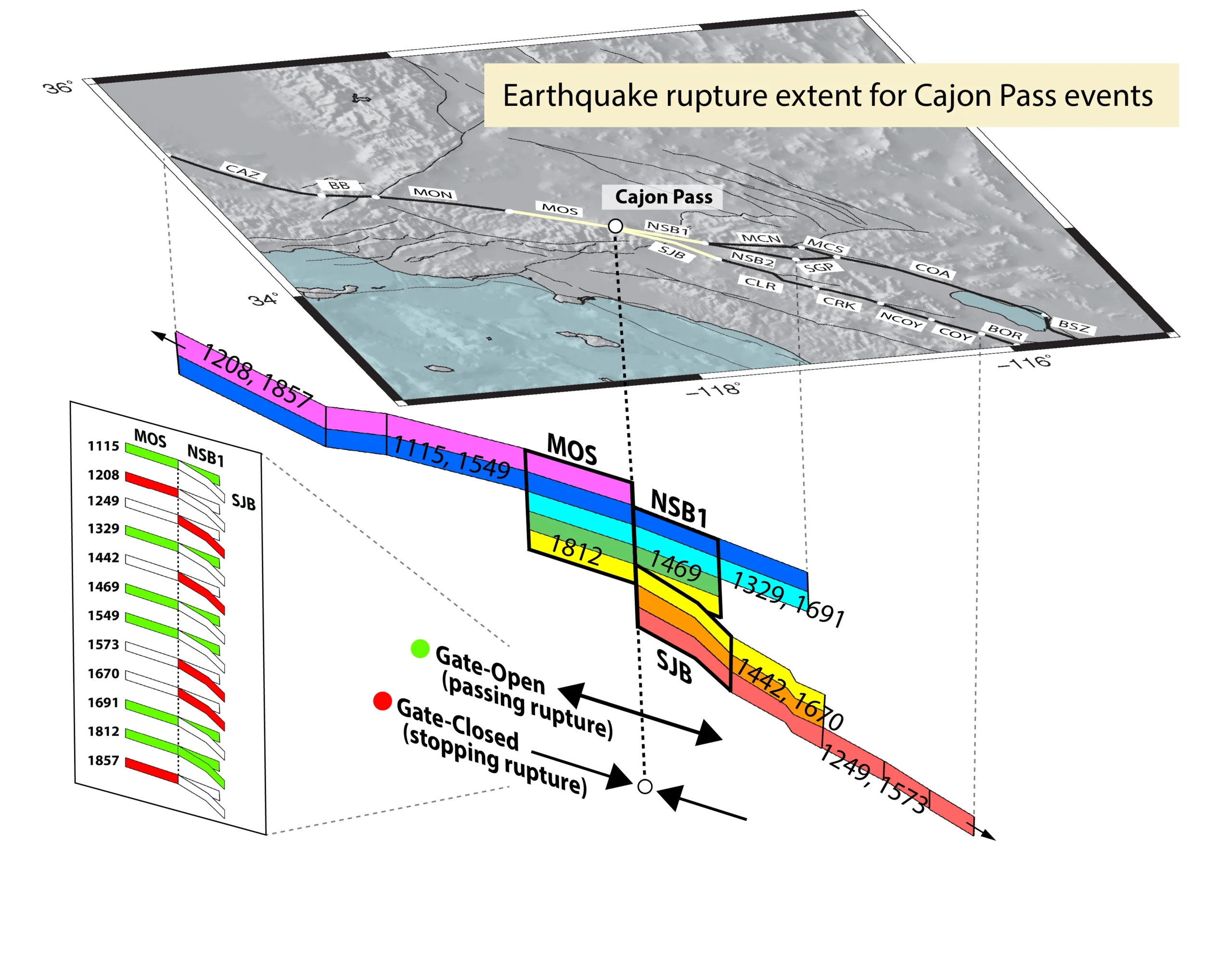
The study, led by Liliane M. L. Burkhard of the University of Bern and published in the Journal of Geophysical Research: Solid Earth, introduces the concept of Cajon Pass as an “earthquake gate” — a fault junction that can either stop a rupture or allow it to continue into neighboring faults under the right stress conditions.
Cajon Pass is located northeast of Los Angeles, where the southern San Andreas Fault and the San Jacinto Fault approach one another.
The area sits within one of the most important tectonic zones in Southern California and contains major highways, rail corridors, and energy infrastructure serving the Los Angeles metropolitan region. Scientists have long known that earthquakes behave differently at this junction.
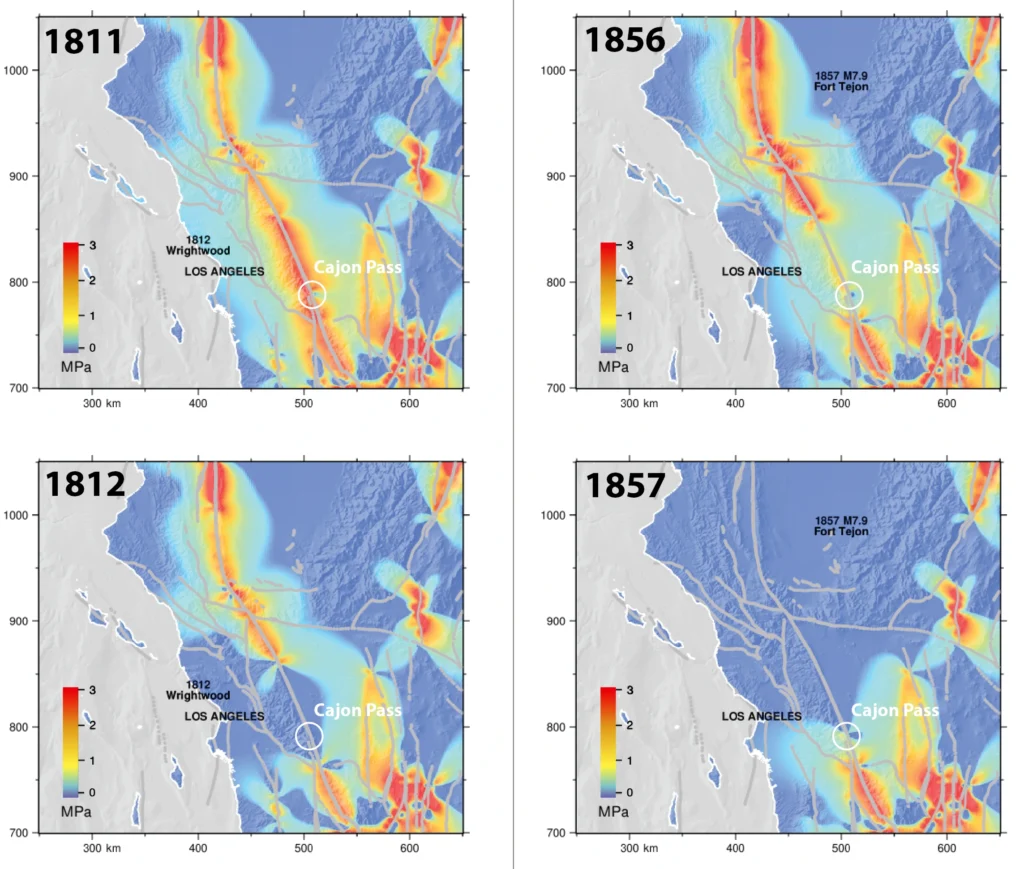
The M7.9 Fort Tejon earthquake in 1857 ruptured more than 330 km (205 miles) of the San Andreas Fault but stopped near Cajon Pass. In contrast, the 1812 Wrightwood earthquake appears to have crossed the junction and involved multiple fault systems in a single rupture.
The new research suggests that the difference may be linked to how stress is distributed across neighboring fault segments.
“The earthquake gate concept captures something important about how fault junctions work. Cajon Pass doesn’t simply block or channel earthquakes: It responds to stress conditions, and those conditions change over centuries,” Burkhard said.
To understand how stress developed through time, the researchers built a four-dimensional earthquake-cycle model that simulates fault behavior in three dimensions while also tracking changes through time.
The model was driven by a 1 000-year earthquake record reconstructed from paleoseismic evidence, including radiocarbon dating, tree-ring anomalies, geological records of surface ruptures, and historical documentation.
Using this information, the simulations tracked how earthquakes transfer stress to neighboring faults, how it accumulates between earthquakes, and how deeper parts of the crust gradually relax after major ruptures.
“The model tracks how each earthquake changes stress on neighboring fault segments, how stress accumulates during the quiet intervals between events, and how the deeper layers of the crust slowly relax following large ruptures,” Burkhard said. “By running the earthquake history of Southern California as a simulation, we can estimate the extent to which the fault system is already under stress today.”
The results show that stress levels across parts of the fault system have reached values not seen elsewhere in the model’s 1 000-year record. By 2025, the researchers estimated Coulomb stress values of 2.8 MPa on the Mojave South segment of the San Andreas Fault, 1.8 MPa on the North San Bernardino segment, and 3.6 MPa on the San Jacinto Bernardino segment.
According to the study, the 3.6 MPa value on the San Jacinto Bernardino segment exceeds the highest stress level recorded anywhere in the simulation. The authors found that the amount of stress on an individual fault is only part of the picture. Equally important is how closely stress levels on neighboring faults match one another.
When stress accumulates to similarly high levels on both the San Andreas and San Jacinto fault systems, conditions favor larger ruptures that can jump between faults. When stress levels evolve differently, ruptures are more likely to stop at Cajon Pass.
Historical earthquake analysis in the study supports that pattern. Earthquakes that propagated through Cajon Pass generally occurred when stress differences between adjacent fault segments were relatively small.
“So not only is it concerning that the stresses are reaching historic highs, but also that the relative stress conditions between the two fault systems are approaching the range we associate with major ruptures crossing both faults simultaneously – and that is a scenario with much larger consequences for the region,” Burkhard said.
“The study is not a prediction of when an earthquake will occur. What we can say is that the system is critically stressed and that physics-based models like ours give a clearer picture of the range of scenarios we should be prepared for,” Burkhard added.
References:
1 Burkhard, L. M. L., Smith-Konter, B. R., Scharer, K. M., & Sandwell, D. T. (2026). Cajon pass and the southern San Andreas Fault system: Earthquake cycle stress accumulation and present-day loading. Journal of Geophysical Research: Solid Earth, 131, e2025JB033213. https://doi.org/10.1029/2025JB033213
2 Earthquake model reveals: Stress in California at record level – University of Bern – June 8, 2026

I am an Assistant Editor and Severe Weather & Science Journalist at The Watchers, specializing in real-time severe weather coverage, geophysical event reporting, and research-driven scientific analysis. You can reach me at rishav(at)watchers(.)news.

Commenting rules and guidelines
We value the thoughts and opinions of our readers and welcome healthy discussions on our website. In order to maintain a respectful and positive community, we ask that all commenters follow these rules.