
40-year solar record reveals solar-cycle changes beneath the Sun’s surface
A 40-year record of solar observations has revealed that structural changes linked to the Sun’s 11-year activity cycle are becoming increasingly concentrated near the solar surface. The finding is based on helioseismic measurements spanning Solar Cycles 22 through 25 and offers a new view of how solar magnetic activity evolves beneath the visible surface.
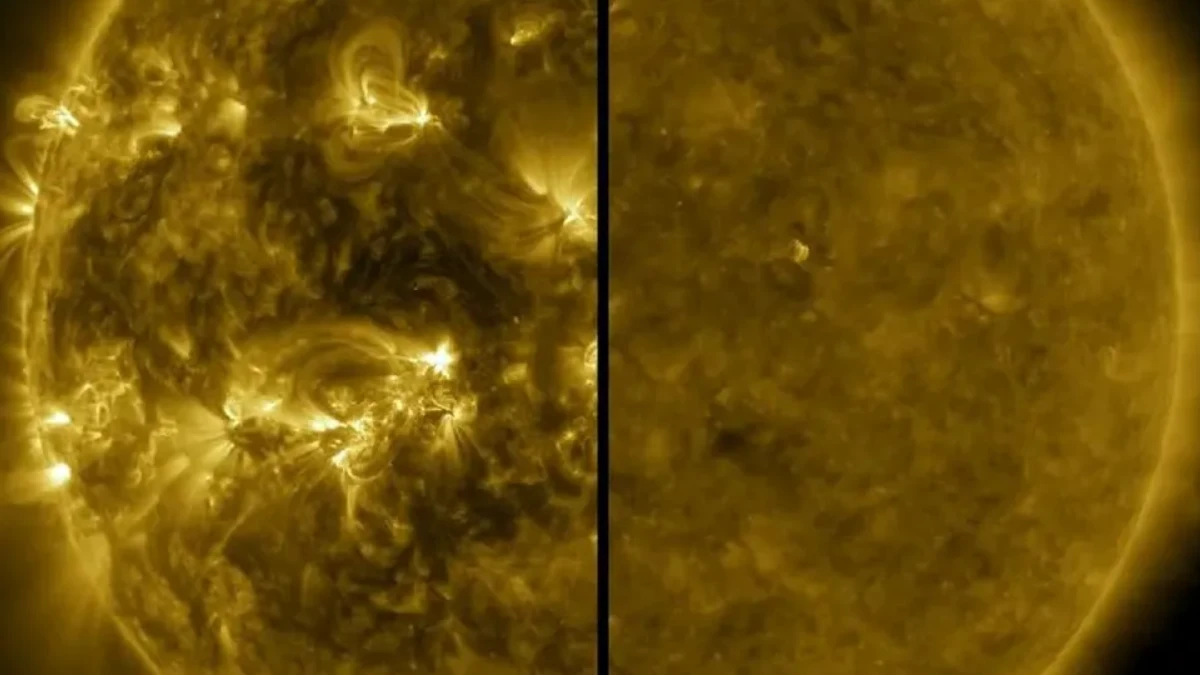
A split image showing an active Sun during solar maximum (left, in 2014) and a quiet Sun during solar minimum (right, in 2019). Credit: NASA/SDO
Solar-cycle-driven changes beneath the Sun’s surface have become increasingly confined to shallow layers over the past four solar cycles, according to a new study based on nearly 40 years of observations from the Birmingham Solar-Oscillations Network (BiSON).
The study, published in Monthly Notices of the Royal Astronomical Society, found that magnetic activity linked to the Sun’s 11-year cycle is becoming concentrated closer to the solar surface than it was in earlier cycles.
The findings are based on observations spanning Solar Cycles 22 through 25 and provide new insight into how solar magnetic activity evolves beneath the Sun’s visible surface.
Solar activity rises and falls in roughly 11-year cycles. These cycles produce sunspots, solar flares, and coronal mass ejections (CMEs), which drive space weather. Strong space weather can affect satellites, communications systems, GPS networks, and power infrastructure on Earth.
To investigate changes inside the Sun, researchers used a technique known as helioseismology. This method studies solar p-mode oscillations — sound waves that travel through the Sun’s interior. The frequencies of these waves change in response to solar magnetic activity. Because different frequencies probe different depths below the surface, they allow scientists to examine layers that cannot be observed directly.
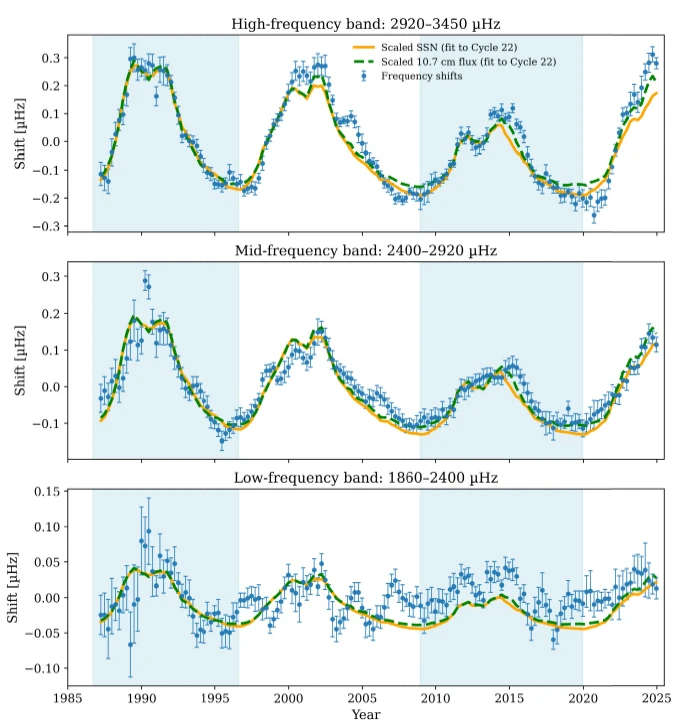
respectively, scaled for the plots in each panel by a linear fit to the appropriate band frequency shifts in Cycle 22. Credit: William J Chaplin et al. Subsurface structural changes associated with successive 11-yr solar activity cycles have been progressively more confined near the surface: new helioseismic results on Cycles 22–25 from BiSON
The team analyzed almost four decades of data collected by six BiSON telescopes located around the world. The dataset covers the period from the rise of Solar Cycle 22 in 1987 to the maximum phase of Solar Cycle 25 in 2025.
Researchers compared changes in oscillation frequencies with two widely used measures of solar activity: the 10.7 cm radio flux and the international Sunspot Number. The results showed that a change first detected during the declining phase of Solar Cycle 23 has continued through Cycles 24 and 25.
Earlier studies found that low-frequency oscillations, which probe deeper layers below the solar surface, no longer followed traditional solar activity indicators in the same way they did during Cycle 22. The new study shows that this difference remains present today.
The clearest signal came from high-frequency oscillations, which are sensitive to shallower layers beneath the surface. The researchers found that frequency shifts during Cycle 25 were much stronger than expected based on relationships seen in earlier cycles.
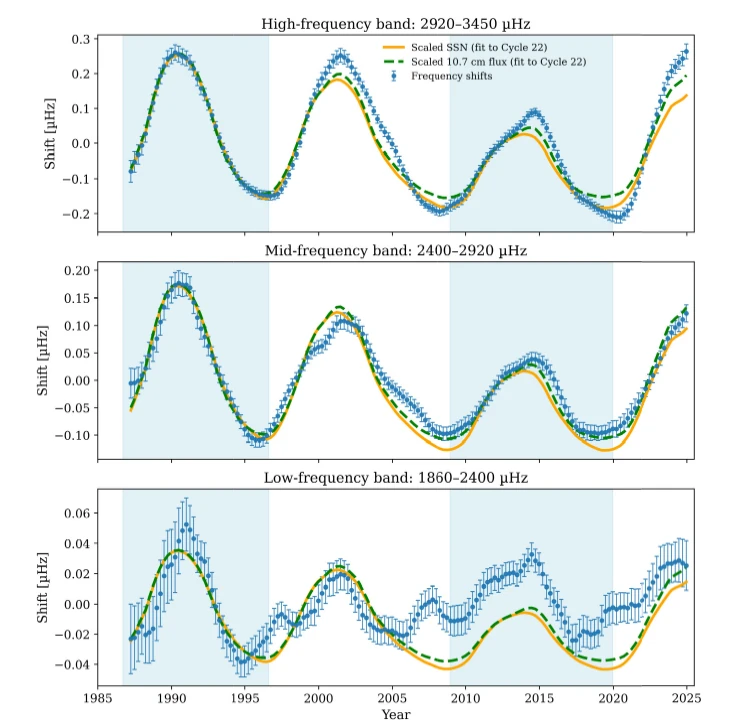
When viewed through these high-frequency helioseismic measurements, Cycle 25 appears as strong as Cycles 22 and 23. This differs from traditional surface indicators, which show a weaker cycle.
According to the study, the peak of the smoothed Sunspot Number cycle is about 25% lower in Cycle 25 than it was in Cycle 22. In the high-frequency helioseismic data, however, Cycle 25 shows a response comparable to the earlier cycles.
Taken together, the behavior of low-, mid-, and high-frequency oscillations points to a gradual change in how solar magnetic activity is organized beneath the surface. The researchers conclude that solar-cycle-related structural changes are becoming increasingly confined to shallow layers within about 1 000 km (621 miles) of the Sun’s surface.
“We have uncovered evidence of systematic changes in the solar activity cycle. Crucially, magnetic activity is becoming more tightly confined near the surface with each cycle. This is the first such discovery and would have been impossible without the long BiSON observations,” William Chaplin, Professor of Astrophysics at the University of Birmingham, said.
Traditional measures such as sunspot counts and radio emissions track activity at or above the solar surface. Helioseismology examines deeper layers where the solar cycle originates. The study shows that internal solar measurements and traditional activity indicators no longer evolve in the same way they did during earlier solar cycles.
“We discovered that the relationship between internal solar oscillations and surface activity has evolved over the past few cycles. This trend cannot be explained simply by weaker magnetic fields. Instead, it indicates a structural reorganisation of how the Sun’s magnetic activity is stored beneath the surface,” Sarbani Basu of Yale University said.
The authors also conclude that the results cannot be explained by changes in magnetic-field strength alone. While weaker or stronger magnetic fields would change the size of the observed signals, they would not explain the changing relationship between solar oscillations and activity indicators.
According to the researchers, the observations require a change in how magnetic activity is distributed and confined inside the Sun.
Scientists will continue collecting BiSON observations during the remainder of Solar Cycle 25 and into Cycle 26. Future data will help determine whether the trend represents a long-term shift in solar magnetic behavior or part of a longer cycle.
References:
1 Chaplin, W. J., et al. (2026). Sub-surface structural changes associated with successive 11-yr solar activity cycles have been progressively more confined near the surface: New helioseismic results on Cycles 22–25 from BiSON. Monthly Notices of the Royal Astronomical Society, 549(2), stag847. https://doi.org/10.1093/mnras/stag847

I am an Assistant Editor and Severe Weather & Science Journalist at The Watchers, specializing in real-time severe weather coverage, geophysical event reporting, and research-driven scientific analysis. You can reach me at rishav(at)watchers(.)news.

Commenting rules and guidelines
We value the thoughts and opinions of our readers and welcome healthy discussions on our website. In order to maintain a respectful and positive community, we ask that all commenters follow these rules.