
New Horizons awakens after longest hibernation, resumes science mission 9.5 billion km from Earth
NASA announced on July 7, 2026, that its New Horizons spacecraft has resumed active operations after completing its longest hibernation period to date. The spacecraft emerged from a 321-day hibernation in good health, allowing mission controllers to begin retrieving spacecraft telemetry and science data gathered while it continued its journey through the Kuiper Belt, approximately 9.5 billion km (5.9 billion miles) from Earth.
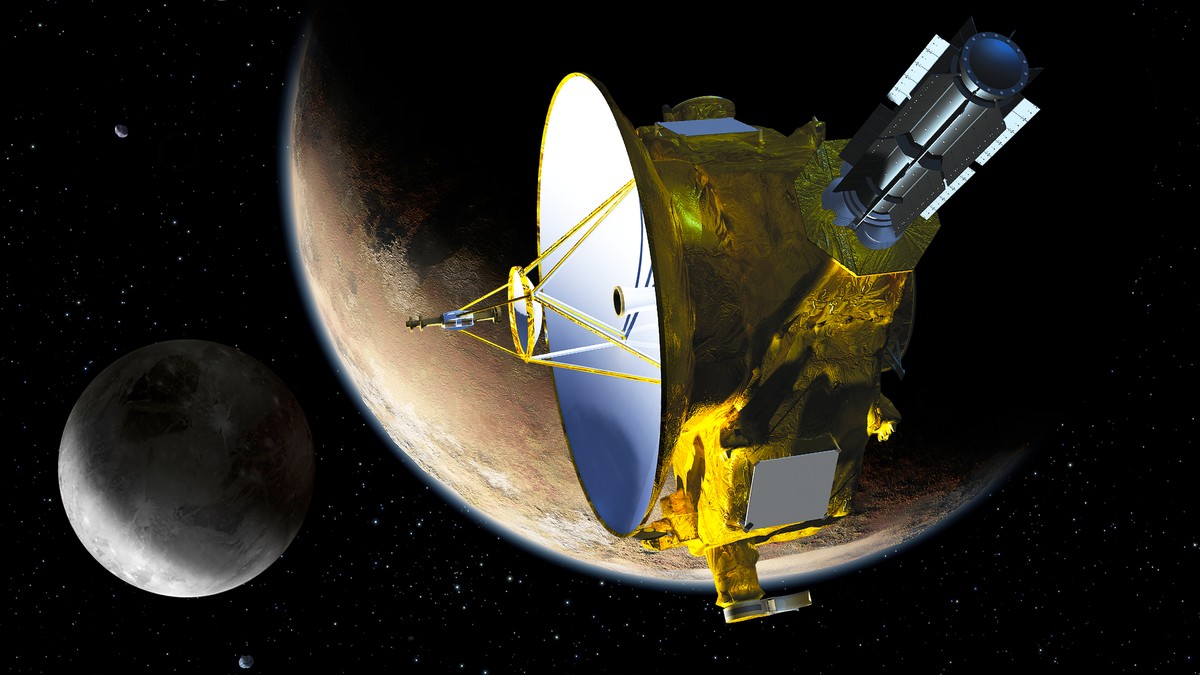
NASA's New Horizons spacecraft. Credit: NASA
Flight controllers at the Johns Hopkins Applied Physics Laboratory (APL) confirmed that New Horizons successfully executed stored commands uplinked to its main computer in July 2025, safely ending a hibernation period that began on August 7, 2025. Because of the enormous distance separating the spacecraft from Earth, the confirmation signal required approximately 8 hours and 52 minutes to travel through NASA’s Deep Space Network from its Madrid station to the mission operations center in Laurel, Maryland.
The mission team routinely places New Horizons into resource-saving hibernation during long cruise phases. While most spacecraft systems are powered down, the probe continues gathering and storing scientific observations around the clock. During the latest hibernation, the Solar Wind Around Pluto (SWAP) instrument, Pluto Energetic Particle Spectrometer Science Investigation (PEPSSI), and Venetia Burney Student Dust Counter continued monitoring the outer heliosphere and the local dust environment without interruption.
“Every status report through this hibernation period was ‘green,’ meaning all was well aboard New Horizons each and every week,” said Mission Operations Manager Alice Bowman.
With the spacecraft back in active operations, engineers will first downlink spacecraft health and safety data before retrieving observations collected by its scientific instruments. In about three weeks, the Alice ultraviolet spectrograph will begin observing the distribution of hydrogen gas in the outer heliosphere, while SWAP, PEPSSI and the Student Dust Counter continue their long-term measurements. Mission teams are also completing upgrades to the ground software used to operate the spacecraft, with testing expected to continue through the year.
New Horizons is also operating with updated onboard autonomy designed for conditions encountered far beyond Pluto. The revised software accommodates declining power output from the spacecraft’s radioisotope thermoelectric generator, increasing communication delays, and the greater reliance on autonomous operations required as the spacecraft travels ever farther from the Sun.
Launched on January 19, 2006, New Horizons remains one of NASA’s landmark planetary exploration missions. It left Earth at the highest launch velocity ever attained by a human-made object relative to Earth, received a gravity assist from Jupiter in 2007, completed humanity’s first close exploration of Pluto and its moons in July 2015, and became the first spacecraft to fly past a Kuiper Belt object when it encountered Arrokoth on January 1, 2019. On October 1, 2024, the spacecraft reached another milestone, passing a distance 60 times farther from the Sun than Earth is—twice Pluto’s distance from the Sun during the 2015 flyby.
Data returned from Pluto transformed scientists’ understanding of the distant dwarf planet. Observations revealed active geology, extensive nitrogen-ice glaciers, layered atmospheric haze and a lower-than-expected atmospheric escape rate, prompting revisions to previous models of the Pluto system. Scientists also found evidence suggesting Pluto may still harbor a subsurface ocean beneath its icy crust. The flyby of Arrokoth later provided the first close examination of a primordial Kuiper Belt object that has remained largely unchanged since the Solar System formed about 4.5 billion years ago.
Today, New Horizons is focused on a different scientific objective. Rather than preparing for another close planetary encounter, the spacecraft is serving as a deep-space observatory, studying the outer heliosphere and the particle and dust environment of the Kuiper Belt from a region explored by no other active planetary mission.
As the spacecraft continues moving away from the Sun at roughly 480 million km (300 million miles) per year, its observations are extending one of the longest-running planetary missions ever undertaken, providing a unique record of conditions in the distant outer Solar System.
References:
1 NASA’s New Horizons Spacecraft Wakes from Hibernation in Good Health – NASA – July 7, 2026

I’m a science journalist and researcher at The Watchers, contributing to the Epicenter edition, where I cover peer-reviewed scientific research and emerging discoveries across Earth and space sciences. With a background in astronomy and a passion for environmental science, I’ve worked in shark and coral conservation in Fiji, conducting reef and shark-behavior research, contributing to mangrove restoration, and earning PADI Open Water and Coral Reef Certifications. I bring a blend of scientific rigor and storytelling to illuminate the discoveries shaping our planet and beyond.

Commenting rules and guidelines
We value the thoughts and opinions of our readers and welcome healthy discussions on our website. In order to maintain a respectful and positive community, we ask that all commenters follow these rules.