
Local State of Disaster declared after tornado tears through Menasha, Appleton and Neenah, Wisconsin
A destructive tornado crossed Lake Winnebago before striking communities across Wisconsin’s Fox Valley on Monday, July 27, 2026, causing extensive damage in Menasha, Appleton, and Neenah. Menasha declared a local State of Disaster as emergency crews responded to heavily damaged neighborhoods, gas leaks, and widespread infrastructure damage following a broader outbreak of severe thunderstorms.
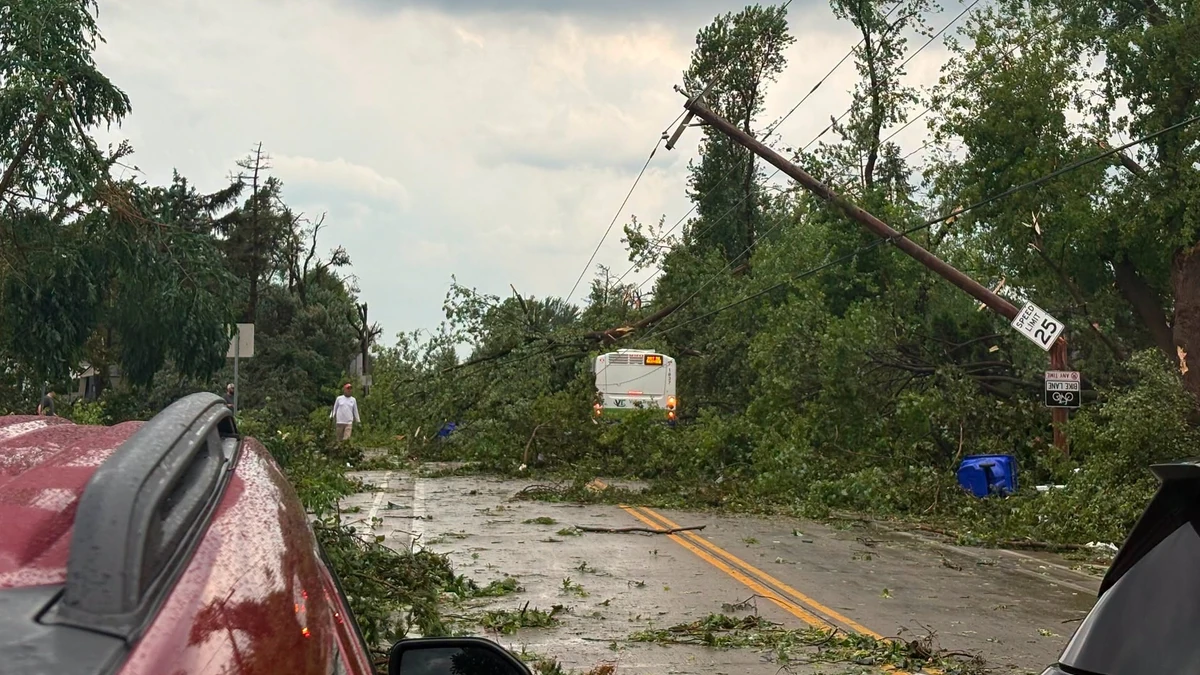
Tornado damage in Appleton Wisconsin on July 27, 2026. Credit: Appleton Police Department
A destructive tornado tore through parts of northeast Wisconsin on Monday, July 27, causing extensive damage across the Fox Valley after crossing Lake Winnebago.
The twister struck communities including Menasha and Appleton, where emergency officials reported severe damage to homes, businesses, and infrastructure.
Tornado and severe thunderstorm warnings were issued for parts of northeast Wisconsin, including Appleton, Menasha, and Neenah.
Videos and photos shared on social media showed multiple buildings sustaining severe damage, with some structures completely destroyed. Emergency crews also responded to gas leaks and carried out search-and-rescue operations in heavily affected neighborhoods while damage assessments continued.

“The City of Appleton has sustained significant storm damage, and we are actively working to support residents as recovery efforts begin. Please use the following resources to report damage, request assistance, and stay informed,” city officials said in the storm recovery bulletin.
The City of Menasha declared a local State of Disaster after the tornado and severe weather struck the area beginning at 12:20 LT on Monday.
“At this time, the City of Menasha is closed. Non-emergency services are limited. There are multiple hazards such as downed power lines and debris. First responders are securing the areas. Please stay where you are unless you are in immediate danger. Too many vehicles on the roadways prevent our first responders from moving freely and helping people,” city officials said in the disaster proclamation.
Menasha Police Department enforced a curfew through the night of 22:00 LT on July 27 to 05:00 LT on July 28. Meanwhile, a boil water notice was issued for portions of Menasha and Fox Crossing due to the risk of contamination.

The tornado was part of a broader severe weather outbreak across northeast Wisconsin. Clusters of thunderstorms, including multiple supercells, moved southeast across northern and eastern Wisconsin, producing widespread wind damage and very large hail.
While local media reported that the damage seemed consistent with an EF2, the National Weather Service is yet to conduct an official survey.
Widespread hail measuring up to 5.1 cm (2 inches) in diameter was reported across the region, while one report from Shawano County measured hail larger than 10.2 cm (4 inches), among the largest observed during the event. Destructive straight-line winds caused additional tree damage and power outages outside the tornado’s path.
More than 30 000 customers lost electricity as the storms swept across northeast Wisconsin, with almost the entirety of Menasha reporting outages.
Utility crews worked alongside emergency responders to clear roads, restore essential infrastructure, and assess damage, while local officials urged residents to stay away from impacted areas because of downed power lines, debris, and blocked streets. Shelters were opened for residents displaced by the storm.
As of Monday evening, officials had reported no fatalities or confirmed injuries, although emergency crews continued searching damaged neighborhoods because some areas had not yet been fully accessed.
References:
1 Local State of Disaster – City of Menasha – July 27, 2026
2 Community Storm Recovery Information – City of Appleton – July 27, 2026

Rishav Kothari is Editor-in-Chief of The Watchers, where he runs the newsroom and covers earthquakes, volcanoes, severe weather and space weather.
Published in the last 24 hours
- Hawaii's largest freshwater lake was 200 feet deep at 10 a.m. on June 2, 2018. By that afternoon, lava from Kilauea had boiled it away Epicenter
- Flying glass cut a teacher in Russia but none of her 44 pupils, because when a meteor flashed across the sky in 2013, she told them to get under their desks Epicenter
- A South Dakota man put the widest and heaviest hailstone on US record in his freezer, and a power cut melted part of it before NOAA measured it at 8 inches across and nearly 2 pounds in 2010 Epicenter
- Black kites and brown falcons in northern Australia have been seen snatching smoldering sticks from wildfires, flying them into unburned grass and dropping them, starting new fires that send lizards, rodents and insects running straight toward the waiting birds Epicenter
