
New analysis suggests Earth’s response to extreme solar storms may have no upper limit
For decades, scientists have believed Earth’s response to powerful solar storms reaches a limit beyond which stronger solar wind produces little additional impact. A NASA-led study published in Nature on July 30, 2026, argues that this apparent ceiling may be nothing more than a statistical illusion caused by uncertainties in solar wind measurements. If confirmed, the findings suggest the most severe solar storms could have about twice the impact on satellites, communications, navigation systems and power infrastructure than previously estimated.

This artist's conception shows the boundary in the Sun's atmosphere where the speed of the outward solar wind becomes faster than the speed of magnetic waves. The area appears to shift between spiky and frothy, and is the point of no return for material that escapes the Sun's magnetic grasp. Deep dives into the Alfvén surface using NASA's Parker Solar Probe combined with far-away measurements, have allowed scientists to track the evolution of this structure throughout the solar cycle and produce a map of this previously uncharted territory. Credit: CfA/Melissa Weiss
The Sun constantly releases a stream of charged particles known as the solar wind. During major solar storms, this flow intensifies and transfers energy into Earth’s magnetosphere, generating powerful electric currents in the upper atmosphere that can disrupt technological systems on the ground and in space.
For years, observations suggested those electric currents increased with stronger solar wind only to a certain point before leveling off, a phenomenon known as geomagnetic saturation. The apparent limit became widely accepted and led to the development of roughly ten different theories attempting to explain why Earth’s magnetosphere seemed unable to respond beyond a fixed threshold.
Researchers led by Nithin Sivadas of NASA’s Goddard Space Flight Center now argue that the saturation itself may never have existed.
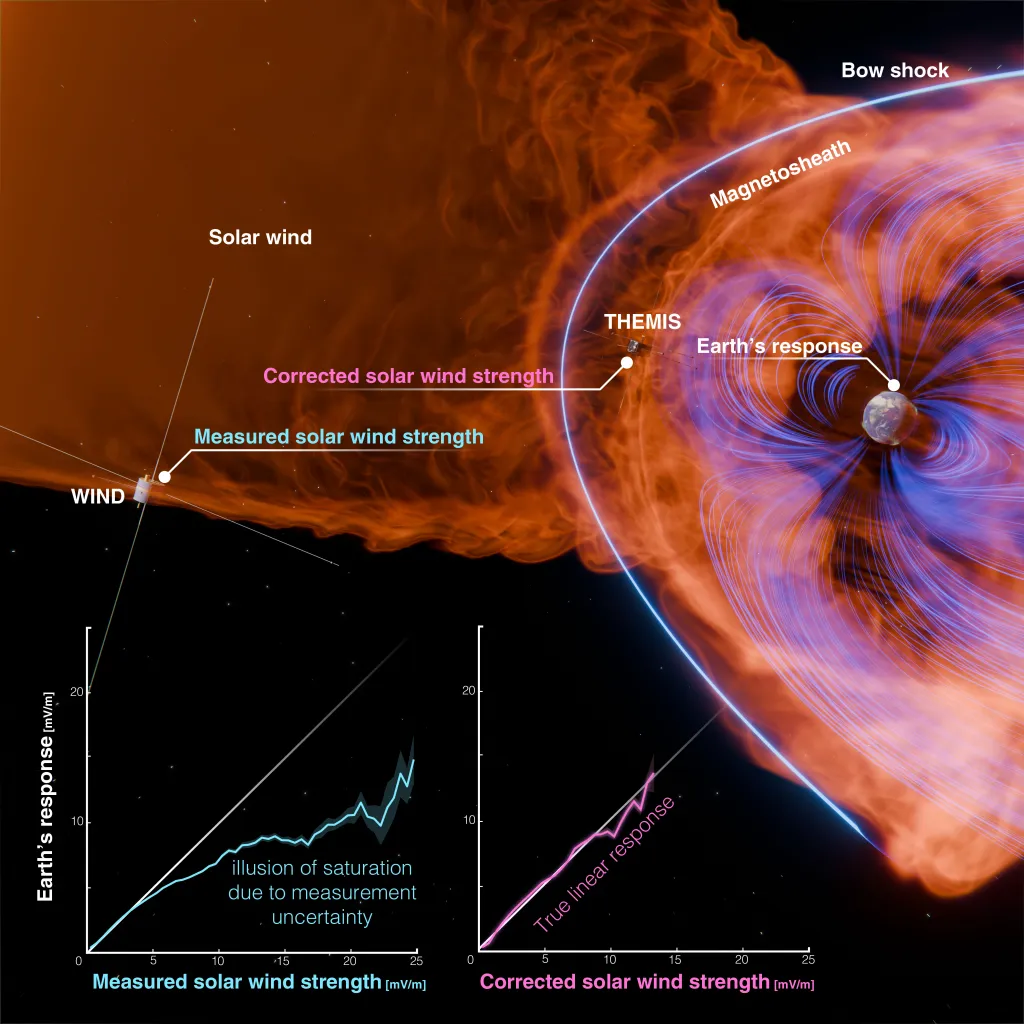
The problem, according to the study, lies in how the solar wind is measured. Most observations are collected by spacecraft positioned near the Sun-Earth L1 Lagrange point, about 1.5 million km (932 000 miles) upstream from Earth. As the solar wind continues traveling toward the planet, however, its properties evolve.
Statistically, the solar wind that ultimately reaches Earth’s magnetic shield is more likely weaker than the values measured much farther upstream. That mismatch makes it appear that extremely strong solar wind produces only modest increases in geomagnetic activity when, in reality, the response is being compared with measurements that overestimate the actual driver.
The researchers identify this effect as regression to the mean, a statistical phenomenon arising from uncertainty in the timing and magnitude of solar wind measurements. Rather than revealing a physical limit in Earth’s response, they argue, decades of observations have been distorted by measurement uncertainty.
To test the idea, the team analyzed more than one million solar wind measurements together with observations from spacecraft operating much closer to Earth, including NASA’s Magnetospheric Multiscale (MMS) mission and THEMIS. They also developed an error model that accounts for uncertainties introduced as the solar wind travels from the L1 point toward Earth’s magnetosphere.
After correcting those uncertainties using regression calibration, the apparent saturation disappeared. Instead, the relationship between solar wind strength and geomagnetic activity remained linear throughout the observed range.
According to the authors, there is currently no statistical evidence that Earth’s response reaches an upper limit under the strongest solar wind conditions yet observed.
That conclusion has important implications for space weather forecasting. The authors estimate that the impacts of extreme geomagnetic storms could be roughly twice as large as previously thought when extrapolated to the strongest solar wind conditions considered in the study.
At the same time, they caution that observations remain insufficient to determine whether a genuine physical limit exists beyond the range of measurements currently available.
The findings challenge decades of research built around the apparent saturation effect. Because existing theories were developed using measurements affected by statistical bias, the authors argue those models should be revisited and tested against corrected estimates of the solar wind driving Earth’s magnetosphere.
The researchers suggest the same statistical bias may influence studies of other rare and extreme events whenever uncertain measurements are involved. They identify potential applications ranging from climate extremes and earthquake hazards to chronic pain research and artificial intelligence systems that rely on uncertain observational data.
Additional observations during future episodes of exceptionally strong solar wind will ultimately determine whether Earth’s response reaches a true physical limit. For now, the study concludes that existing observations provide no statistical evidence that such a limit has yet been detected.
References:
1 Sivadas, N., Sibeck, D., Subramanyan, V. et al. Regression to the mean can explain saturation of geomagnetic storms. Nature (2026). https://doi.org/10.1038/s41586-026-10757-4
2 New NASA study says possibly no limit to solar storm effects – NASA – July 30 2026

I’m a science journalist and researcher at The Watchers, contributing to the Epicenter edition, where I cover peer-reviewed scientific research and emerging discoveries across Earth and space sciences. With a background in astronomy and a passion for environmental science, I’ve worked in shark and coral conservation in Fiji, conducting reef and shark-behavior research, contributing to mangrove restoration, and earning PADI Open Water and Coral Reef Certifications. I bring a blend of scientific rigor and storytelling to illuminate the discoveries shaping our planet and beyond.

Commenting rules and guidelines
We value the thoughts and opinions of our readers and welcome healthy discussions on our website. In order to maintain a respectful and positive community, we ask that all commenters follow these rules.