
Venus may still be tectonically active, new simulations identify recently formed rift systems
High resolution three-dimensional simulations conducted by researchers at ETH Zurich suggest several of Venus’ largest rift systems are still tectonically active or ceased moving only within the past few tens of millions of years, according to a study published in Nature Geoscience on July 27, 2026. The findings identify wide rift flank uplifts as a key indicator of recent tectonic activity, challenging the long-standing view that Earth’s sister planet is largely geologically dormant while providing new targets for future Venus exploration.
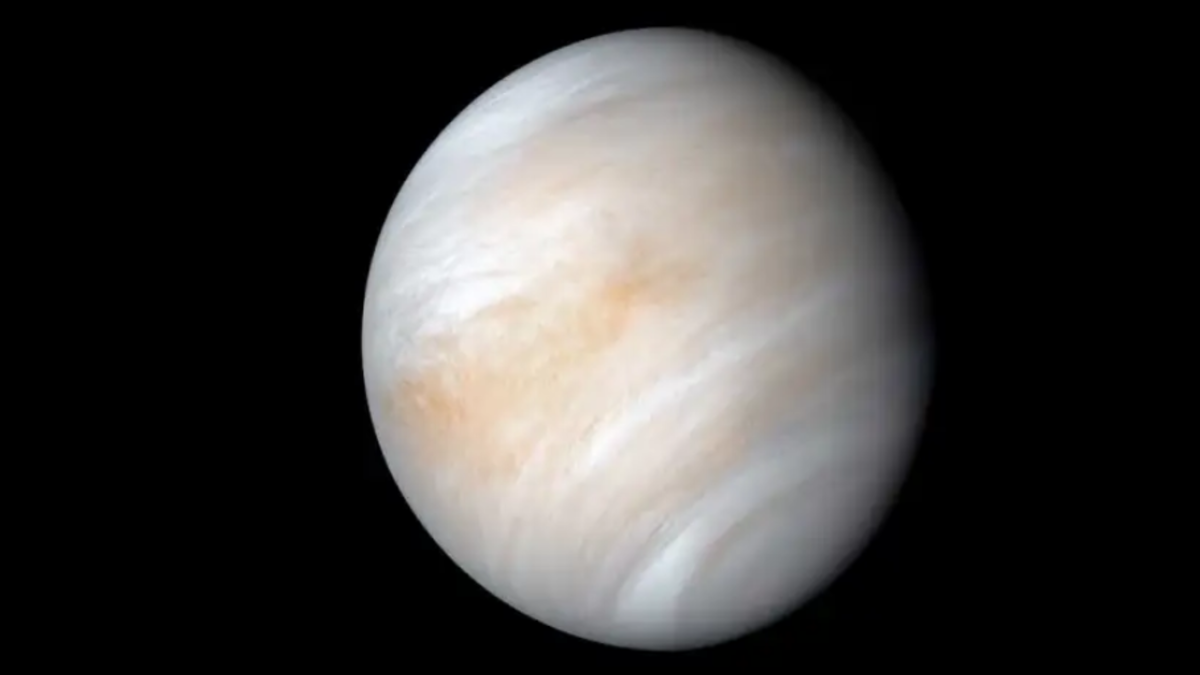
As it sped away, NASA's Mariner 10 spacecraft captured this view of Venus. Credit: NASA/JPL-Caltech
Although Venus has no Earth-like plate tectonics, its surface is crossed by about 40 000 km (24 855 miles) of rift systems covering roughly 8% of the planet. Many are considered among the youngest tectonic features on Venus, yet scientists have long debated whether they are ancient remnants or signs of ongoing geological activity.
Researchers led by ETH Zurich used high resolution three-dimensional thermomechanical models to investigate how Venusian rifts form, evolve and change after tectonic extension stops. Unlike previous studies, which largely relied on simplified two-dimensional models, lower extension rates and less realistic rock behavior, the new simulations incorporate visco-elasto-plastic rock rheology, grain-size evolution and compressible crustal deformation under Venusian conditions. They also model how rift topography relaxes after extension ceases, providing a way to distinguish recently active rifts from ancient fossil structures.
The models identify wide, elevated rift flanks as a diagnostic signature of active or geologically recent rifting. During extension, broad uplifts develop along both sides of rift valleys. Once tectonic activity ends, those flanks progressively relax and subside as the crust adjusts, becoming narrower over tens of millions of years.
According to the researchers, this topographic evolution provides a measurable indicator that can distinguish active or recently active rifts from much older inactive ones.
To test the models, the researchers compared their results with topographic observations collected by NASA’s Magellan spacecraft.
The simulations closely reproduced the broad rift flank uplifts observed at Ganis Chasma, Dali Chasma and Devana Chasma, features that the models indicate are consistent with tectonic activity that is either ongoing or ended only within the past few tens of millions of years.
The preferred models require a relatively strong crust with rheological properties similar to dry diabase or mafic granulite together with extension rates of 3 to 10 cm (1.2 to 3.9 inches) per year. Those rates are substantially faster than previously assumed for Venusian rifting and suggest vigorous localized deformation rather than slow, long-lived extension.
The simulations also indicate that Venusian rifting likely requires a thermal lithosphere about 150 km (93 miles) thick. Models using substantially thinner lithospheres failed to reproduce the observed faulted rift valleys, suggesting the planet’s thermal structure plays a major role in controlling where tectonic deformation can occur.
The researchers suggest the relatively rapid extension rates may be driven by vigorous mantle plume activity beneath parts of Venus. Several major rift systems are associated with volcanic rises that are thought to overlie mantle upwellings, providing a plausible mechanism capable of sustaining localized extension despite the absence of plate tectonics.
The study also highlights important limitations. The current models assume a relatively homogeneous lithosphere and unidirectional extension, while Venus almost certainly contains variations in crustal thickness, multidirectional tectonic stresses and more complex interactions between mantle plumes and surface deformation. Future studies will explore those processes to better reproduce the diversity of Venusian rift systems.
The findings also have practical implications for future exploration. Identifying tectonically active regions could help prioritize observations by upcoming missions, including the European Space Agency’s EnVision orbiter, scheduled for launch in the early 2030s. Improving understanding of tectonic processes on Venus may also provide new insights into the evolution of rocky planets, including terrestrial exoplanets beyond the Solar System.
References:
1 Yang, X., Gerya, T. V., & Gülcher, A. J. P. (2026). Recent active rifting on Venus revealed by wide rift flank uplifts. Nature Geoscience. https://doi.org/10.1038/s41561-026-02044-8
2 Venus: Dead? Far from it – ETH Zurich – July 24, 2026

I’m a science journalist and researcher at The Watchers, contributing to the Epicenter edition, where I cover peer-reviewed scientific research and emerging discoveries across Earth and space sciences. With a background in astronomy and a passion for environmental science, I’ve worked in shark and coral conservation in Fiji, conducting reef and shark-behavior research, contributing to mangrove restoration, and earning PADI Open Water and Coral Reef Certifications. I bring a blend of scientific rigor and storytelling to illuminate the discoveries shaping our planet and beyond.

Commenting rules and guidelines
We value the thoughts and opinions of our readers and welcome healthy discussions on our website. In order to maintain a respectful and positive community, we ask that all commenters follow these rules.