
A school bus driver in Paradise, California, drove 22 children through the 2018 Camp Fire for about five hours, and when the smoke thickened, he and two teachers tore his shirt into wet strips for them to breathe through
Twenty-two children were still waiting at Ponderosa Elementary School when the Camp Fire forced their evacuation from Paradise, California, on November 8, 2018. Kevin McKay, a bus driver with only a few months on the job, took them aboard with two teachers. Their escape lasted about five hours and included an improvised response to smoke using his shirt and one bottle of water.
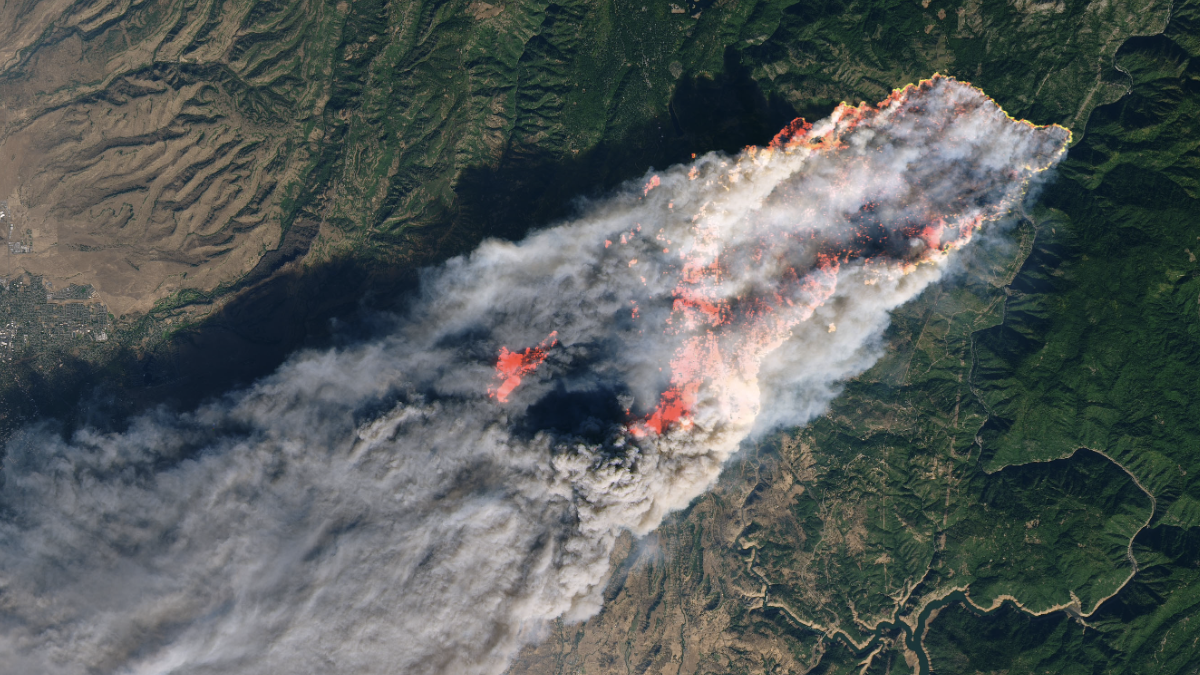
Landsat 8 view of the Camp Fire on November 8, 2018. Shortwave infrared data highlight the active fire. Credit: NASA Earth Observatory/Joshua Stevens, using Landsat data from the US Geological Survey (public domain).
Most families had already collected their children from Ponderosa Elementary School as the fire approached. For the 22 pupils still waiting, an empty bus and the adults who stayed with them became their way out of town.
McKay, kindergarten teacher Abbie Davis and second-grade teacher Mary Ludwig described the evacuation to CNN 10 days later. Their account included stalled traffic, flames beside the road, and the decision to tear up a shirt when smoke began reaching the children.
An empty bus and a call for help
McKay was 41 and had worked as a school bus driver for only a few months. He had taken the job while preparing for a teaching career, a plan that allowed him to attend Butte College and gain experience working with children.
In a November 2025 interview with ChicoSol, he recalled driving Bus 963 toward his own home when a radio call requested an empty bus for students at Ponderosa Elementary. His mother and son also needed to leave Paradise, but the school was close, and he answered the call.
“I knew what my job was,” McKay told ChicoSol.
He later received word that his family was getting to safety in Chico. On the bus, Davis and Ludwig stayed with the pupils whose relatives had not been able to reach the school before the evacuation.
Keeping 22 children together

Leaving the school did not mean leaving the danger. Roads were crowded with other people trying to escape, and the bus became caught in traffic as fire burned nearby.
The adults organized the children for the possibility that conditions would worsen. Older pupils were paired with younger ones, names and contact details were recorded, and the teachers reviewed the emergency exits, first aid kit, and fire extinguisher with McKay.
Davis and Ludwig moved along the aisle, reassuring students while the driver watched the road. The emergency plan gave them practical tasks to carry out as the evacuation slowed.
They also discussed whether they might have to leave the vehicle. With fire on both sides at points along the route, getting off the bus carried dangers of its own.
One shirt and one bottle of water
As smoke entered the bus, Davis noticed some children becoming drowsy. The group had only one bottle of water available.
McKay removed a shirt. He and the teachers tore it into pieces, dampened the cloth and handed the strips to the children to hold over their mouths and breathe through.
The cloth coverings were an emergency improvisation. They did not make the smoke safe to breathe.
The US National Institute for Occupational Safety and Health explains that cloth masks and bandanas, whether wet or dry, lack the fit and filter material needed to provide reliable protection against the very small particles in wildfire smoke.
Finding a way through the traffic
The bus was sideswiped by another vehicle during the evacuation. Along the way, the group also picked up a preschool teacher whose car had broken down, according to CNN’s interviews.
McKay’s later account to ChicoSol described a prolonged stop on Roe Road before the bus could reach Neal Road and continue toward Chico. He recalled two people helping direct traffic so vehicles could begin moving again.
After about five hours, the children reached safety and were reunited with their families. The duration describes the evacuation journey, including time spent trapped in traffic.
“We had the bus driver from heaven,” Ludwig told CNN.
Why the escape took hours
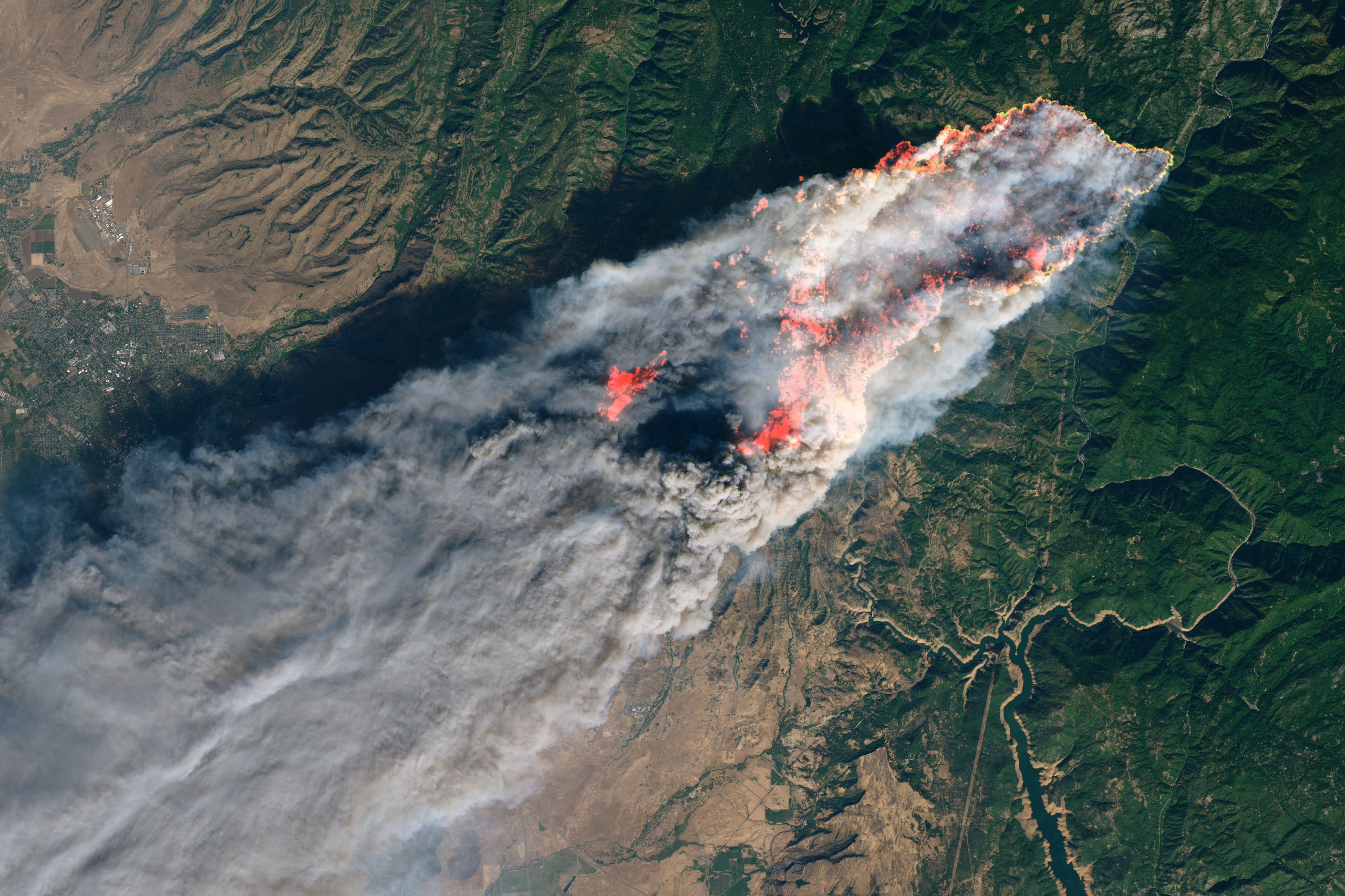
Landsat 8 view of the Camp Fire on November 8, 2018. Shortwave infrared data highlight the active fire. Credit: NASA Earth Observatory/Joshua Stevens, using Landsat data from the US Geological Survey (public domain).
The conditions around Bus 963 were part of a much wider evacuation crisis. The National Institute of Standards and Technology (NIST) later reconstructed how fire, traffic and blocked roads affected people across the communities of Concow, Paradise and Magalia.
NIST documented winds of about 80 km/h (50 mph) during the fire’s initial spread, and burning material started new fires as far as 6.3 km (3.9 miles) ahead. These spot fires helped bring the threat into neighborhoods beyond the main advancing fire.
Its evacuation study found that heavy traffic, road closures caused by fire and debris, and direct exposure to flames complicated the escape. Journeys that ordinarily took about 25 minutes could take several hours, when routes remained passable at all.
Researchers identified 31 temporary refuge areas used by more than 1 200 people and 198 specific evacuation assistance or rescue events involving at least 1 000 civilians. The school bus evacuation was one account within a disaster that required help across the community.
The Watchers’ initial report on the Camp Fire documented the evacuations and rapidly spreading destruction. Its subsequent November coverage followed the search for missing residents as the toll continued to rise.
The final CAL FIRE incident record lists 85 deaths, 18 804 structures destroyed and approximately 62 053 ha (153 336 acres) burned. The fire was fully contained on November 25, 2018.
Investigators determined that electrical transmission lines owned and operated by Pacific Gas and Electric Company near Pulga caused the fire. Strong winds and dry vegetation contributed to its rapid spread toward populated areas.
The list McKay kept
Journalist Lizzie Johnson later reconstructed the escape in her 2021 book Paradise: One Town’s Struggle to Survive an American Wildfire. The evacuation also inspired the 2025 film The Lost Bus, directed by Paul Greengrass and starring Matthew McConaughey and America Ferrera.
The film is a dramatization. Both Ludwig and Davis took part in the real evacuation, as McKay emphasized in 2025.
By that interview, McKay was teaching at Fair View High School in Chico, working with students facing difficulties including homelessness and the loss of parents.
He also still had the attendance sheet made during the evacuation, kept in a drawer at home. It recorded the children’s names and the three adults responsible for them, with a short heading: “22 kids. 3 adults.”
References
- CNN Wire. “‘Bus driver from heaven’ rescued young children from California wildfire.” November 18, 2018. CNN’s report, republished by FOX 13.
- CNN Newsroom. Broadcast transcript containing McKay’s and Davis’s accounts of the evacuation. November 19, 2018.
- Tang, Y. “Seven years after Camp Fire, McKay’s work continues.” ChicoSol, November 7, 2025.
- CAL FIRE. Camp Fire final incident record.
- California Public Utilities Commission, Safety and Enforcement Division. Incident Investigation Report for the 2018 Camp Fire, with attachments. November 8, 2019.
- NIST. “Fire Progression Timeline.” Research accompanying NIST Technical Note 2135, 2021. DOI: 10.6028/NIST.TN.2135.
- Maranghides, A., et al. “A Case Study of the Camp Fire—Notification, Evacuation, Traffic, and Temporary Refuge Areas.” NIST Technical Note 2252, July 18, 2023. DOI: 10.6028/NIST.TN.2252. See also NIST’s life-safety findings.
- NIOSH. “How to Protect Workers and the Public from Wildfire Smoke.” January 13, 2025.
- Johnson, L. “The wildfire was everywhere. Could a school bus driver and 22 kids find a way out?” Adapted excerpt from Paradise, The Washington Post, August 19, 2021.
- Apple. “The Lost Bus.” Official film information, 2025.

Rishav Kothari is Editor-in-Chief of The Watchers, where he runs the newsroom and covers earthquakes, volcanoes, severe weather and space weather.
Published in the last 24 hours
- Mount Pinatubo in the Philippines sits about 7,000 miles from California, yet after it erupted in 1991 the whole planet cooled by about 1°F for nearly two years, because the sulfur it blasted into the sky formed a thin haze that bounced sunlight back into space Epicenter
- A tangled sunspot cluster about 93 million miles away doubled in size in a single weekend earlier this month and fired 20 solar flares in one day, and forecasters gave it a small chance of producing an X-class flare, the most powerful kind the Sun is known to unleash
- A ring of wind spinning about 19 miles above the Arctic, far higher than any passenger jet flies, has started breaking apart weeks earlier than ever recorded, and forecasters say the cold it was holding in place could spill into the US and Europe within weeks
- US flights resume after FAA lifts nationwide ground stop that lasted more than four hours
