
On 28 August 1859 a solar storm shocked telegraph operators and threw sparks on other lines, and on 2 September Boston to Portland clerks unhooked their batteries and kept sending for more than two hours on the aurora’s current alone.
Solar storms on August 28 and September 2, 1859, drove disruptive currents through telegraph networks, shocking operators and throwing sparks from equipment. During the second storm, operators between Boston and Portland, Maine, disconnected their batteries and exchanged messages for more than two hours using the storm-induced current alone.

M8.1 solar flare on August 20, 2026. Credit: NASA/SDO AIA 304, The Watchers
Telegraph superintendent George B. Prescott documented how the disturbances alternately strengthened and overwhelmed the currents used to carry messages. The battery-free exchange appeared in a December 1859 account in The Atlantic Monthly, providing a contemporary record of operators deliberately adapting their equipment to the unusual electrical conditions.
The episode belongs to a sequence of two major geomagnetic storms. James L. Green and colleagues reconstructed the events using scientific reports, newspapers and ships’ logs, distinguishing the disturbance beginning on August 28 from the one beginning on September 2.
Two storms around Carrington’s solar flare
The first storm was already disrupting communications on August 28, several days before Carrington’s celebrated observation. Magnetic records from Kew Observatory in England independently distinguish two abrupt disturbances, corresponding to the auroral displays of late August and early September.
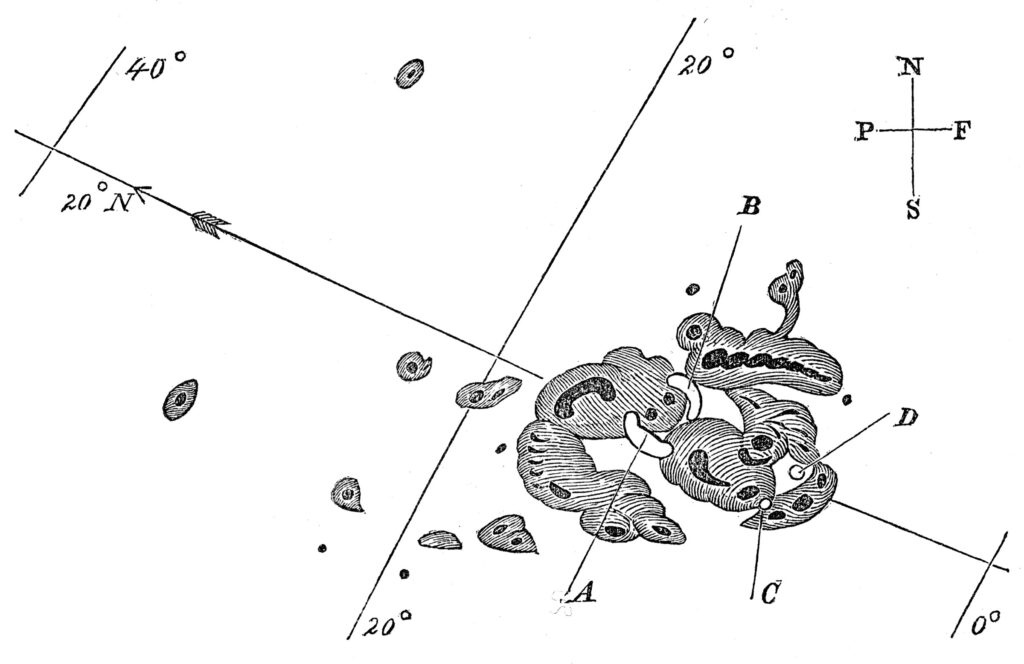
On September 1, English astronomer Richard Christopher Carrington was observing a large sunspot group when two intensely bright patches appeared within it. The brightening lasted only minutes and was independently observed by Richard Hodgson. Their observations are generally recognized as the first clear descriptions of a solar flare.
The associated solar eruption is inferred to have reached Earth roughly 18 hours later. A solar flare is a burst of radiation; a coronal mass ejection is an eruption of magnetized plasma. The latter can drive a geomagnetic storm when it interacts with Earth’s magnetic environment.
The September disturbance became known as the Carrington Event. Reports assembled by Green and colleagues document auroral displays extending into tropical latitudes, illustrating the exceptional geographical reach of the sequence.
Operators reported shocks on both dates
In Washington, D.C., Frederick W. Royce described difficulty working the Richmond and northern lines on the evening of August 28. While one hand rested on an iron plate, his forehead brushed a ground wire near the sounder. He reported receiving a severe electric shock that briefly stunned him.
The spark in this account was reported by another person. Royce said a nearby witness saw “a spark of fire jump from my forehead to the sounder.” His testimony therefore distinguishes what he experienced from what the witness said he saw.
In Pittsburgh, telegraph manager E. W. Culgan reported sparks and brief electrical discharges when the circuit was broken on August 28. He also described instrument coils becoming too hot to touch.
Such effects were not confined to the first storm. Philadelphia superintendent H. Emmons Thayer reported a severe shock while testing wires on the morning of September 2, together with currents that opposed the batteries. The surviving accounts document hazardous conditions on both dates.
Disconnecting the batteries restored useful communication
The best-known experiment took place on the American Telegraph Company’s line between Boston and Portland, Maine. The contemporary account places the battery-free working between 08:30 and 11:00 on September 2, using the local clock times reported in the source.
Conditions had initially prevented ordinary business. The storm-induced current sometimes opposed the batteries and sometimes strengthened the circuit beyond what the instruments could handle. The operators tried removing the batteries while retaining the line’s connections to Earth.
The Boston operator proposed: “Please cut off your battery, and let us see if we cannot work with the auroral current alone.” Portland agreed, and the operators found that they could exchange messages under the changed arrangement.
The account states that this continued for more than two hours before the batteries were restored. It also describes fluctuating currents and brief usable intervals, so the episode should not be understood as two hours of perfectly steady electrical supply.
Other routes provided related examples. The South Braintree–Fall River line in Massachusetts reportedly worked without batteries for more than an hour. In Philadelphia, an operator exchanged a business message with Pittsburgh during a battery-free conversation lasting four or five minutes; signals were also exchanged between Boston and Manchester, New Hampshire.
How a magnetic storm supplied current to the circuit
A changing magnetic field induces an electric field. At Earth’s surface, that field can drive currents through conducting ground and connected electrical networks. Long telegraph circuits, including their ground connections, provided paths for these geomagnetically induced currents.
Removing the batteries left those paths available. During suitable intervals, the natural electrical disturbance supplied enough current for the operators to control signals with their telegraph keys. At other times, changes in strength or direction disrupted the instruments.
The visible aurora and the currents in the wires were related consequences of the disturbed magnetic environment. The telegraph was not collecting energy from the light itself.
The paper-fire accounts require separate dates and locations
One frequently repeated fire story concerns Bain’s chemical telegraph, which recorded signals on chemically treated paper. Prescott’s contemporary account explicitly dates the burning of that prepared paper to February 19, 1852, seven years before the Carrington storms.
That date does not establish that every account of paper ignition belongs to 1852. In his examination of the 1859 records, geomagnetic researcher David H. Boteler reproduced a Norwegian report by Christoph Hansteen describing sparks and discharges that set pieces of paper alight during the disturbances.
The two reports describe different circumstances: chemical recording paper burning in 1852, and paper reportedly ignited by electrical sparks in Norway during the 1859 sequence. Keeping those accounts separate preserves the evidence without transferring an earlier incident to a later storm.
A benchmark whose exact strength remains uncertain
The 1859 sequence remains an important reference for extreme space weather, but reconstructing its global intensity requires interpretation of a limited historical record. The operators’ reports establish practical effects at particular places; magnetic observations provide a separate basis for estimating the storm’s strength.
A 2024 study led by Jeffrey J. Love used a statistical model and historical observations from Colaba, India, to examine the Carrington storm’s intensity. Its results show that estimates depend on the treatment and interpretation of the historical measurements, leaving substantial uncertainty in estimates of how frequently comparable storms occur.
Modern power networks can experience the same underlying induction process. Geomagnetically induced currents can push transformers outside their intended operating conditions, contributing to heating, protective trips and voltage instability. NOAA’s Space Weather Prediction Center issues alerts, watches and warnings covering space-weather hazards.
Alongside space-weather monitoring, assessing the consequences for an electrical network requires information about magnetic variations, conducting paths through the ground and the network’s own equipment. Those local conditions determine how a disturbance in space becomes a current through infrastructure.
References
1 The Aurora Borealis – The Atlantic Monthly, Volume IV, No. 26, transcribed by Project Gutenberg – December 1859.
2 Green, J. L., Boardsen, S., Odenwald, S., Humble, J., and Pazamickas, K. A. Eyewitness Reports of the Great Auroral Storm of 1859 – NASA Technical Reports Server – August 5, 2005. Preprint; document 20050210157.
3 Boteler, D. H. (2006). The super storms of August/September 1859 and their effects on the telegraph system – Advances in Space Research, 38(2), 159–172; author-uploaded full text. DOI: 10.1016/j.asr.2006.01.013.
4 Stewart, B. (1861). On the Great Magnetic Disturbance which extended from August 28 to September 7, 1859, as recorded by Photography at the Kew Observatory – Philosophical Transactions of the Royal Society of London, Volume 151; scan via Wikimedia Commons.
5 Solar Physics Historical Timeline (1800–1999), section “1859: First observation of a solar flare” – High Altitude Observatory, NSF National Center for Atmospheric Research
6 Geomagnetic Storms – NOAA / National Weather Service Space Weather Prediction Center – undated.
7 Chronology of effects – Natural Resources Canada – last modified March 1, 2019. Includes reproduced nineteenth-century telegraph reports.
8 Electric Power Transmission – NOAA / National Weather Service Space Weather Prediction Center – undated.
9 Love, J. J., Rigler, E. J., Hayakawa, H., and Mursula, K. (2024). On the uncertain intensity estimate of the 1859 Carrington storm – Journal of Space Weather and Space Climate, 14, 21; abstract and publication record via USGS – August 21, 2024. DOI: 10.1051/swsc/2024015.
10 Alerts, Watches and Warnings – NOAA / National Weather Service Space Weather Prediction Center – undated.

Rishav Kothari is Editor-in-Chief of The Watchers, where he runs the newsroom and covers earthquakes, volcanoes, severe weather and space weather.
Published in the last 24 hours
- In the winter of 1811–12, earthquakes near New Madrid, Missouri, shook so hard that witnesses saw the Mississippi River flow backward, and the shaking left a brand-new lake in Tennessee Epicenter
- In 2019, the Ronald Reagan Presidential Library hired hundreds of goats to eat 13 acres of brush around it; months later the Easy Fire surrounded the library, and the fire break the goats left behind slowed the flames before they reached the building Epicenter
- Britain appointed a Minister for Drought in August 1976, and it rained so much afterward that by November MPs were calling him the Minister of Flood Epicenter
- LOFAR's deepest low-frequency radio images reveal hidden structure in distant galaxies Epicenter
