
The Carrington Event of 1859 – Strongest geomagnetic storm in recorded history
On September 1, 1859, British astronomer Richard Carrington observed a sudden flash of light erupting from a group of sunspots. Less than 24 hours later, Earth was struck by the most powerful geomagnetic storm in recorded history. Telegraph systems failed, auroras spread across the globe, and the event became known as the Carrington Event.

A giant prominence eruption on August 31, 2012. Credit: NASA/SDO, The Watchers
The 1859 Carrington Event remains the strongest solar storm ever recorded. It revealed the connection between solar activity and geomagnetic disturbances on Earth, setting the foundation for modern space weather science and raising ongoing concerns about the vulnerability of today’s technology.
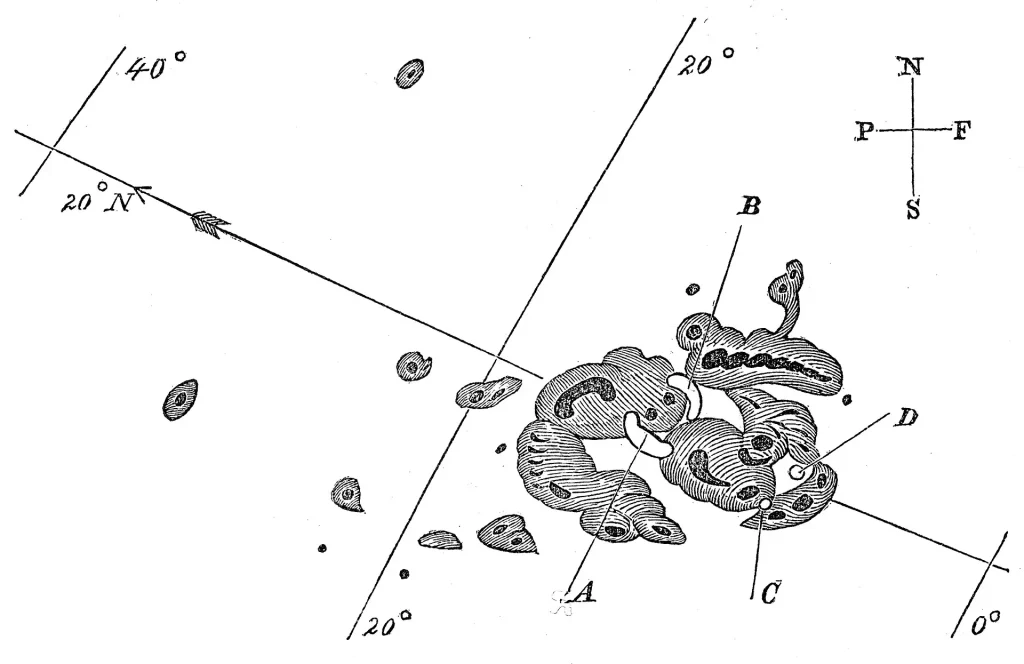
At exactly 11:18 LT on September 1, 1859, during Solar Cycle 10, Carrington noticed two patches of intense white light in a large sunspot cluster while sketching the solar disk. The brightening lasted about five minutes before fading. Richard Hodgson, another British astronomer, independently observed the same phenomenon.
Carrington’s notes, later published in the Monthly Notices of the Royal Astronomical Society, provided the earliest direct evidence of solar activity linked to terrestrial effects.
Modern reconstructions estimate that the associated coronal mass ejection (CME) released energy equivalent to billions of nuclear detonations.
Geomagnetic storm arrival
The CME traveled from the Sun to Earth in only 17.6 hours, far faster than the typical 2–4 days. Its unusually high speed suggests that an earlier CME had cleared the way, allowing this one to move unhindered through interplanetary space.
When the plasma cloud struck on September 2, Earth’s magnetic field was severely disturbed. The storm reached an estimated Dst index of −850 to −1760 nT, far beyond any recorded during the space age.
Compasses became unreliable as magnetic needles swung erratically, and magnetometers worldwide registered extreme fluctuations.
Global auroral displays
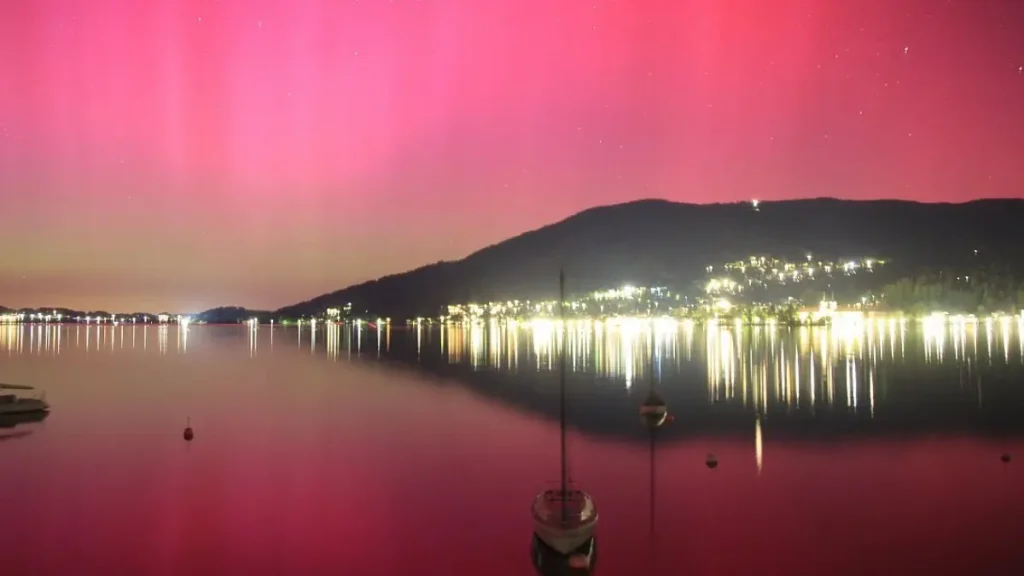
Auroras extended far from the polar regions and were observed across much of the world. Reports came from Havana, Cuba at 23°N, Monterrey, Mexico at 26°N, Rome, Italy at 41°N, and as far south as Santiago, Chile at 33°S. In geomagnetic terms, the auroral oval expanded equatorward to roughly 20–25° geomagnetic latitude, a range normally far beyond the visibility of such phenomena.
In the Rocky Mountains, miners awoke around 01:00 local time believing it was already dawn. Newspapers across the United States reported that in northeastern cities, people could read printed text outdoors at night by auroral light. In Boston, observers described the sky as “appearing to be on fire.”
The displays included deep red, green, and purple colors that illuminated skies across both hemispheres, producing one of the most widely observed auroral events in recorded history.
For comparison, the March 1989 geomagnetic storm, which collapsed Hydro-Québec’s power grid, produced auroras visible as far south as Texas and Florida in the United States, reaching about 40° geomagnetic latitude. During the October–November 2003 “Halloween Storms,” auroras were seen as far south as California and the Mediterranean. The Carrington Event, however, extended several hundred kilometers closer to the equator than these modern examples.
Telegraph system disruptions
The telegraph, then the backbone of long-distance communication, was severely impacted by the geomagnetic storm. Operators reported strong shocks when touching their instruments, sparks arced from equipment, and in some offices telegraph paper caught fire. The induced currents were powerful enough to ignite combustible materials, something never before documented in telegraph operations.
Reports collected in newspapers described chaotic conditions across Europe and North America. In Philadelphia, an operator noted that “a stream of fire followed the pen at every stroke.” In Washington, D.C., clerks disconnected their batteries as equipment became too dangerous to handle. The auroral currents were so strong that they drove systems into overload, forcing some offices to shut down.
Remarkably, in some cases the telegraph network continued to function without any external power supply. Operators in Portland, Maine, and Boston, Massachusetts, exchanged messages for nearly two hours with batteries completely disconnected, powered solely by geomagnetically induced currents along the wires. Similar accounts came from New York, where operators observed their equipment transmitting faint but readable signals without batteries.
For the telegraph industry, the disruptions were unprecedented as never before had natural phenomena interfered with communications so directly, but for scientists, the event was a turning point. It demonstrated for the first time that activity on the Sun could generate electrical effects strong enough to disrupt human technology.
This realization marked the birth of what is now called space weather science.
Timeline of events
- August 28, 1859 – Large sunspot groups appear, producing moderate flares and auroras.
- September 1, 1859, 11:18 LT – Carrington and Hodgson observe the first recorded solar flare.
- September 1–2, 1859 – A massive CME erupts, traveling 150 million km (93 million miles) in 17.6 hours.
- September 2, 1859, early morning – Earth is struck, producing the strongest geomagnetic storm in recorded history.
- September 2–3, 1859 – Auroras and telegraph disruptions are reported worldwide.
- Following days – Scientific debate begins, establishing the foundation of space weather research.
Comparisons with later storms
Although no storm since 1859 has matched the intensity of the Carrington Event, several modern episodes demonstrate the continuing risk.
In March 1989, a geomagnetic storm triggered by a CME caused the collapse of Hydro-Québec’s power grid in Canada. The outage left 6 million people without electricity for 9 hours. Satellites experienced anomalies, and auroras were seen as far south as Texas and Florida.
In July 2012, a CME comparable in scale to the Carrington Event crossed Earth’s orbit but missed the planet by several days. NASA’s STEREO spacecraft measured its speed at over 2 000 km/s (1 240 miles/s). Had the event struck Earth directly, the consequences for modern infrastructure could have been severe.
The May 2024 Gannon storm reached G5 – Extreme strength, the first such event in more than two decades. Multiple fast CMEs merged and impacted Earth, producing intense auroras at unusually low latitudes. The storm disrupted GPS systems, causing navigation errors in aviation and agriculture, and altered Earth’s radiation belts.
At the end of December 2024, a G4 – Severe storm produced strong geomagnetic disturbances, continuing into January 2025. While less intense than the May 2024 event, it demonstrated the active state of Solar Cycle 25.
In late May 2025, another G4 storm reached Earth, generating widespread auroras visible across much of the continental United States, including states as far south as New Mexico and Alabama.
These modern events, though weaker than 1859, show the persistent threat posed by solar eruptions. They confirm that Carrington-class storms are rare but not singular, and that extreme space weather remains a credible risk to critical infrastructure.
Modern recurrence risk and forecasting gaps
Statistical models suggest a 10–12% chance of a Carrington-class storm occurring in any given decade. This places the probability of recurrence within a human lifetime at a level that cannot be ignored.
Forecasting capabilities, while continually improved, remain limited. Satellites positioned at the L1 point, such as NOAA’s DSCOVR and ESA’s Solar Orbiter, monitor solar wind in real time. However, they provide only 15 to 60 minutes of warning before a CME reaches Earth. This window is too short for large-scale preventive measures.
The geoeffectiveness of a CME depends on the orientation of its magnetic field. When the interplanetary magnetic field points southward, coupling with Earth’s magnetic field is maximized, producing the strongest geomagnetic storms. This orientation cannot be determined until the CME is close to Earth, creating a critical forecasting gap.
Despite mitigation strategies, vulnerabilities remain. Long transmission lines make modern power grids highly susceptible to geomagnetically induced currents. Satellite constellations are exposed to surface charging and drag effects, while aviation and navigation systems are dependent on technologies that are sensitive to space weather disturbances.
Implications for the modern world
If a Carrington-class storm occurred today, the effects would reach far beyond the telegraph lines of 1859. High-voltage power grids are among the most vulnerable systems. Transformer damage caused by geomagnetically induced currents could lead to prolonged, large-scale blackouts.
Navigation and timing systems that rely on GPS would be severely degraded. Signal disruptions could affect aviation, shipping, agriculture, and financial networks. The loss of GPS accuracy would cascade into multiple sectors of the global economy.
Satellites would face heightened risks from surface charging, radiation damage, and atmospheric drag in low Earth orbit. Malfunctions or complete failures could disrupt communications, weather forecasting, and Earth observation.
Aviation and maritime communication dependent on HF radio would be interrupted for hours or days. Polar flight routes, which rely heavily on HF, would be especially vulnerable to radio blackouts and increased radiation exposure.
Economic assessments indicate that a Carrington-scale storm could generate damages exceeding 2 trillion USD in the first year alone. Recovery would likely take months to years, depending on the extent of power grid failures and satellite losses.
Legacy
The Carrington Event remains the strongest solar storm on record and the benchmark against which all modern storms are measured.
More than 160 years later, the event continues to shape planning for worst-case scenarios. Modern monitoring systems provide improved warning capabilities, but no technology can prevent a severe solar storm from reaching Earth.
International preparedness plans and infrastructure protections are designed to lower the risks, but the Carrington Event remains a reminder that the star that gives us life can also unleash sudden disruptions capable of crippling human society.

I'm a dedicated researcher, journalist, and editor at The Watchers. With over 20 years of experience in the media industry, I specialize in hard science news, focusing on extreme weather, seismic and volcanic activity, space weather, and astronomy, including near-Earth objects and planetary defense strategies. You can reach me at teo /at/ watchers.news.

Commenting rules and guidelines
We value the thoughts and opinions of our readers and welcome healthy discussions on our website. In order to maintain a respectful and positive community, we ask that all commenters follow these rules.