
NASA built the Opportunity rover to last 90 days on Mars, and Martian winds helped keep it alive for nearly 15 years by blowing dust off its solar panels, until a planet-wide dust storm in 2018 blocked sunlight and silenced the rover
On June 10, 2018, engineers at NASA’s Jet Propulsion Laboratory received the final signal from Opportunity, a Mars rover that had already outlived its planned mission by more than a decade. Its solar panels had repeatedly benefited from dust-clearing winds, but an extraordinary atmospheric dust storm was cutting off the sunlight needed to recharge its batteries. Eight months of recovery efforts followed, ending with NASA’s formal mission closure in February 2019.
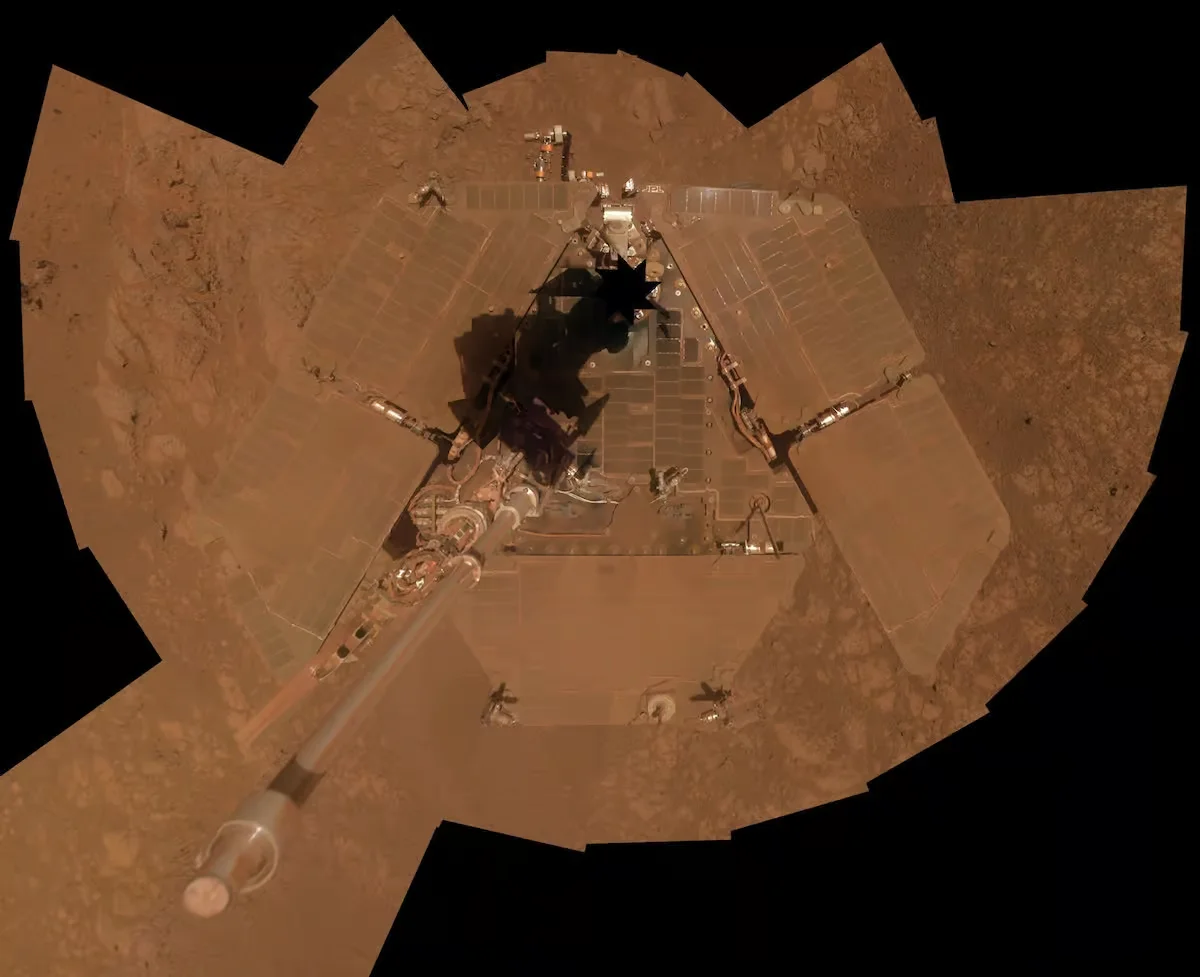
Self-portrait of the Opportunity rover captured between January 3 and 6, 2014, almost ten years to the day after its arrival on Mars, with its panoramic camera (PanCam). Credit: NASA, JPL-Caltech, Cornell University, Arizona State University
Opportunity landed in the Meridiani Planum region on January 24, 2004, seven months after launching from Earth. Its original assignment was to operate for 90 Martian days, known as sols, and travel approximately 1 000 m (3 300 feet) while investigating rocks and soil for evidence that liquid water had once existed on Mars. A sol lasts about 24 hours and 39 minutes, making the original mission roughly three Earth months long.
When NASA declared the mission complete on February 13, 2019, Opportunity had accumulated 5 111 sols of operation before its final signal and traveled 45.16 km (28.06 miles). Its working life had exceeded the original design goal by roughly 60 times. The achievement depended on durable engineering, careful power management, repeated intervention by mission controllers, and an unexpected form of help from the Martian environment: winds that removed dust from its solar arrays.
The unexpected winds that kept the solar panels working
Opportunity and its twin rover, Spirit, used solar panels to convert sunlight into electricity. Dust settling on the panels reduced the amount of light reaching their photovoltaic cells, gradually limiting the energy available for driving, communication, scientific instruments, and survival heaters.
NASA engineers had anticipated this problem. Dust accumulation, combined with cold Martian winters and declining sunlight, was one reason the mission’s initial operating period was so conservative. But the rovers began experiencing events that mission planners had not counted on: Martian winds periodically cleared substantial amounts of dust from the arrays, restoring electrical output.
These natural cleaning events did not eliminate the risks of dust accumulation or guarantee continued operation. They did, however, provide repeated increases in available energy at times when the rovers otherwise faced declining power. The effect was especially valuable during seasonal changes, when the amount of sunlight reaching a stationary or slowly moving rover could vary considerably.
One of the clearest examples occurred in March 2014, during Opportunity’s sixth Martian winter. Winds removed enough dust that the rover’s solar panels became cleaner than they had been during any Martian winter since 2005. A partial cleaning reported on March 27 increased electrical output by approximately 10%, following another cleaning event the previous week.
Opportunity photographed the result itself. Images collected between March 22 and 24 showed much cleaner arrays than an earlier self-portrait taken in January. By mid-April, its solar panels were producing more than 620 watt-hours of electricity per day, compared with less than 375 watt-hours per day in January. The improvement reflected both cleaner panels and lengthening daylight, so it cannot be attributed entirely to wind.
This distinction matters because Opportunity’s longevity was not the result of a single environmental advantage. Mission engineers also changed operations in response to deteriorating equipment, difficult terrain, and seasonal power limitations. In 2005, they spent weeks developing and testing a procedure to free the rover from a sand ripple after its wheels became deeply embedded. Other problems included steering faults and the eventual loss of its flash memory.
How a regional dust storm became a planet-encircling event
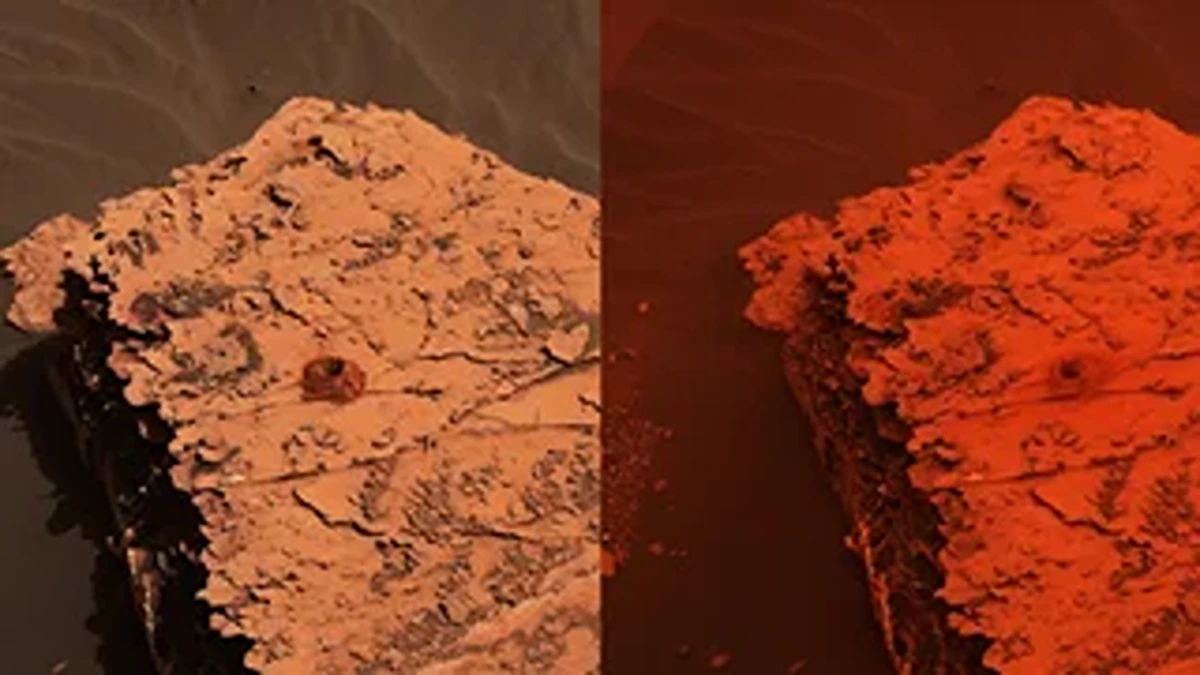
Mars has a thin atmosphere, but winds can lift fine dust high above the surface. Sunlight heats suspended dust, changing atmospheric temperatures and circulation. Under favorable seasonal conditions, this process can support further dust lifting and allow multiple regional storms to expand and merge into a much larger event.
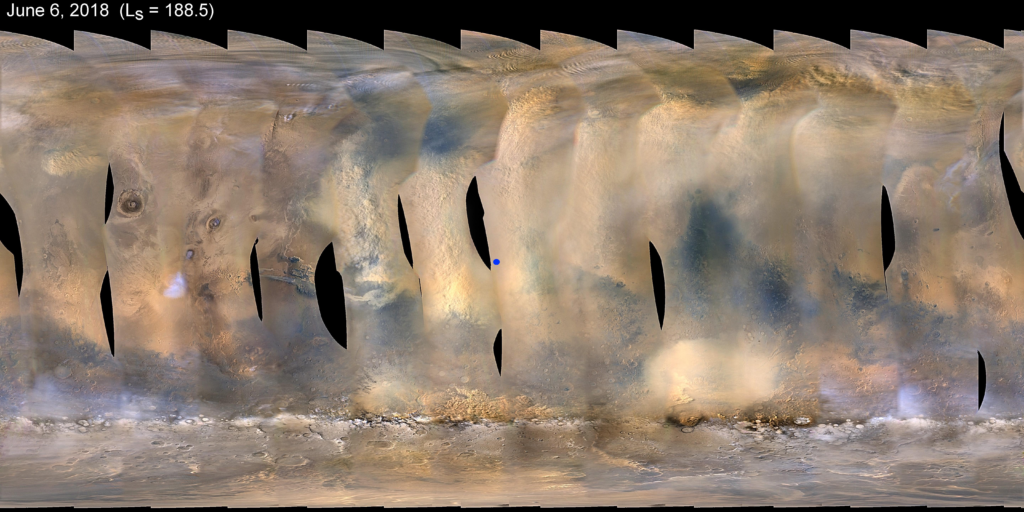
NASA’s Mars Reconnaissance Orbiter detected the storm that would threaten Opportunity on May 30, 2018. Within days, the disturbed area had expanded dramatically. By June 12, NASA reported that the storm covered approximately 35 million km² (14 million square miles), around one-quarter of the planet’s surface.
Opportunity was operating in Perseverance Valley, on the western rim of Endeavor Crater, when atmospheric dust began reducing the sunlight reaching its panels. By June 6, electrical output had declined enough for the rover to enter minimal operations, with science activities suspended to conserve energy.
The storm continued to spread. On June 19, scientists classified it as a planet-encircling dust event. That designation described the extent of the storm across Mars, not uniform darkness at every location. NASA’s contemporaneous assessment noted that the storm remained patchy and was not as extensive by area as the 2007 storm that Opportunity had survived.
Earlier reports by The Watchers documented the storm’s rapid intensification in June 2018, when it was still uncertain whether the event would become global. The same hazard had been recognized years earlier, when a 2012 regional storm raised concerns about the power available to Opportunity.
The last transmission and a sky nearly without sunlight
The crucial measurement during the 2018 storm was atmospheric optical depth, commonly called tau. It describes how strongly suspended dust reduces light passing through the atmosphere. Higher tau values mean that a smaller fraction of direct sunlight can reach the surface.
At Opportunity’s location, tau reached an estimated 10.8 on June 10, 2018. During the major dust storm the rover survived in 2007, local opacity had exceeded 5.5. The 2018 value represented substantially more severe sunlight attenuation over the rover, even though the earlier storm had covered a larger area of Mars.
Opportunity’s own panoramic camera recorded the effect. On June 10, images taken through two camera filters showed only a faint trace of the Sun through the dust. Scientists used those images to estimate atmospheric opacity. The Sun had not physically disappeared, but the amount of light reaching the rover was insufficient to sustain normal solar-powered operations.
Engineers received a transmission that morning confirming the rover was still able to communicate. Its reported temperature was approximately -29 °C (-20 °F). That was the last signal NASA received from Opportunity.
On June 12, after further contact attempts failed, engineers proceeded on the assumption that battery voltage had fallen below 24 V and that Opportunity had entered a low-power fault state. In this protective mode, the rover would shut down most systems while retaining a mission clock intended to periodically wake the computer and check whether enough energy had become available.
This was an engineering assessment, not a final voltage measurement transmitted from the surface. NASA could establish that available solar energy had collapsed and communication had ceased, but it could not directly observe the rover’s internal condition once the signal was lost.
Why clearing skies could not bring Opportunity back
The end of the storm did not immediately mean the end of the recovery effort. By late July 2018, orbital and surface observations showed that airborne dust was beginning to settle. Engineers hoped sufficient sunlight would eventually return to recharge Opportunity’s batteries and allow its computer to restart.
JPL estimated that local tau would need to fall below approximately 2 before the rover could plausibly begin recharging. Recovery efforts also considered whether dust deposited directly on the solar panels might continue obstructing sunlight after atmospheric conditions improved.
The team faced other uncertainties. Prolonged low power could prevent the rover from maintaining its internal temperature, potentially damaging batteries or electronics. Engineers also considered possible fault states involving the mission clock and communication hardware. Without a response, they could not determine which condition, or combination of conditions, prevented recovery.
Seasonal winds had cleared the arrays before, giving engineers another reason to continue listening. NASA identified the November-to-January period as a possible dust-clearing season, during which winds might remove newly deposited material from the panels.
Those hopes did not produce a signal. During an eight-month recovery campaign, mission controllers transmitted more than 1 000 commands using NASA’s Deep Space Network. Their final attempt took place on February 12, 2019, using the 70 m (230 feet) antenna at the Goldstone Deep Space Communications Complex in California. NASA declared the mission complete the following day.
John Callas, the Mars Exploration Rover project manager at JPL, explained the decision: “We have made every reasonable engineering effort to try to recover Opportunity and have determined that the likelihood of receiving a signal is far too low to continue recovery efforts.”
What Opportunity actually communicated in its final moments

Opportunity’s disappearance later became closely associated with the phrase “My battery is low, and it’s getting dark.” It was widely repeated as though the rover had transmitted those words directly to Earth.
It had not. The wording originated in a social media account by science reporter Jacob Margolis, who summarized the meaning of Opportunity’s last communications after speaking with mission personnel. Margolis subsequently explained that the line had spread beyond its original context and was being mistaken for a literal spacecraft message.
Opportunity transmitted engineering data rather than a sentence expressing its condition. The observations indicated very low available power and an atmosphere so dusty that sunlight was severely reduced. Its final images of the faint Sun remain a direct scientific record of those conditions, rather than a message composed in human language.
What the 2018 storm revealed about Mars
Although Opportunity could no longer operate, other spacecraft continued observing the storm. NASA’s Curiosity rover, which used a radioisotope power system rather than relying on solar panels, was able to measure atmospheric changes from Gale Crater on another part of Mars.
In a study published in Geophysical Research Letters in December 2018, researchers led by Scott Guzewich analyzed approximately 100 Martian sols of enhanced environmental observations. Curiosity’s cameras measured a maximum atmospheric optical depth of 8.5, while its environmental instruments recorded a reduction of approximately 97% in total ultraviolet solar radiation reaching the surface.
Those measurements were made at Curiosity’s location, not Opportunity’s, and they should not be treated as interchangeable. Together, however, observations from both rovers and orbiting spacecraft showed how widely the storm altered the Martian atmosphere. Dust reduced incoming sunlight, changed daily temperature variations, and affected atmospheric pressure patterns.
Further observations of the same event helped scientists investigate towering dust clouds capable of transporting material into the middle atmosphere. These structures were examined in later research and in The Watchers’ coverage of Martian dust towers reaching altitudes of around 80 km.
Opportunity’s final storm therefore became both a spacecraft survival failure and an unusually well-observed atmospheric event. The rover’s earlier cleaning events had shown how local winds could restore the energy available to a solar-powered explorer. The 2018 storm demonstrated the opposing risk: dust suspended throughout the atmosphere could reduce incoming sunlight so severely that even a spacecraft with years of successful survival experience could lose its power supply.
Opportunity’s scientific record remains substantial. Across 45.16 km (28.06 miles), the rover investigated sedimentary rocks, minerals, and geological features that helped establish the presence of liquid water in ancient Martian environments. Its endurance made those observations possible, while its final loss of contact left one technical question unanswered: exactly what failed inside the rover after June 10, 2018.
References:
1 NASA’s Opportunity Rover Mission on Mars Comes to End – NASA Jet Propulsion Laboratory – February 13, 2019.
2 Opportunity – NASA Science – mission overview, accessed November 11, 2026.
3 Mars Rover Mission Comes to an End, But Science, Legacy Live on – NASA Jet Propulsion Laboratory Education – updated October 11, 2024.
4 Cleaner NASA Rover Sees Its Shadow in Martian Spring – NASA Jet Propulsion Laboratory – March 27, 2014.
5 Self-Portrait by Freshly Cleaned Opportunity Mars Rover in March 2014 – NASA Jet Propulsion Laboratory – April 17, 2014.
6 Opportunity Hunkers Down During Dust Storm – NASA Jet Propulsion Laboratory – original June 8, 2018; status updates through July 26, 2018.
7 Last Images Opportunity Took – NASA Jet Propulsion Laboratory – March 12, 2019.
8 Six Things About Opportunity’s Recovery Efforts – NASA Jet Propulsion Laboratory – 2018.
9 Update on Opportunity Rover Recovery Efforts – NASA Jet Propulsion Laboratory – 2018.
10 How A Tweet About The Mars Rover Dying Blew Up On The Internet And Made People Cry – LAist – February 2019.
11 Guzewich, S. D., et al. (2019). Mars Science Laboratory Observations of the 2018/Mars Year 34 Global Dust Storm – Geophysical Research Letters, 46, 71–79 – first published December 5, 2018. DOI: 10.1029/2018GL080839.

Rishav Kothari is Editor-in-Chief of The Watchers, where he runs the newsroom and covers earthquakes, volcanoes, severe weather and space weather.
Published in the last 24 hours
- On 28 August 1859 a solar storm shocked telegraph operators and threw sparks on other lines, and on 2 September Boston to Portland clerks unhooked their batteries and kept sending for more than two hours on the aurora's current alone. Epicenter
- Meteors streaked over Arizona at about 40 a second for 20 minutes one November night in 1966, from the same shower that returns every November Epicenter
- LOFAR's deepest low-frequency radio images reveal hidden structure in distant galaxies Epicenter
- In the winter of 1811–12, earthquakes near New Madrid, Missouri, shook so hard that witnesses saw the Mississippi River flow backward, and the shaking left a brand-new lake in Tennessee Epicenter
