
A soy sauce maker used fire to guide villagers through Japan’s 1854 tsunami, then funded a seawall that protected most of Hiro in 1946
Soy sauce maker Hamaguchi Goryō lit rice-straw fires to guide villagers to higher ground when a tsunami struck Hiro, Japan, in darkness on December 24, 1854. He then financed an embankment that protected most of the settlement from the 1946 Nankai tsunami, 88 years after its completion.
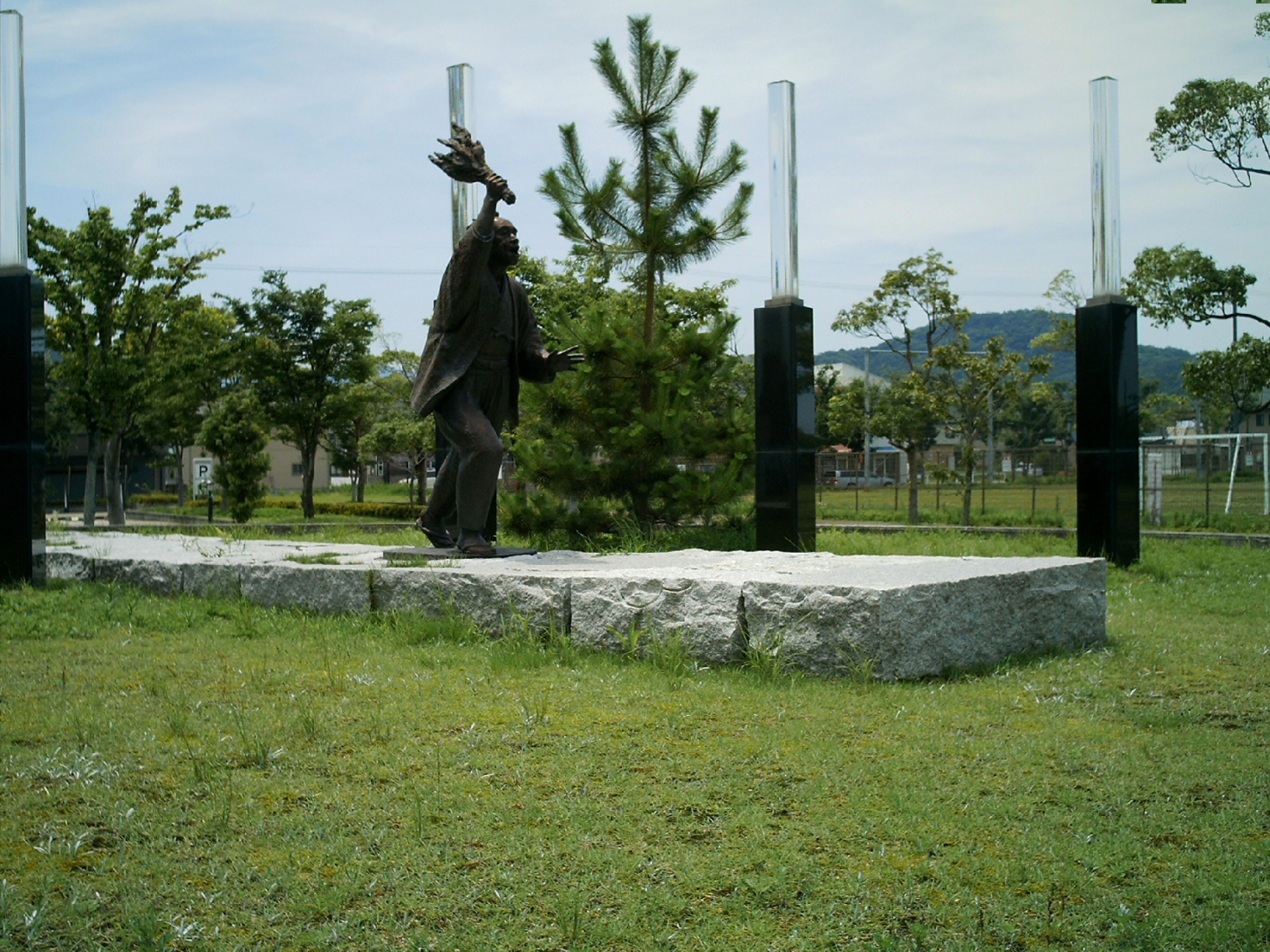
IMAG Hamaguti Goryou. Credit: Ohta TeppeiOhta Teppei (public domain), via Wikimedia Commons.
The village was on the Kii Peninsula, in what is now Hirogawa, Wakayama Prefecture. Its recovery brought together two needs: helping families rebuild their livelihoods and reducing the damage when the sea next came inland.
Goryō’s fires became the best-known part of the story, carried into literature and schoolbooks as Inamura no Hi, “The Fire of Rice Sheaves.” The embankment, built from 1855 to 1858, remained after his death and helped protect people who had never witnessed the original disaster.
Firelight on the evacuation route
Goryō belonged to the family behind Yamasa Soy Sauce in Chōshi and was in his home village when the Ansei-Nankai earthquake struck. He had inherited the family business, but his responsibilities that evening quickly extended beyond it.
The village had already experienced a frightening earthquake the previous day. Another, much more violent shock followed on December 24, sending people toward higher ground as a tsunami approached.
Water entered the settlement and disrupted escape routes. Goryō himself nearly drowned, according to the historical account in the US Geological Survey’s The Orphan Tsunami of 1700.
He and young villagers went back out to help people who had not reached safety. With darkness obscuring the route, rice-straw stacks were set alight to provide visible landmarks toward the refuge at Hirohachiman Shrine.
The USGS account says the fires were credited with guiding nine people to safety. That is a narrower claim than the later tale of an entire village saved by a single man’s warning, and it sits alongside the documented loss of 36 lives.
Rebuilding meant finding work
Survival left families with another emergency. Fields were damaged, fishing boats and gear were lost, and some residents began leaving because they could no longer make a living.
Hirogawa’s account, drawn from its town history, describes Goryō providing housing, tools, and fishing equipment. It records 50 new houses built during the early recovery, with accommodation supplied free to people who could not afford it and installment arrangements for those able to pay.
Building the embankment also provided employment. Residents could earn money while working on a structure intended to protect their community, giving families a reason and a means to remain.
The town’s museum describes his achievement as an effort “to plan for the relief of a hundred generations.” Construction was one part of that longer recovery, alongside the help that families needed immediately.
A barrier built to outlast its backers
Work began in 1855 and continued until 1858. The defenses combined an earthen embankment with trees and an older stone barrier nearer the sea, according to the Japan Meteorological Agency’s historical account.
Hirogawa’s current description gives the embankment’s length as 652.3 m (2 140 feet). It lists the structure as 3–3.4 m (9.8–11.2 feet) high, with its top approximately 4.5 m (14.8 feet) above mean sea level.
The work continued well beyond Goryō’s lifetime. The town’s chronology records repairs, tree protection, and the installation of a tide gate in a passage through the embankment in 1926. It became a national historic site in 1938.

When the waves returned
The town’s maintenance history credits the embankment with protecting Hiro during the 1944 Tōnankai tsunami and again during the Nankai tsunami on December 21, 1946.
The 1946 earthquake struck before dawn. JMA’s historical account describes a tsunami approximately 4–5 m (13–16 feet) high reaching Hiro about half an hour later.
The barrier protected most of the residential district. However, water entered along the Egami River and a tributary on the unprotected southwestern side, striking a school, a textile factory, and workers’ housing before spreading into fields behind the settlement.
JMA records 22 deaths in Hiro, many near that unprotected area. The embankment reduced the extent of inundation, but the remaining routes inland still exposed people to lethal water flows.
Its success therefore depended on where people and buildings stood in relation to the defenses. The 1946 account preserves both outcomes: a largely protected residential center and severe losses beyond it.
How the rescue became a different story
Lafcadio Hearn’s “A Living God,” included in his 1897 collection Gleanings in Buddha-Fields, turned the episode into a story with a different central character and a different sequence of events.
Hearn’s Hamaguchi Gohei is an elderly farmer living above a coastal village. After an earthquake and an unusual withdrawal of the sea, he burns his rice harvest. Villagers rush uphill to fight the fire, reaching safety before the tsunami destroys their homes.
“That was why I set fire to the rice,” Gohei tells them in Hearn’s story.
JMA explicitly distinguishes that literary version from the historical event. The real Goryō lived in the low-lying settlement, experienced violent shaking, and used the fires to indicate a safe destination to people already caught in the disaster.
A school adaptation by Nakai Tsunezō was published for Japanese national readers in 1937. The story helped carry the evacuation lesson to successive generations, while the differences between the tale and the record remained important.
One difference has practical consequences. JMA cautions that the sea does not always withdraw before a tsunami: some waves arrive without the dramatic retreat described in the story.
A story kept alive with earth and upkeep

The United Nations designated November 5 as World Tsunami Awareness Day in a resolution adopted on December 22, 2015, citing the Inamura no Hi account. The date follows the old Japanese calendar date of the disaster; its Gregorian equivalent is December 24, 1854.
Hirogawa’s Tsunami Festival began in 1903. The town describes residents preparing the embankment, adding earth and holding a memorial ceremony, with local elementary and junior high school students taking part.
Along the same Nankai Trough earthquake system, an M7.1 earthquake near Kyushu prompted a special preparedness advisory in August 2024.
At Hirogawa, the history is preserved in the Inamura-no-Hi no Yakata museum and in the embankment itself. The local commemoration includes the physical work of caring for the defenses that Goryō helped build.
References
1 Inamura-no-Hi no Yakata, Hirogawa Town. “Hamaguchi Goryo.” Biography and chronology.
2 Wakayama Prefecture Cultural Information Archive. “Hamaguchi Goryō.” Japanese-language biographical record, including the burning of his own rice-straw stacks.
3 Atwater, B. F., et al. The Orphan Tsunami of 1700—Japanese Clues to a Parent Earthquake in North America. USGS Professional Paper 1707, 2005, p. 47. Inspected page extract, archived by the Redwood Coast Tsunami Work Group. DOI: 10.3133/pp1707.
4 Hirogawa Town. “Hiromura Embankment.” Town-history account and measurements; updated February 2, 2026.
5 Inamura-no-Hi no Yakata, Hirogawa Town. “Tsunami Prevention: Embankment Maintenance History.” Construction, maintenance and the 1944 and 1946 tsunamis.
6 Japan Meteorological Agency. Inamura no Hi educational series: Goryō’s recovery work; the embankment’s components; differences between the historical event and the literary story; the 1946 tsunami, remaining exposure and natural-warning limitations. In Japanese.
7 Hirogawa Town. “The Fire of Rice Sheaves.” Museum interpretation of the historical event.
8 Hearn, L. “A Living God,” in Gleanings in Buddha-Fields. 1897. Digitized by Project Gutenberg.
9 Cabinet Office, Japan. “Tsunami Disaster Prevention Day.” Bōsai, No. 76, 2014. Calendar conversion and the story’s educational history; in Japanese.
10 United Nations General Assembly. “World Tsunami Awareness Day,” Resolution A/RES/70/203. Adopted December 22, 2015.
11 Hirogawa Town. “Tsunami Festival.” History and community participation; updated September 8, 2026.
12 Japan Meteorological Agency. “Nankai Trough Earthquake Extra Information (Megathrust Earthquake Attention).” August 8, 2024; Japanese-language announcement and supporting material.

Rishav Kothari is Editor-in-Chief of The Watchers, where he runs the newsroom and covers earthquakes, volcanoes, severe weather and space weather.
Published in the last 24 hours
- Second nationwide US flight halt since 9/11: how the November 13 FAA ground stop compares with September 2001 and January 2023 Epicenter
- In 2013 a landslide fell onto Svínafellsjökull in southeast Iceland, leaving thicker ice at the foot of the slope; that ice is now moving away and the mountainside has shifted 1 to 3 cm. Epicenter
- Kīlauea's north vent threw lava about 660 feet (200 m) high for six hours on 5 November 2026; the summit is now reinflating, with the next episode forecast for 16 to 21 November. Epicenter
- A crack up to 6 m (20 ft) wide is splitting the summit of the Hochvogel in the Allgäu Alps; 12 years of measurements now put the loose block at about 400,000 cubic metres, half the peak. Epicenter
