
ESA’s Mars orbiters record interstellar comet 3I/ATLAS in once-in-a-lifetime encounter
The European Space Agency’s (ESA) ExoMars Trace Gas Orbiter (TGO) and Mars Express spacecraft recorded images of interstellar comet 3I/ATLAS on October 3, 2025, from about 30 million km (18.6 million miles) away, marking the closest observation of the object from any spacecraft so far.

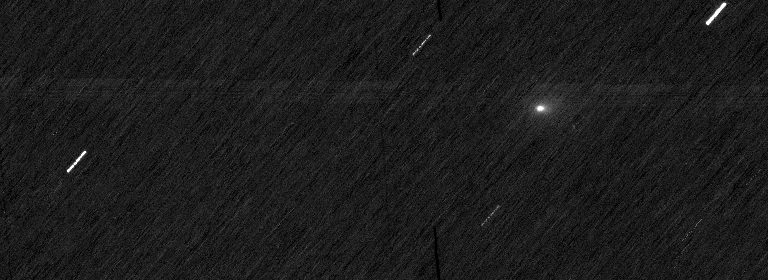
VLT FORS2 ESO image of 3I/ATLAS in motion through 13 minutes - visible as a line. Credit: ESO/O. Hainaut
For one week between October 1 and 7, 2025, both Mars orbiters turned their instruments toward a faint, fast-moving point of light. The object, designated 3I/ATLAS, passed roughly 30 million km (18.6 million miles) from Mars at its closest approach on October 3.
Such encounters are extraordinary. Interstellar comets do not belong to our Solar System. They come from distant stellar nurseries, their orbits revealing they are not bound by the Sun’s gravity. Only two such visitors, 1I/ʻOumuamua in 2017 and 2I/Borisov in 2019, had been seen before.
Each of these cosmic wanderers follows a hyperbolic trajectory, a path that confirms its foreign origin. The fact that three have been detected in less than a decade suggests interstellar debris may be more common than once believed.
Astronomers believe 3I/ATLAS could predate our Solar System by several billion years. If confirmed, it would be one of the oldest pieces of solid material ever observed, a relic from a long-vanished star system.
For planetary scientists, that makes it priceless. Observing such a body lets researchers test whether the chemical processes that shaped our planets also occurred around other stars billions of years ago.

ExoMars captures the faint halo around 3I/ATLAS
The ExoMars Trace Gas Orbiter used its Colour and Stereo Surface Imaging System (CaSSIS) to image the comet. The instrument, designed to photograph Mars at high resolution, took a series of five-second exposures. In those frames, 3I/ATLAS appeared as a dim, slightly blurred dot drifting across the star field.
Nick Thomas, Principal Investigator of CaSSIS, explained that “the comet is around 10 000 to 100 000 times fainter than our usual target.” The challenge pushed the camera’s sensitivity to its limits, since it was built to study bright Martian terrain just a few hundred kilometres below, not a faint comet tens of millions of kilometres away.
The nucleus itself was far too small to resolve. Estimates from ground-based and Hubble observations suggest its core may be only a few hundred meters to several kilometers wide. Seeing it from Mars would be like spotting a mobile phone lying on the Moon from Earth.
Even so, CaSSIS revealed the surrounding coma, a haze of gas and dust a few thousand kilometres across. This diffuse envelope forms when sunlight heats the comet’s frozen surface, causing ices to vaporise and release dust. The brightness fades rapidly with distance from the nucleus, making the coma blend into background noise beyond the inner halo.
No tail was visible in these early images, but scientists expect it to brighten as the comet continues toward the Sun. Later observations may show jets or extended dust trails once the nucleus becomes more active.
Mars Express adds another perspective
Mars Express, the older of the two orbiters, also turned its cameras toward the comet. Its Visual Monitoring Camera captured short 0.5-second exposures, the maximum possible for the spacecraft. Because of the short exposure and distance, 3I/ATLAS did not immediately appear in the raw images.
Researchers are now stacking and combining multiple frames to increase sensitivity. This process may reveal the faint signal of the comet against the background noise. The effort mirrors the patience of early deep-sky observers, who built images photon by photon over long hours.
Beyond imaging, the team also attempted to collect spectral data. Mars Express used its OMEGA and SPICAM instruments, while ExoMars deployed its NOMAD spectrometer. These devices split light into its component wavelengths to identify chemical signatures.
Whether the comet’s coma and tail were bright enough for a clear reading remains uncertain. The data are now being reprocessed to search for faint traces of molecules such as water, carbon dioxide, or cyanide, common in Solar System comets but untested in material from beyond the Sun.
ESA scientist Colin Wilson said that while the Mars orbiters are designed primarily for Martian research, “it is exciting to see them adapt to completely new opportunities like this.”
Why this interstellar visitor stands apart
Comet 3I/ATLAS was first spotted on July 1, 2025, by the Asteroid Terrestrial-impact Last Alert System (ATLAS) telescope in Río Hurtado, Chile. From the first calculations of its orbit, astronomers recognised it was not native to the Solar System. Its hyperbolic path means it will never return.
The composition of such objects can reveal what kinds of materials formed around other stars. Some early analyses suggest its surface may contain silicates and organic compounds distinct from the typical mix found in Solar System comets. These differences may trace back to chemical variations in the interstellar cloud where it formed.
If its estimated age of more than 7 billion years holds true, 3I/ATLAS predates the Sun by billions of years. That makes it a messenger from the earliest epoch of planet formation in the Milky Way.
Its visit also highlights how planetary systems exchange material. As stars form, they eject debris that drifts for eons before occasionally passing through other systems, carrying with it the story of its birthplace.
For astronomers, these cosmic passers-by are not only curiosities but laboratories in motion, natural samples of other worlds delivered across the Galaxy.
A rare opportunity from Mars to Jupiter
ESA’s next chance to observe 3I/ATLAS will come from farther out in the Solar System. In November 2025, the Jupiter Icy Moons Explorer (JUICE) will aim its instruments at the comet soon after its closest approach to the Sun. By then, the nucleus should be more active, with brighter outgassing and possibly a visible tail several million kilometres (millions of miles) long.
JUICE will be much farther away than the Mars orbiters were, but its instruments are capable of capturing the comet’s overall brightness and behaviour as it interacts with solar radiation. Because of the spacecraft’s distance and slow data rate, scientists expect the images and measurements to reach Earth around February 2026.
This coordinated approach, spanning spacecraft at two planets, offers a rare chance to observe how an interstellar comet evolves as it crosses the inner Solar System. It is the first time ESA has observed the same object from both Mars orbit and Jupiter’s neighbourhood.
The data will allow scientists to compare changes in the coma, tail, and overall activity as the comet approaches and recedes from the Sun. Such time-linked observations are crucial for understanding how sunlight and solar wind shape these ancient travelers.
By combining data from ExoMars, Mars Express, JUICE, and Earth-based telescopes, ESA aims to reconstruct the complete evolution of this interstellar visitor.
Preparing for the next encounter
To build on these observations, ESA is developing a new mission called Comet Interceptor, scheduled for launch in 2029. It will wait in a stable orbit at the Sun–Earth L2 point, ready to pursue a pristine comet from the distant Oort Cloud or, ideally, another interstellar object like 3I/ATLAS.
The spacecraft will consist of a main platform and two smaller probes designed to fly through a comet’s coma, measuring its composition and structure in detail. If an interstellar target appears, it could be humanity’s first close-up encounter with matter from another star system.
Michael Kueppers, Comet Interceptor project scientist, explained that when the mission was first proposed, only 1I/ʻOumuamua had been discovered. “Since then, two more have appeared, each very different. Visiting one directly could reveal the true diversity of interstellar objects.”
Although the odds of catching such a target are small, the mission will demonstrate how to rapidly retarget a spacecraft when an unexpected object is discovered. That capability could transform future planetary defence and exploration strategies.
For now, ESA’s success in capturing 3I/ATLAS from Mars marks a first step toward that goal. It shows how even distant orbiters can work together to study fleeting phenomena beyond their original design.
Deepening our understanding of cosmic origin
Every observation of an interstellar object deepens our understanding of cosmic origins. Comets like 3I/ATLAS contain frozen gases and minerals that predate the formation of the Solar System. Analysing them helps scientists understand how the building blocks of planets, and possibly life, are distributed through the Galaxy.
Comparing interstellar and Solar System comets may reveal whether planet-forming chemistry follows universal rules. If their compositions differ widely, it would suggest that other star systems form planets under very different conditions.
For ESA and the global astronomy community, the 3I/ATLAS campaign demonstrates how quick coordination among multiple missions can transform unexpected discoveries into scientific breakthroughs.
It also connects human exploration across planets. Spacecraft orbiting Mars have now observed an object from another star, linking our study of the Red Planet to the broader cosmic environment that produced it.
Colin Wilson summarised it simply: “Every observation of an interstellar object gives us a piece of a much larger cosmic puzzle.”
Reference:
1 ESA’s ExoMars and Mars Express observe comet 3I/ATLAS – ESA – October 7, 2025

I’m a science journalist and researcher at The Watchers, contributing to the Epicenter edition, where I cover peer-reviewed scientific research and emerging discoveries across Earth and space sciences. With a background in astronomy and a passion for environmental science, I’ve worked in shark and coral conservation in Fiji, conducting reef and shark-behavior research, contributing to mangrove restoration, and earning PADI Open Water and Coral Reef Certifications. I bring a blend of scientific rigor and storytelling to illuminate the discoveries shaping our planet and beyond.

Commenting rules and guidelines
We value the thoughts and opinions of our readers and welcome healthy discussions on our website. In order to maintain a respectful and positive community, we ask that all commenters follow these rules.