
NASA telescopes detect unusual chemistry in interstellar comet 3I/ATLAS
NASA released the first results of James Webb Space Telescope (JWST) observations of interstellar comet 3I/ATLAS on August 25, 2025, showing a coma dominated by carbon dioxide. The comet was observed on August 6, and complementary data from Hubble and SPHEREx confirm unusual volatile ratios.

Hubble Space Telescope view of interstellar comet 3I/ATLAS, captured with the Wide Field Camera 3. Credit: Image: NASA, ESA, David Jewitt (UCLA), Joseph DePasquale (STScI)
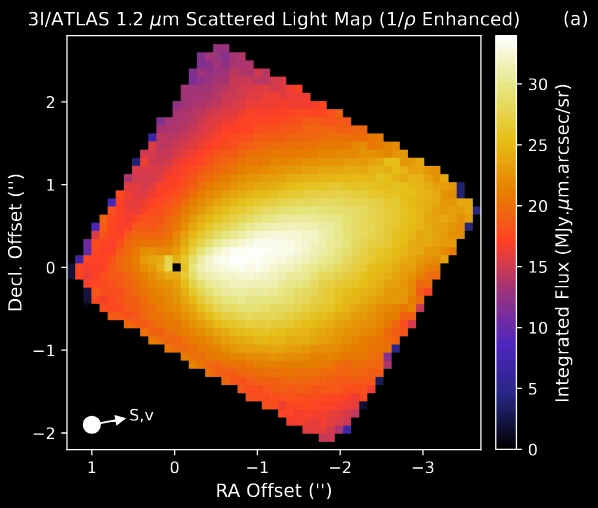
James Webb Space Telescope (JWST) recorded near-infrared spectra of interstellar comet 3I/ATLAS on August 6, using the NIRSpec Integral Field Unit. The findings, made public on August 25, include spectral image maps and an analysis submitted to Astrophysical Journal Letters.
The analysis identified water (H2O), carbon monoxide (CO), and carbon dioxide (CO2), with CO2 dominating the detected emissions. The CO2/H2O mixing ratio was measured at 8.0 ± 1.0, one of the highest values reported in a cometary coma.
The presence of volatile ices and a diffuse coma supports the object’s classification as a comet. However, the extreme CO2/H2O ratio is atypical for Solar System comets, where water generally outnumbers carbon dioxide. Astronomers note that the chemistry of 3I/ATLAS most closely resembles that of comet C/2016 R2 (PanSTARRS), considered an outlier.

Additional observations were conducted with NASA’s Hubble Space Telescope (HST) on July 21, producing the sharpest image to date and constraining the nucleus to a maximum diameter of 5.6 km (3.5 miles). Hubble’s imaging also revealed a teardrop-shaped dust coma.
NASA’s Spectro-Photometer for the History of the Universe, Epoch of Reionization and Ices Explorer (SPHEREx) tracked the comet between August 7 and 15, 2025. Spectrophotometry performed August 8–12 detected strong water-ice absorption features and a CO2 coma extending at least 348 000 km (216 000 miles) from the nucleus.
SPHEREx analysis determined a CO2 production rate of approximately 9.4 × 1026 molecules per second, equivalent to about 69 kg/s (152 pounds/s). Upper limits for other gases were constrained to Q(H2O) ≤ 1.5 × 1026 molecules/s and Q(CO) ≤ 2.8 × 1026 molecules/s.
Trajectory analysis shows that 3I/ATLAS will reach perihelion at about 1.4 AU (210 million km / 130 million miles) on October 29–30, 2025. Its closest approach to Earth will occur on December 19, 2025, at a distance of 1.8 AU (270 million km / 168 million miles). NASA emphasized that the comet poses no threat to Earth.
3I/ATLAS is the third confirmed interstellar object observed passing through the solar system, after 1I/ʻOumuamua in 2017 and 2I/Borisov in 2019.
Coordinated observations by JWST, HST, and SPHEREx provide the most complete compositional profile yet of such an object, supporting both planetary defense goals and research into the diversity of icy bodies formed in extrasolar environments.

References:
1 NASA’s Webb Space Telescope Observes Interstellar Comet – NASA – August 25, 2025
2 NASA’s New SPHEREx Mission Observes Interstellar Comet – NASA – August 25, 2025

I’m a science journalist and researcher at The Watchers, contributing to the Epicenter edition, where I cover peer-reviewed scientific research and emerging discoveries across Earth and space sciences. With a background in astronomy and a passion for environmental science, I’ve worked in shark and coral conservation in Fiji, conducting reef and shark-behavior research, contributing to mangrove restoration, and earning PADI Open Water and Coral Reef Certifications. I bring a blend of scientific rigor and storytelling to illuminate the discoveries shaping our planet and beyond.

Commenting rules and guidelines
We value the thoughts and opinions of our readers and welcome healthy discussions on our website. In order to maintain a respectful and positive community, we ask that all commenters follow these rules.