
Pumice from Titan Ridge eruption blocks sea access in Manus Province, Papua New Guinea
Large floating pumice accumulations from the Titan Ridge submarine eruption have inundated coastal villages in Manus Province, Papua New Guinea, this week, blocking sea access and preventing boat movement.

Large raft of pumice field from the Titan Ridge submarine volcano drifting ashore of Loniu, Manus - June 2026. Credit: Stanis Pwam (stillshot)
Residents reported disruption to fishing, markets, healthcare access, and potential food and fresh-water shortages after pumice reached Manus coastal villages over the past weekend. ABC reported that floating volcanic rock covered much of the surrounding sea near affected communities, while Reuters reported blocked boats, damaged fishing grounds, disrupted sea transport to Lorengau, and concerns about food shortages on Manus Island.
PNG’s Department of Mineral Policy and Geohazards Management, Geohazards Management Division (DMPGM), reported that eruptive activity at Titan Ridge decreased between June 4 and June 9, while a thin, dense steam plume extended about 50 km (31 miles) NW and remotely sensed thermal anomalies increased. Hydroacoustic data from station H11 South recorded 141 signals on June 6 and 212 signals on June 8.
The Rabaul Volcano Observatory (RVO) reported that the eruption continued during May 28–June 4 after a short decrease in activity, with hydroacoustic signals rising during May 28–29 and semi-continuous activity resuming.
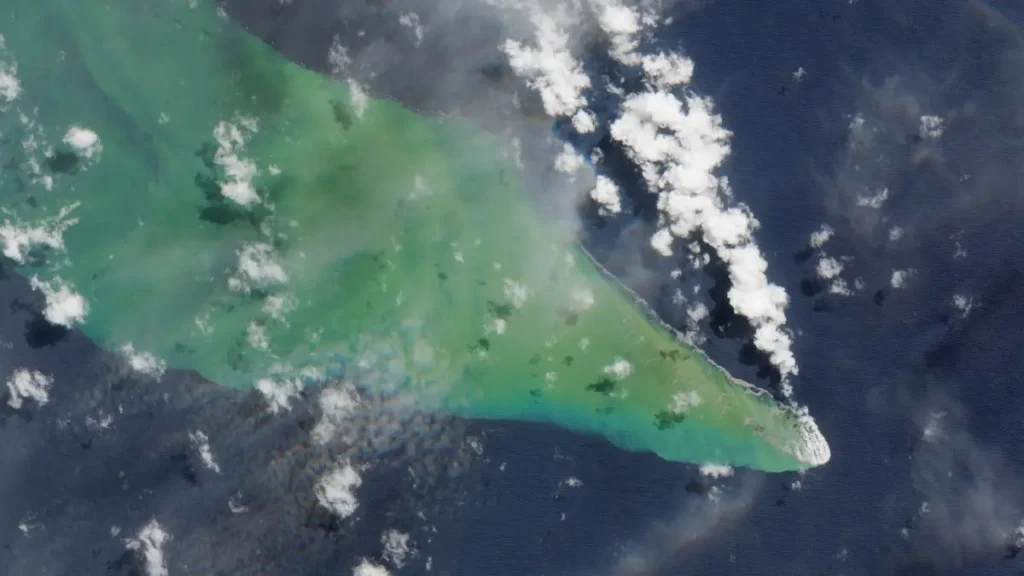
By June 1, a steam plume rose from part of the NE vent area, discolored water drifted as far as 8 km (5 miles) SE, hot pumice floated within a few hundred meters of the vent, and eruption plumes reached as high as 5 km (3.1 miles) above sea level during June 2–4.
Reuters reported on June 10 that thick pumice rafts had blocked boats, damaged fishing grounds, disrupted sea transport to Lorengau, and raised concerns about food shortages among remote coastal communities on Manus Island. Residents described pumice lining parts of the coast 2–3 m (7–10 feet) deep, while Timoenai head teacher Michael Kuam said outboard motors could not be used where pumice had stacked up in some areas.
ABC reported that Baon residents were unable to travel to market, fish, or use normal boat routes to reach health clinics after pumice covered much of the surrounding sea.
Councilor Raymond Simeku told ABC that one boat nearly sank while trying to pass through the pumice, and residents were using drinking water for bathing because they could no longer wash in the sea.
Locals in Papua New Guinea struggled to row their boats on volcanic pumice-laden waters in Manus province after an undersea eruption, fueling fears of food shortages https://t.co/Q2ou045jFm pic.twitter.com/zr2FuznMsp
— Reuters (@Reuters) June 10, 2026
Prime Minister James Marape directed government agencies to assess undersea volcanic activity in waters around Manus after pumice rafts from the ongoing submarine eruption reached Manus shores and disrupted sea travel, The National reported. Marape said he had instructed his chief of staff to write to disaster authorities and relevant agencies for a full report, and urged communities around affected waters to remain vigilant and avoid unnecessary sea travel.
Acting Manus disaster coordinator Otto Obert said pumice had reached villages over the weekend, including Boan village in Lou Island, restricting access to the open sea. Obert said teams were traveling to Lou, Baluan, and Rambutjo to assess impacts, with transport, food supply, and water supply under review.
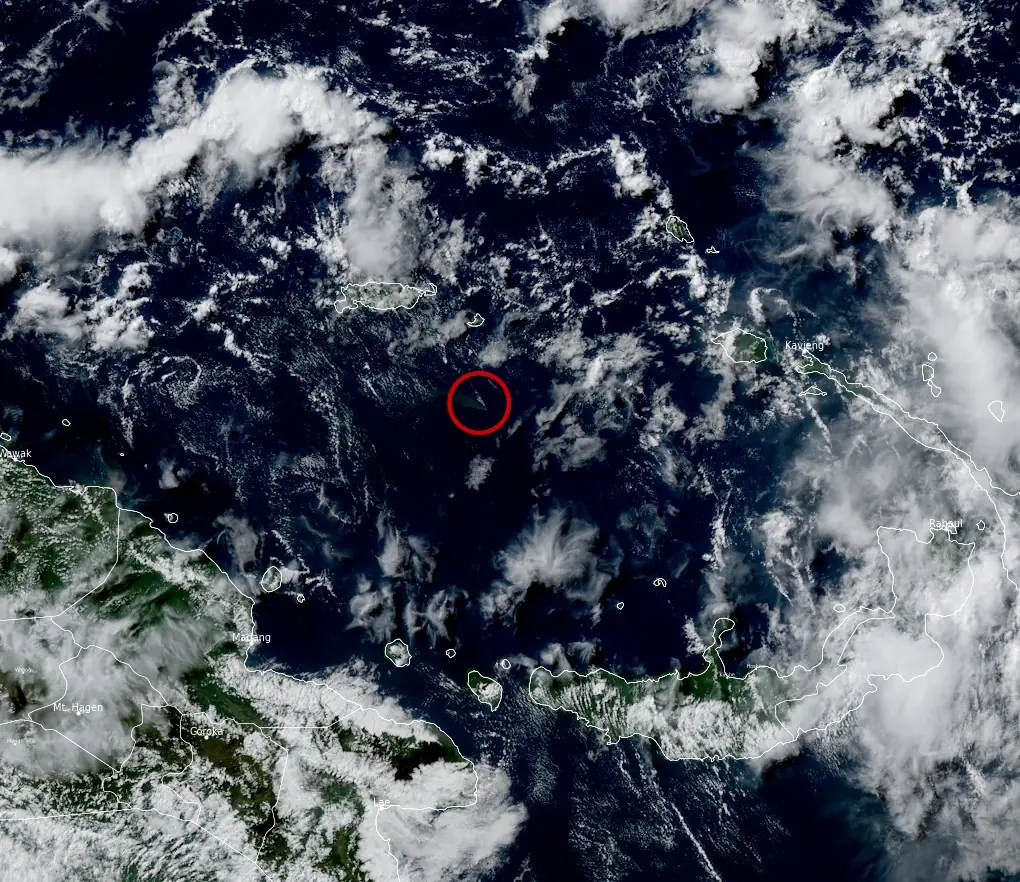
The eruption began at around 01:15 on May 8 in the Central Bismarck Sea, about 82 km (51 miles) S of Rambutyo Island and 125 km (78 miles) SE of Manus Island. This is around 16 km (10 miles) SE of the approximate location of a 1972 submarine eruption, according to RVO.
Gas-and-steam plumes rose as high as 3 km (10 000 feet) above sea level during May 9–12, with discolored water drifting away from the origin point and MODVOLC thermal alerts recorded during the same period.
NASA Earth Observatory said satellites detected signs of the submarine eruption in the Central Bismarck Sea on May 8, in an area where high-resolution seafloor maps were unavailable, and the exact erupting feature, original vent depth, and previous eruption history remained unresolved at the time.
NASA reported that thermal anomalies spanned roughly 7 km2 (2.7 mi2) on May 12 while satellite imagery showed discolored water, steam and ash vents, and expansive pumice rafts forming long bands in surface currents.
The Smithsonian’s Global Volcanism Program (GVP) places Titan Ridge at 3.03°S, 147.78°E, with an elevation of -1 300 m (-4 265 feet), volcano number 250030, and a submarine fissure-vent setting in the Bismarck Sea Volcanic Province. The database records one confirmed earlier eruptive period at Titan Ridge from January 8–12, 1972, based on hydrophonic evidence.
References:
1 Pumice clogs island shores after Papua New Guinea eruption, stoking fears of food shortage – Reuters – June 10, 2026
2 Submarine eruption near Titan Ridge opens new island possibility in the Bismarck Sea, Papua New Guinea – The Watchers – May 28, 2026
3 Rare volcanic ash emission detected from submarine volcano in Central Bismarck Sea, Papua New Guinea – The Watchers – May 13, 2026

I'm a dedicated researcher, journalist, and editor at The Watchers. With over 20 years of experience in the media industry, I specialize in hard science news, focusing on extreme weather, seismic and volcanic activity, space weather, and astronomy, including near-Earth objects and planetary defense strategies. You can reach me at teo /at/ watchers.news.

Thank you for reporting this, also your 1972 hydrophonic record mention.
Locals in the videos captured looking about as one might expect at their situation, visual scale of having them in shot was helpful.
Marine algal bloom and perhaps anoxic under the pumice rafts?
Blašković Island broken the surface yet?