
Tropical volcanic eruptions shift global flood patterns, Princeton study shows
A study published in Nature Geoscience on August 26, 2025, shows that major tropical volcanic eruptions alter global flood patterns, reducing floods in the hemisphere of eruption and increasing them across the equator, depending on stratospheric aerosol distribution.
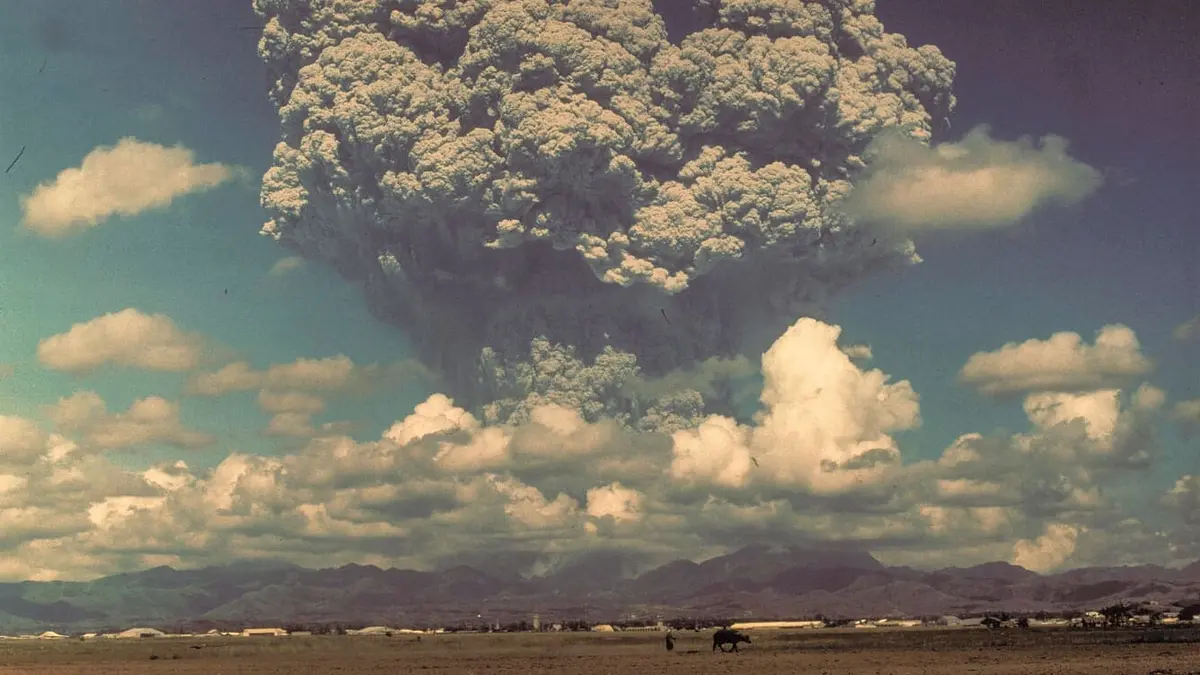
Mount Pinatubo eruption in 1991. Credit: USGS
Researchers at Princeton University used global climate model simulations with volcanic forcing and statistical relationships to analyze responses of seasonal peak discharges from 7 886 stream gauges worldwide to three tropical explosive eruptions: Santa Maria in Guatemala (1902), Agung in Indonesia (1963), and Pinatubo in the Philippines (1991).
Eruptions with aerosol plumes concentrated in a single hemisphere triggered asymmetric flood responses in tropical regions. Flooding decreased in the hemisphere of the eruption and increased in the opposite hemisphere. This interhemispheric contrast was more pronounced in tropical regions than in non-tropical areas.
The shift results from volcanic aerosols altering atmospheric temperature gradients and therefore the position of the Intertropical Convergence Zone (ITCZ), a major tropical rainfall belt.
When aerosol concentration is hemispherically skewed, the ITCZ moves away from the affected hemisphere, reducing rainfall there and enhancing it in the opposite tropics. Villarini said the effects of the increased rainfall are generally strongest in the year after the eruption and lessen after several years.
Data from historical stream gauges confirmed these patterns. Following the Agung eruption in the southern hemisphere, about 50% of southern tropical stream gauges recorded reduced peak flows in the first post-eruption year, while about 40% of northern tropical gauges recorded increased flows.
The Santa María eruption, with aerosols concentrated in the northern hemisphere, was followed by a decrease of about 35% in northern tropical peak flows and an increase of about 25% in southern tropical sites. In addition, higher peak floods were observed in arid and temperate regions of the northern hemisphere, where about 25% of sites recorded increases in the two years after the eruption.
For eruptions like Pinatubo (1991), which spread aerosols more symmetrically across both hemispheres, flood responses differed. Tropical regions in both hemispheres experienced decreased peak discharges, with reductions at about 20% of southern tropical sites and 35% of northern tropical sites.
In contrast, arid regions in both hemispheres saw increases in peak flooding at about 35% of sites. The study attributes this pattern not to ITCZ displacement, but to cooling-driven circulation changes, including monsoon-desert coupling mechanisms that enhance rainfall in dry areas.
References:
1 Global response of floods to tropical explosive volcanic eruptions – Kim et al. – Nature Geoscience – August 26, 2025 – DOI https://doi.org/10.1038/s41561-025-01782-5
2 Tropical volcanic eruptions push rainfall across the equator – Princeton University – August 26, 2025

I’m a science journalist and researcher at The Watchers, contributing to the Epicenter edition, where I cover peer-reviewed scientific research and emerging discoveries across Earth and space sciences. With a background in astronomy and a passion for environmental science, I’ve worked in shark and coral conservation in Fiji, conducting reef and shark-behavior research, contributing to mangrove restoration, and earning PADI Open Water and Coral Reef Certifications. I bring a blend of scientific rigor and storytelling to illuminate the discoveries shaping our planet and beyond.

Commenting rules and guidelines
We value the thoughts and opinions of our readers and welcome healthy discussions on our website. In order to maintain a respectful and positive community, we ask that all commenters follow these rules.