
Research on 2025 M7.7 Mandalay earthquake reveals variable rupture behavior of the Sagaing Fault
A study published on August 11, 2025, in the Proceedings of the National Academy of Sciences analyzes the Mw7.7 Mandalay earthquake of March 28, 2025, revealing that the Sagaing Fault in Myanmar is capable of unusually long supershear ruptures and irregular recurrence patterns.

Building collapsed in Myanmar after M7.7 earthquake on March 28, 2025. Image credit: SmuitHansd
Researchers from the California Institute of Technology and collaborating institutions used remote sensing observations and numerical simulations to investigate the March 2025 Mw7.7 Mandalay earthquake.
Their results indicate that the ~510 km (317 miles) rupture challenges conventional models of fault segmentation and recurrence, demonstrating that even geologically mature strike-slip faults can produce unexpected rupture patterns.
The study, led by Solène L. Antoine and Jean-Philippe Avouac, applied image correlation of satellite optical and radar data to measure surface deformation along the Sagaing Fault after the earthquake.
This method revealed a continuous rupture length of 510 km with uniform slip distribution averaging 3.3 m and no shallow-slip deficit, a feature rarely observed in large continental strike-slip earthquakes.
The earthquake propagated at supershear velocity, exceeding the speed of seismic shear waves. According to the authors, this was likely facilitated by the relatively smooth and mature geometry of the Sagaing Fault, which allowed rupture to spread further than previously expected.
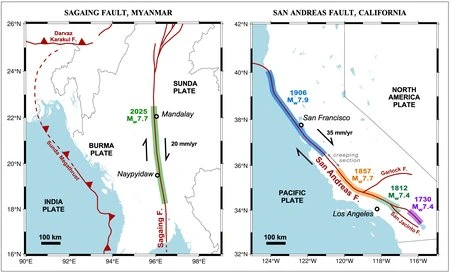
Historically, the segment of the fault that ruptured in 2025 was considered a seismic gap, with the last major rupture occurring in 1839. However, the rupture also extended into adjacent sections that last broke in 1930 and 1946. This observation challenges the segmentation-based view of earthquake recurrence, in which fault sections are thought to rupture independently.
To test long-term fault behavior, the researchers performed quasidynamic earthquake cycle simulations using a simplified nonplanar model of the Sagaing Fault.
These simulations reproduced sequences of earthquakes with irregular segmentation, clustering, and variable magnitudes, including events similar to the 2025 rupture. The results suggest that Mw>7.5 earthquakes occur irregularly with an average recurrence of ~141 years and standard deviation of ~40 years.
The study highlights the limitations of seismic hazard assessments that rely primarily on time-independent statistical models or strict fault segmentation. Instead, the authors propose that physics-based models incorporating stress redistribution and structural fault geometry can provide more accurate, time-dependent hazard forecasts.
The findings are also significant for California’s San Andreas Fault, a structurally similar strike-slip system. The Mandalay earthquake demonstrates that even well-studied faults can rupture in ways that defy expectations, producing longer and more complex earthquakes than previously modeled.
References:
1 Imaging and Modeling of Myanmar Quake Gives Clues about Behavior of the San Andreas – Caltech – August 11, 2025.

I’m a science journalist and researcher at The Watchers, contributing to the Epicenter edition, where I cover peer-reviewed scientific research and emerging discoveries across Earth and space sciences. With a background in astronomy and a passion for environmental science, I’ve worked in shark and coral conservation in Fiji, conducting reef and shark-behavior research, contributing to mangrove restoration, and earning PADI Open Water and Coral Reef Certifications. I bring a blend of scientific rigor and storytelling to illuminate the discoveries shaping our planet and beyond.

Commenting rules and guidelines
We value the thoughts and opinions of our readers and welcome healthy discussions on our website. In order to maintain a respectful and positive community, we ask that all commenters follow these rules.