
New hybrid plasma wave mode observed over Jupiter’s north pole
NASA’s Juno spacecraft has detected a new plasma wave mode in Jupiter’s auroral magnetosphere, where electron plasma frequency is lower than the ion gyrofrequency, an unprecedented condition in space plasma physics. The discovery was made during recent polar passes by Juno and is described in a study published last month by a team led by R. L. Lysak. Researchers propose this wave type, now called the Alfvén0-Langmuir mode emerges in extremely low-density, highly magnetized plasma.
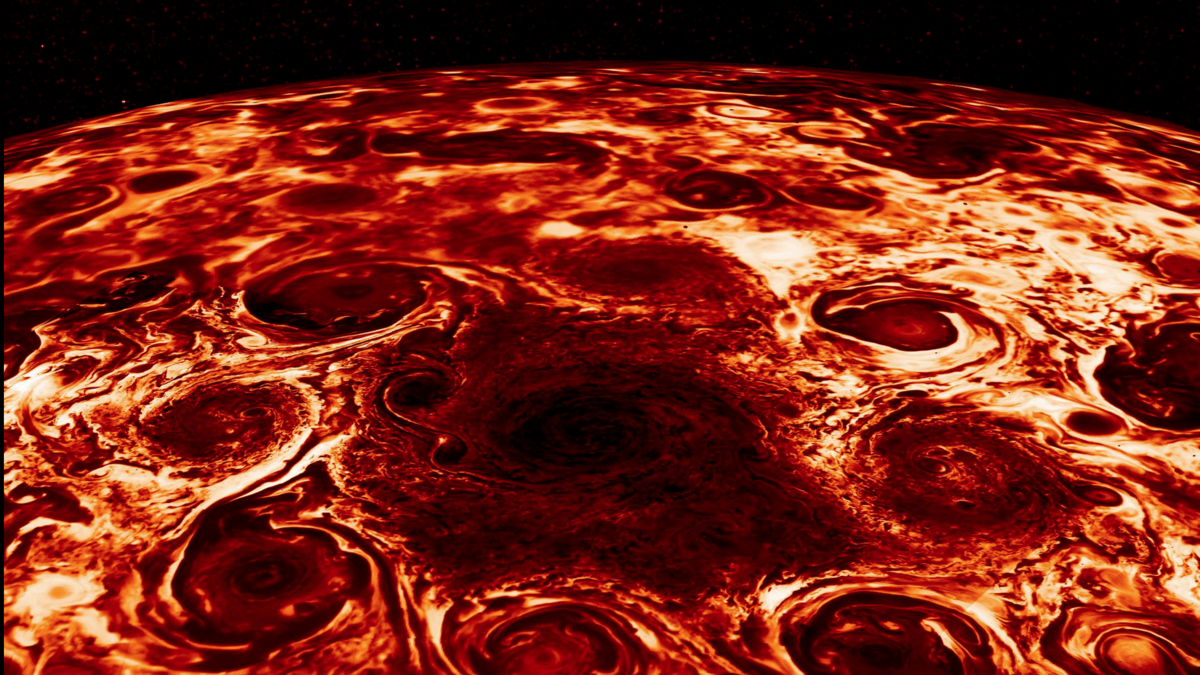
Jupiter's North Pole. Credit: NASA; JPL-Caltech; SwRI; ASI; INAF; JIRAM
NASA’s Juno spacecraft has recorded the first evidence of a new plasma wave mode in Jupiter’s auroral magnetosphere, where extremely low electron densities and strong magnetic fields create conditions not previously documented in space plasma physics.
The newly identified Alfvén-Langmuir mode, described by R. L. Lysak and colleagues in a Physical Review Letters paper published on July 16, emerges in a regime where the electron plasma frequency falls below the ion gyrofrequency. This hybrid wave type displays characteristics of both Alfvén and Langmuir waves.
The detection was made by Juno during close approaches to Jupiter’s north pole, an area now accessible due to the gradual precession of its orbit during the extended mission phase.
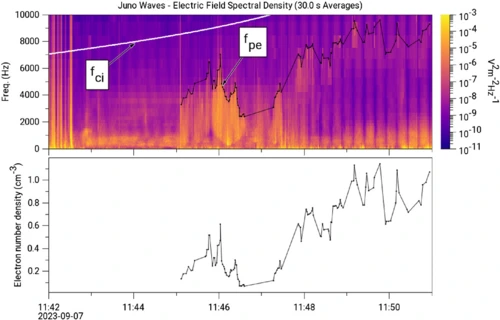
The region, classified as part of Jupiter’s Zone I auroral area, was found to have electron densities as low as 10⁻³ cm⁻³, based on electric and magnetic field measurements collected by Juno’s Waves instrument and corroborated by the JADE particle instrument.
These densities yield plasma frequencies below 1 kHz, significantly lower than the ion gyrofrequency, a situation not previously observed.
According to classical plasma physics, Langmuir waves oscillate parallel to magnetic field lines and operate at frequencies above the electron plasma frequency. Alfvén waves, by contrast, oscillate perpendicular to field lines and are confined to frequencies below the ion gyrofrequency.
In the plasma environment above Jupiter’s north pole, however, the observed Alfvén waves extended only up to the plasma frequency which itself was lower than the ion gyrofrequency, and never exceeded it.
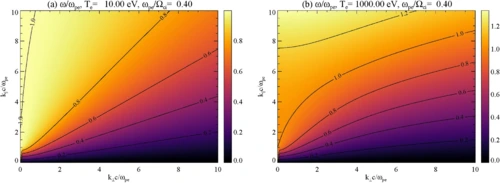
Analysis of Juno’s data using a kinetic low-frequency dispersion solver revealed that Alfvén waves at high perpendicular wave numbers (k⊥) morph into oscillations with characteristics of Langmuir waves.
These waves form resonance cones, in which the wave frequency is determined by the angle between the wave vector and the background magnetic field which is another departure from standard models.
The resulting behavior, referred to as the Alfvén-Langmuir mode, arises specifically in strongly magnetized, low-density plasmas, where traditional assumptions about plasma wave separation no longer hold.
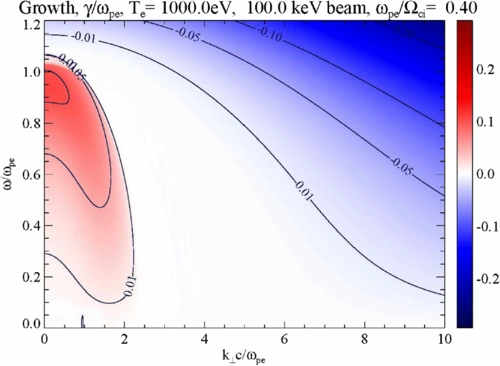
The excitation mechanism is proposed to be upward-propagating electron beams, with energies ranging from 1 keV to 2 MeV, which have been previously detected by Juno during earlier polar encounters.
Jupiter’s magnetosphere, the largest in the solar system, extends up to 7 million km (4.3 million miles) toward the Sun and nearly reaches Saturn’s orbit in the opposite direction.
This expansive and highly magnetized environment makes it a key target for understanding fundamental plasma interactions in planetary systems.
The discovery of this new wave mode redefines known plasma behaviors in Jupiter’s magnetosphere and introduces a new regime of relevance to magnetized stars, pulsars, and exoplanets with intrinsic magnetic fields.
The authors suggest that the Alfvén-Langmuir mode could become a critical factor in modeling magnetospheric and auroral physics in these distant environments.
References:
1 New Plasma Regime in Jupiter’s Auroral Zones – R. L. Lysak, A. H. Sulaiman – Physical Review Letters – https://doi.org/10.1103/fn63-qmb7 – July 16, 2025

I’m a science journalist and researcher at The Watchers, contributing to the Epicenter edition, where I cover peer-reviewed scientific research and emerging discoveries across Earth and space sciences. With a background in astronomy and a passion for environmental science, I’ve worked in shark and coral conservation in Fiji, conducting reef and shark-behavior research, contributing to mangrove restoration, and earning PADI Open Water and Coral Reef Certifications. I bring a blend of scientific rigor and storytelling to illuminate the discoveries shaping our planet and beyond.

Commenting rules and guidelines
We value the thoughts and opinions of our readers and welcome healthy discussions on our website. In order to maintain a respectful and positive community, we ask that all commenters follow these rules.