
Astronomers detect birth of new solar system
For the first time, astronomers have observed the condensation of solid planet-forming material in the protoplanetary disc of the protostar HOPS-315, located in the Orion B molecular cloud, about 1 300 light-years away.

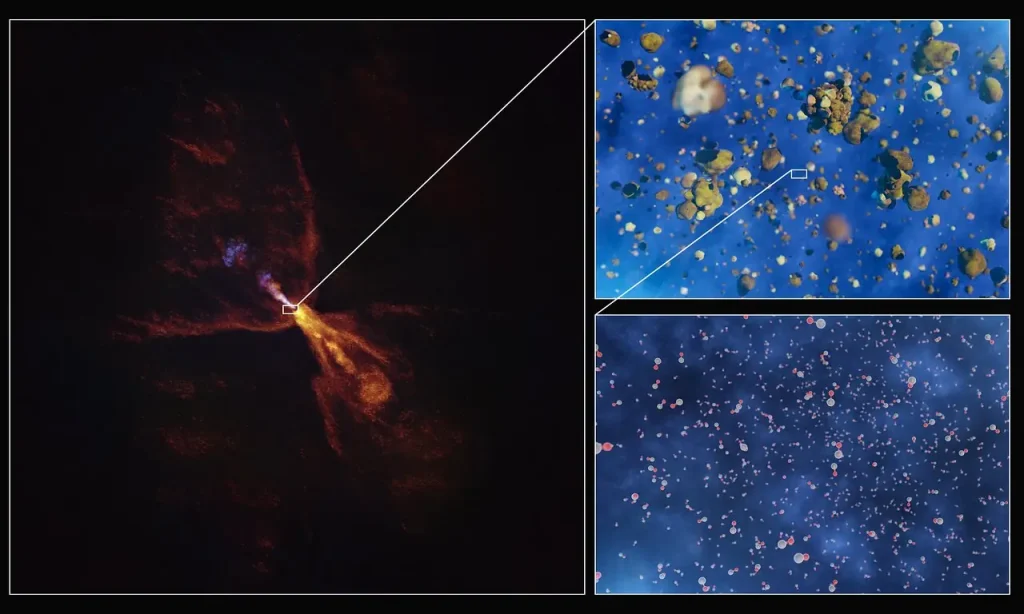
This is HOPS-315, a baby star where astronomers have observed evidence for the earliest stages of planet formation. Credit: ALMA(ESO/NAOJ/NRAO)/M. McClure et al.
The protostar HOPS-315, a Class I object which is 100 000 to 200 000 years old, has become the first known system beyond the Solar System where astronomers have directly witnessed the formation of the earliest solid materials necessary for planetary formation.
Located about 1 300 to 1 370 light-years away in the Orion B molecular cloud, HOPS-315 offers a unique view into processes that likely mirrored the early evolution of our Solar System.
Observations were conducted using the mid-infrared capabilities of JWST’s MIRI and NIRSpec instruments, which identified the spectral signatures of SiO gas and crystalline silicates in the inner region of HOPS-315’s disc.
These crystalline materials, including forsterite and enstatite, condense at temperatures above 1 300°C (2 372°F) and are known from primitive meteorites found in the Solar System.
To pinpoint the spatial origin of these materials, researchers combined JWST spectral data with ALMA’s spatially resolved imaging. ALMA revealed a narrow, jet-like structure of gaseous SiO as well as a wind of carbon monoxide, confirming that the emission originated from a region of the disc comparable in scale to the Solar System’s asteroid belt, approximately 2 to 4 astronomical units from the central protostar.
The detection of hot crystalline silicates within this region marks the onset of the solid-state phase of planet formation, often referred to as “time zero.” In this phase, refractory minerals condense from the gas, forming the building blocks that later aggregate into pebbles, kilometre-scale planetesimals, and eventually planets.
“This process has never been seen before in a protoplanetary disc, or anywhere outside our Solar System,” said Edwin Bergin, a co-author from the University of Michigan. Logan Francis of Leiden University added, “We’re really seeing these minerals at the same location in this extrasolar system as where we see them in asteroids in the Solar System.”
HOPS-315’s developmental stage makes it an ideal analogue to the early Solar System. Its disc mass is likely sufficient to eventually form multiple planets, possibly up to eight. The discovery opens a new observational window into the study of how solid planetary building blocks emerge from high-temperature gas in young systems.
The research, published in Nature on July 16, involved an international team led by Melissa McClure at Leiden Observatory, with contributions from institutions across the Netherlands, the United States, Taiwan, Sweden, and France.
References:
1 Refractory solid condensation detected in an embedded protoplanetary disk – M. K. McClure, Merel van’t Hoff et al. – Nature – July 16, 2025 – https://doi.org/10.1038/s41586-025-09163-z
2 For the first time, astronomers witness the dawn of a new solar system – ESO – July 16, 2025

I’m a science journalist and researcher at The Watchers, contributing to the Epicenter edition, where I cover peer-reviewed scientific research and emerging discoveries across Earth and space sciences. With a background in astronomy and a passion for environmental science, I’ve worked in shark and coral conservation in Fiji, conducting reef and shark-behavior research, contributing to mangrove restoration, and earning PADI Open Water and Coral Reef Certifications. I bring a blend of scientific rigor and storytelling to illuminate the discoveries shaping our planet and beyond.

Commenting rules and guidelines
We value the thoughts and opinions of our readers and welcome healthy discussions on our website. In order to maintain a respectful and positive community, we ask that all commenters follow these rules.