
Study provides comprehensive analysis of space hurricane observed over the North Pole in 2014
A large-scale space hurricane observed over the magnetic North Pole on August 20, 2014, produced strong GPS signal scintillation and localized geomagnetic disturbances under geomagnetically quiet conditions, new research shows.
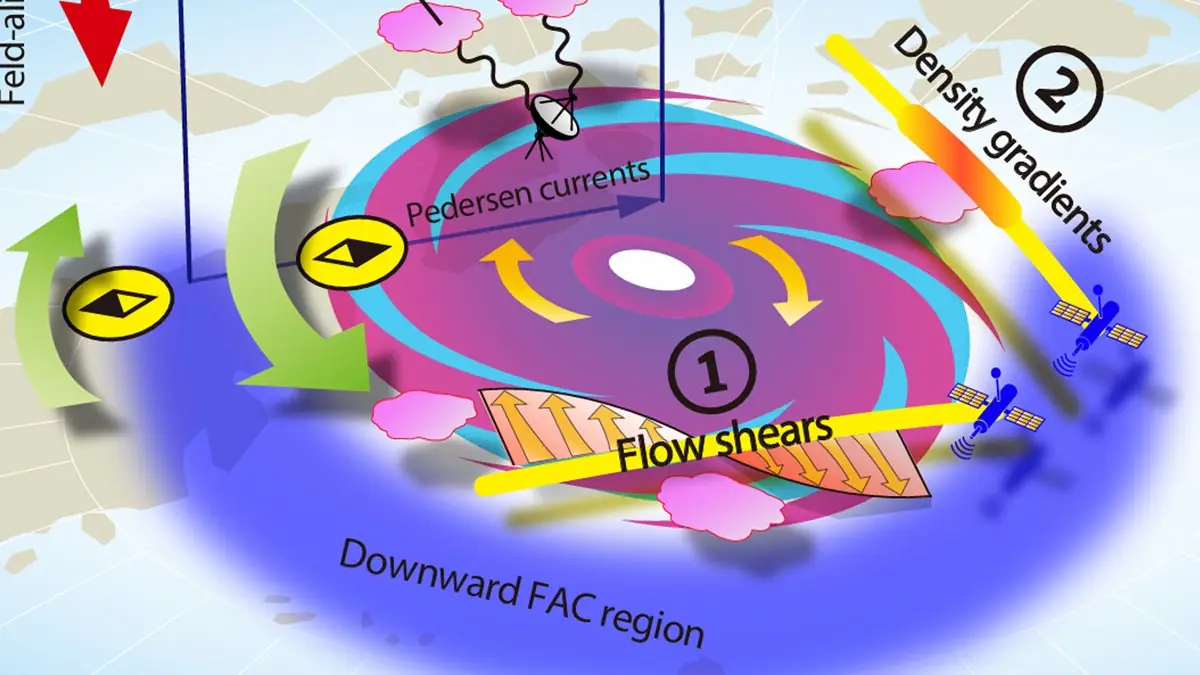
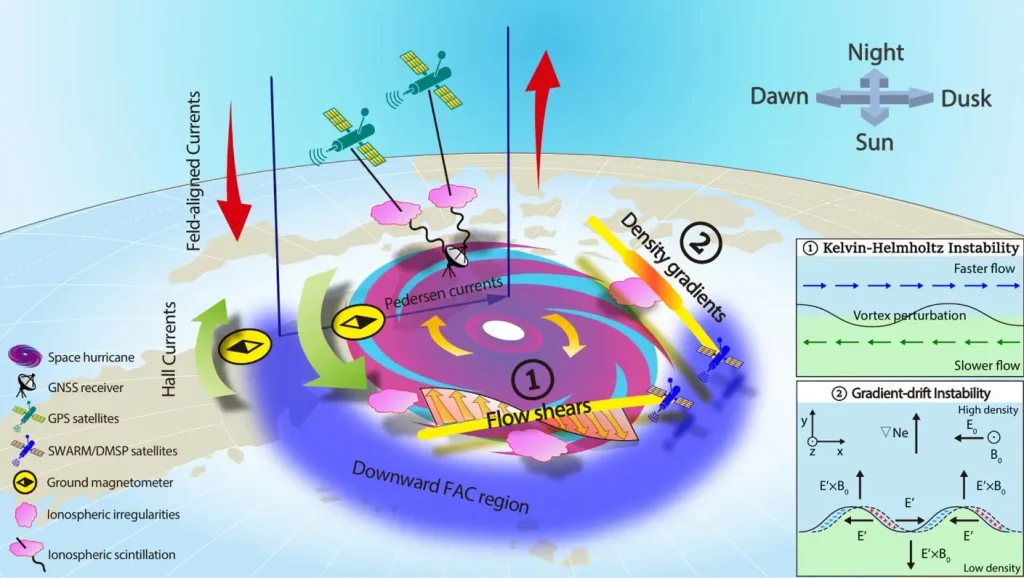
Schematic of the key observational findings and the physical processes associated with 2014 space hurricane event in the northern ionosphere. Credit: AGU/Authors
A new study published in Space Weather on July 12, provides the first comprehensive analysis of the space weather effects of a space hurricane, a cyclone-shaped auroral phenomenon that forms in the polar ionosphere under northward interplanetary magnetic field (IMF) conditions.
The event was detected on August 20, 2014, by the U.S. Defense Meteorological Satellite Program (DMSP) F16 and F17 spacecraft. The structure measured over 1 000 km (620 miles) in diameter, featured multiple spiral arms, and had a calm central “eye.”
It glowed faintly with auroral light and exhibited intense electron precipitation, with an average energy flux of 11.07 erg/cm²/s which are levels comparable to those during geomagnetic superstorms.
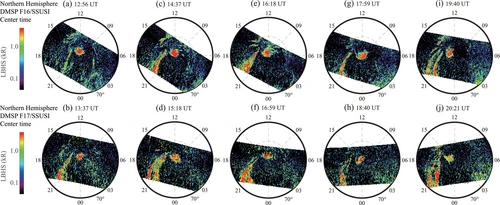
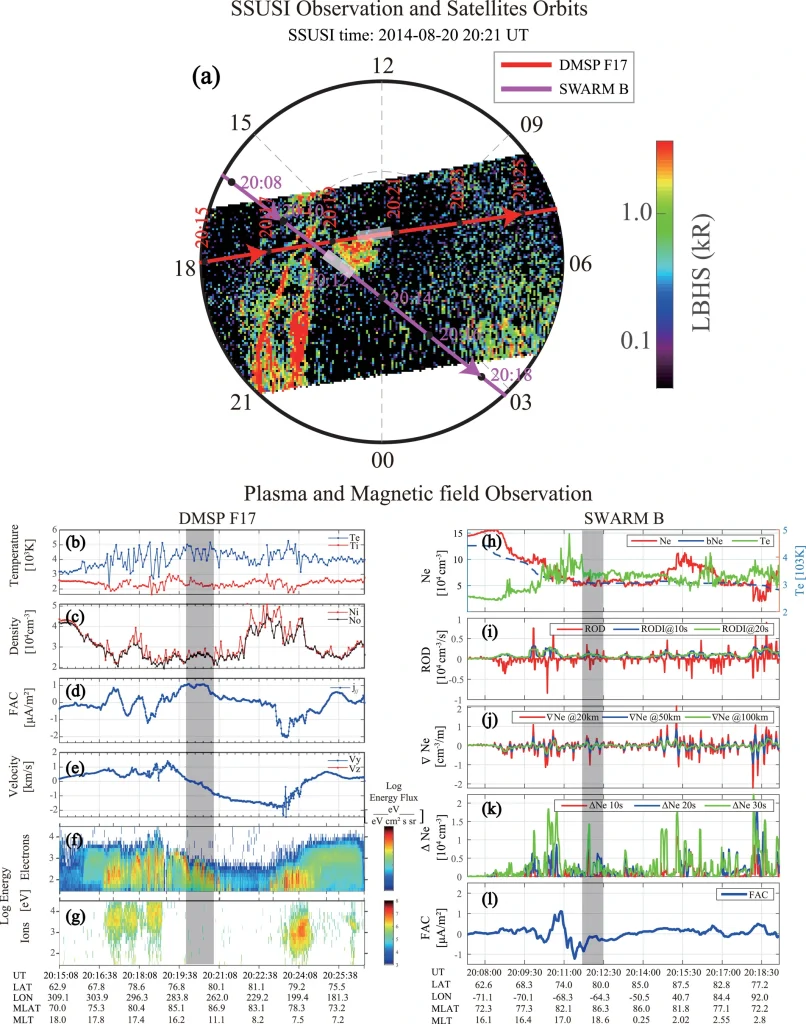
Two satellites passed through the structure within minutes of each other. DMSP F17 crossed directly through the center, while the European Space Agency’s Swarm‑B clipped the outer edge.
Data revealed a dynamic system in the ionosphere, with fast plasma flows, sharp density gradients, and upward field‑aligned currents, resembling the convection engine of a terrestrial hurricane but electromagnetic in nature.
The space hurricane formed during extremely quiet geomagnetic conditions, SYMH ≈ 0 nT, AE < 100 nT and under a northward‑pointing interplanetary magnetic field (IMF) dominated by a positive By component. These conditions typically suppress geomagnetic activity.
Researchers concluded the system was driven by high‑latitude lobe reconnection, a process in which solar wind energy enters the magnetosphere through the polar lobes, bypassing the usual front‑side entry that occurs during southward IMF conditions.
Multi‑instrument observations from the Eureka GNSS receiver, ESA’s Swarm‑B satellite, and DMSP showed steep plasma density gradients and strong plasma flow shears surrounding the storm. These supported the growth of gradient‑drift instability, with a timescale of about 94 seconds, and Kelvin–Helmholtz instability, with a timescale of about 352 seconds.
Both instabilities likely generated small‑scale plasma irregularities responsible for the strong GPS phase scintillation observed. One GPS satellite, PRN 11, recorded a scintillation index of 0.81, sufficient to cause significant degradation in positional accuracy.
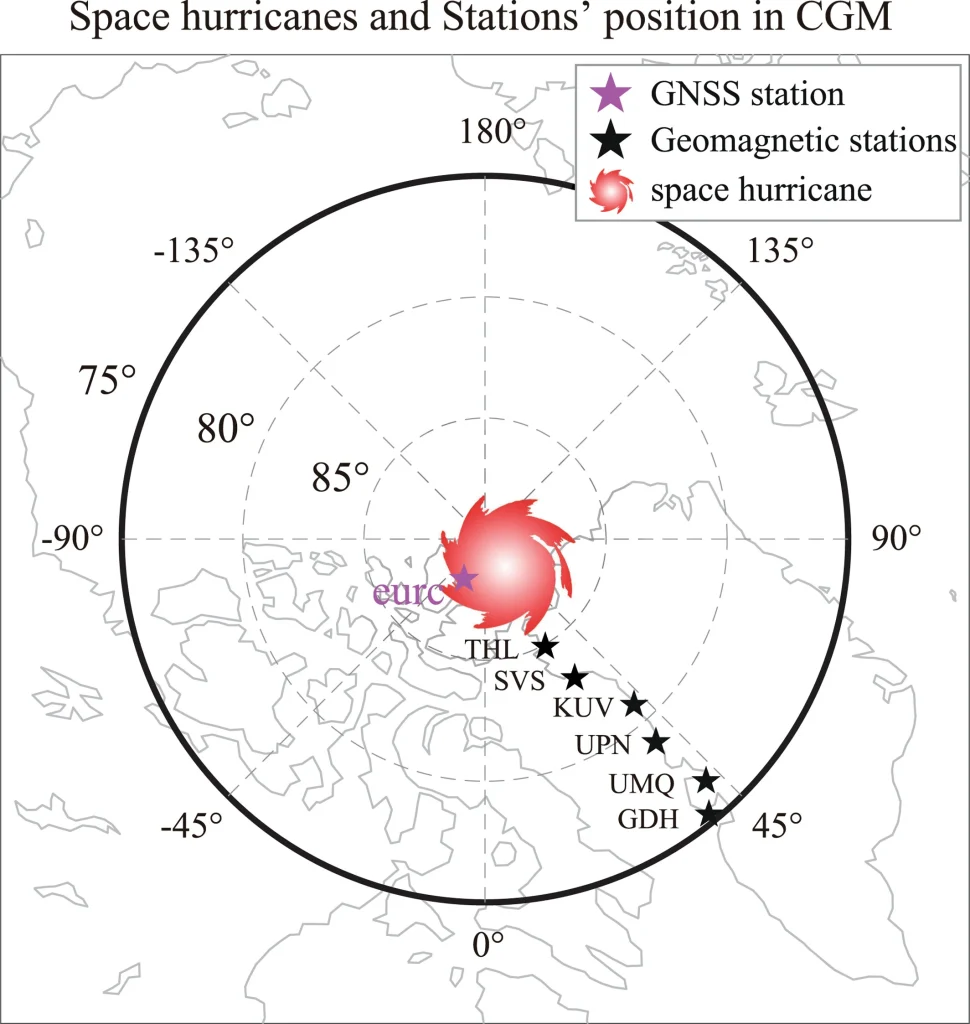
Ground magnetometers in Greenland detected localized geomagnetic disturbances up to 400 nT, comparable to those seen during minor geomagnetic storms. These were likely produced by enhanced Hall currents driven by the storm’s upward field‑aligned currents.
Follow‑up studies have found that space hurricanes can also produce ion temperature increases, Joule heating, and atmospheric gravity waves in the polar thermosphere, potentially affecting satellite drag forecasting and communications in high‑latitude aviation.
Statistical analysis suggests they occur in both hemispheres, with about 10 events recorded per year, most frequently in summer.
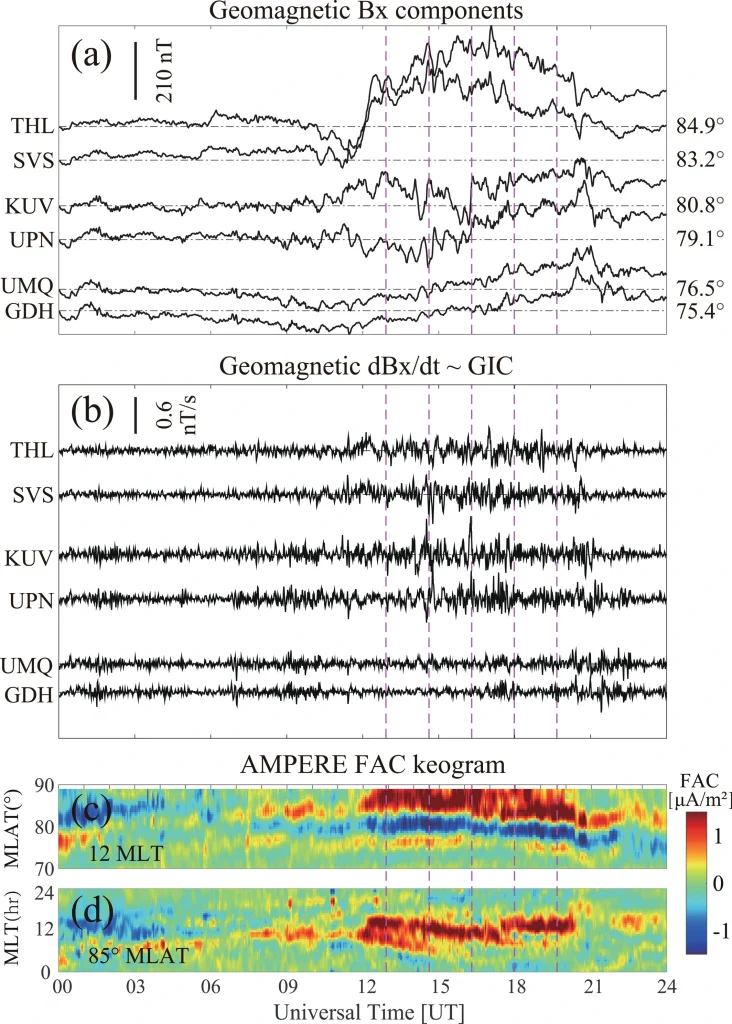
The 2014 event showed that significant ionospheric and geomagnetic effects can occur without the usual solar-storm triggers.
Because standard space weather indices may not detect them, space hurricanes pose an unseen risk to navigation systems, communications, and satellite operations, even during periods of seemingly calm solar activity.
References:
1 Ionospheric Scintillation and Geomagnetic Disturbance Caused by Space Hurricanes – Sheng Lu, Zan-Yang Xing – Space Weather – https://doi.org/10.1029/2025SW004435 – July 12, 2025

I’m a science journalist and researcher at The Watchers, contributing to the Epicenter edition, where I cover peer-reviewed scientific research and emerging discoveries across Earth and space sciences. With a background in astronomy and a passion for environmental science, I’ve worked in shark and coral conservation in Fiji, conducting reef and shark-behavior research, contributing to mangrove restoration, and earning PADI Open Water and Coral Reef Certifications. I bring a blend of scientific rigor and storytelling to illuminate the discoveries shaping our planet and beyond.

Commenting rules and guidelines
We value the thoughts and opinions of our readers and welcome healthy discussions on our website. In order to maintain a respectful and positive community, we ask that all commenters follow these rules.