
Interstellar object 3I/ATLAS shows rapid brightening near perihelion
Interstellar object 3I/ATLAS brightened sharply and appeared bluer as it passed perihelion at 1.36 AU (202 million km / 125 million miles) from the Sun on October 29 2025, according to a new preprint by Qicheng Zhang and Karl Battams, with commentary by astrophysicist Avi Loeb.

Comet 3I/ATLAS seen from Namibia in September 2025. Credit: Gerald Rhemann and Michael Jäger
Interstellar object 3I/ATLAS (C/2025 N1) reached perihelion on October 29, at about 1.36 AU from the Sun. The event made it temporarily invisible from Earth as it entered solar conjunction on October 21, but this same geometry placed it within the fields of view of several space-based solar instruments that continued to record its activity.
A rapid-analysis preprint by Q. Zhang and K. Dattams compiled images from STEREO-A, SOHO, and GOES-19. STEREO-A’s SECCHI suite (HI1 and COR2 cameras) provided wide-field imaging, while SOHO’s LASCO C3 and GOES-19’s Compact CORonagraph (CCOR-1) supplied additional coverage during September and October. The preprint is preliminary and has not yet undergone peer review.
Stacked frames from these instruments show 3I/ATLAS surrounded by an extended glow about 300 000 km (186 400 miles) across in CCOR-1 images. An equivalent stack centred on a nearby star was used as a control to verify the signal. All frames were aligned with north up and annotated with the object’s direction of motion and Sun-facing orientation.
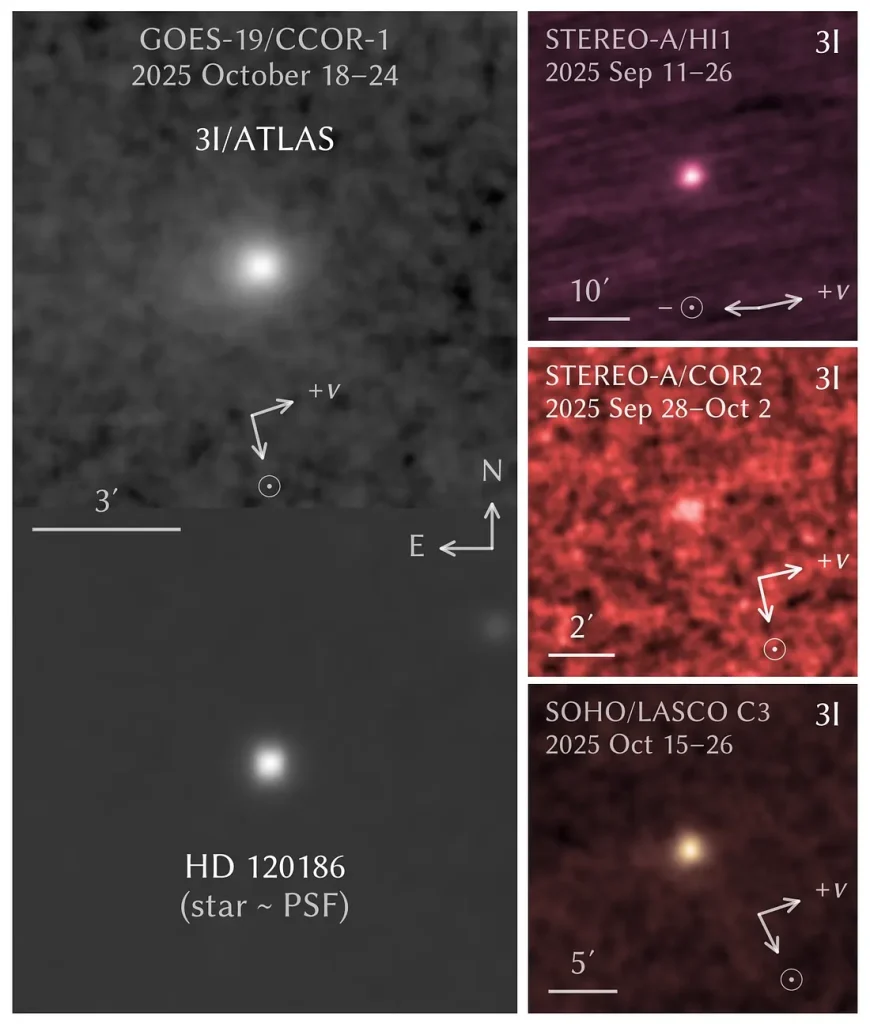
Astrophysicist Avi Loeb commented on the same dataset, writing that “this unfavorable geometry of opposition from Earth — a possible hint of design — placed 3I/ATLAS within the fields of view of several space-based solar coronagraphs and heliospheric imagers.”
Loeb added that the images “reveal rapid brightening and a colour bluer than the Sun,” contrasting with earlier redder ground-based observations. He suggested that emission from gas or dust may dominate the visible light. The phrase “possible hint of design” is Loeb’s interpretation and not part of the scientific analysis.
The coma scale reported by CCOR-1 is close to that seen by the SPHEREx space observatory between August 8 and 12, which detected a plume of carbon dioxide about 348 000 kilometres in radius. SPHEREx data indicated that carbon dioxide was the dominant volatile, while JWST observations on August 6 showed a CO2/H2O ratio near eight to one.
These compositions differ from most Solar System comets, where water vapour usually dominates. Both the SPHEREx and JWST results are mission releases and await formal peer review.
After perihelion, 3I/ATLAS is expected to reappear in the morning sky by mid-November 2025. Its closest approach to Earth will be on December 19 at about 1.8 AU.
Observations with Hubble, JWST, and major ground-based telescopes are planned to measure its brightness and spectrum as it recedes. Researchers expect that it may emerge from perihelion slightly brighter than before.
The authors of the new study write that the reason for 3I/ATLAS’s strong activity, which surpasses that of most Oort-cloud comets at comparable distances, remains unknown. Updated analyses will follow as post-perihelion data become available.
References:
1 3I/ATLAS Rapidly Brightens and Gets Bluer than the Sun Near Perihelion – Avi Loeb – October 30, 2025
2 Rapid Brightening of 3I/ATLAS Ahead of Perihelion – Qicheng Zhang, Karl Battams – Arxiv – October 28, 2025 – https://doi.org/10.48550/arXiv.2510.25035 – OPEN ACCESS

I’m a science journalist and researcher at The Watchers, contributing to the Epicenter edition, where I cover peer-reviewed scientific research and emerging discoveries across Earth and space sciences. With a background in astronomy and a passion for environmental science, I’ve worked in shark and coral conservation in Fiji, conducting reef and shark-behavior research, contributing to mangrove restoration, and earning PADI Open Water and Coral Reef Certifications. I bring a blend of scientific rigor and storytelling to illuminate the discoveries shaping our planet and beyond.

Commenting rules and guidelines
We value the thoughts and opinions of our readers and welcome healthy discussions on our website. In order to maintain a respectful and positive community, we ask that all commenters follow these rules.