
Interstellar comet 3I/ATLAS may be a fragment of a 12-billion-year-old planetary system
The third confirmed interstellar object detected in the Solar System possesses an isotopic composition unlike any known Solar System comet, according to a study published in Nature on June 22, 2026. Observations with the James Webb Space Telescope revealed extreme enrichments in heavy hydrogen and unusual carbon isotope ratios, leading researchers to conclude that 3I/ATLAS likely formed in a cold, metal-poor environment during an early phase of Milky Way evolution, potentially 10 to 12 billion years ago.
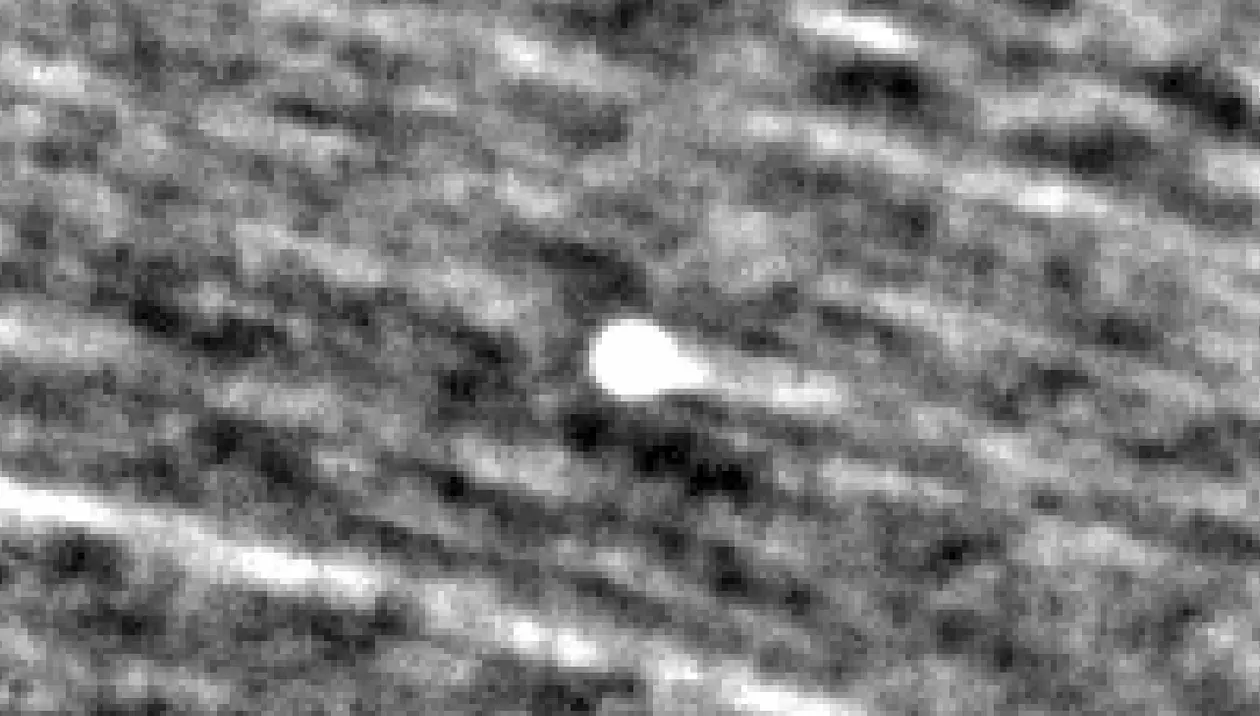
Comet 3I/ATLAS appears as a bright object near the center of this image, made from combining observations from NASA’s PUNCH mission taken from September 20 to October 3, 2025, when the comet was about 231 million to 235 million miles from Earth. Its tail appears as a short elongation to the right. Stars appear as streaks in the background. Credit: NASA/Southwest Research Institute
As interstellar comet 3I/ATLAS moved away from the Sun in December 2025, an international team led by Martin Cordiner of NASA’s Goddard Space Flight Center and the Catholic University of America used the James Webb Space Telescope’s NIRSpec IFU instrument to examine gases released from the comet’s coma. The observations were obtained after Webb’s observing schedule was interrupted to target the object during a brief period when freshly heated ice was actively sublimating.
The measurements revealed a deuterium-to-hydrogen ratio of D/H = (0.98 ± 0.06)%, approximately 30 times higher than values measured in known Solar System comets. According to the authors, such enrichment is consistent with formation in an environment colder than approximately -243°C (-405°F), where heavy-water chemistry can be preserved for billions of years.
Carbon isotopes provided a second indication of the comet’s origin. The measured 12C/13C ratios ranged from 141–191 in CO2 and 123–172 in CO, exceeding values typically observed in Solar System material, nearby molecular clouds, and protoplanetary disks. Because 13C becomes more abundant as successive generations of stars enrich the interstellar medium, the low abundance of carbon-13 in 3I/ATLAS points to formation in a relatively primitive and metal-poor environment.
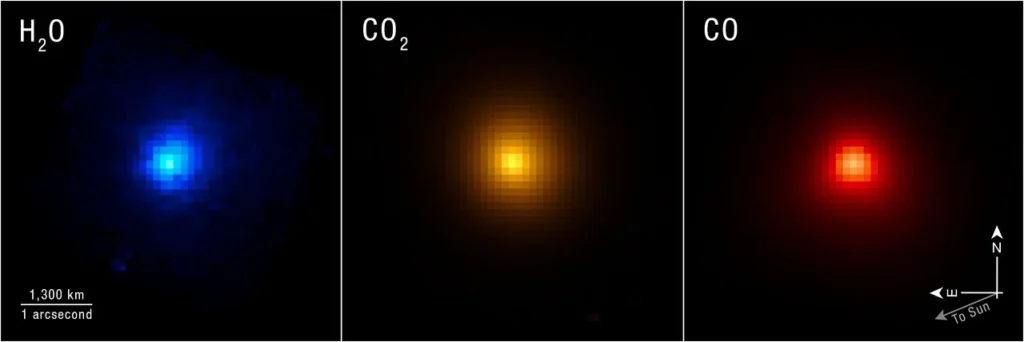
Using Galactic chemical evolution models, the researchers linked the carbon isotope measurements to an origin approximately 10–12 billion years ago, during a period of intense star formation often referred to as cosmic noon. If correct, 3I/ATLAS would represent a preserved remnant of a planetary system that formed billions of years before the Sun.
A complementary study led by Cyrielle Opitom of the University of Edinburgh used the European Southern Observatory’s Very Large Telescope to examine carbon and nitrogen isotopes within cyanide gas in the comet’s coma. Together, the observations provide one of the most detailed isotopic analyses yet obtained from an interstellar object.
Only three confirmed interstellar objects have been identified to date: 1I/’Oumuamua, 2I/Borisov, and 3I/ATLAS. Unlike its predecessors, 3I/ATLAS has yielded isotopic measurements detailed enough to reconstruct aspects of the environment in which it formed, providing a direct chemical record of planetary building blocks from another stellar system.
References:
1 Webb finds clues to ancient, distant origin of Comet 3I/ATLAS – ESA Webb – June 22, 2026
2 Isotopic evidence for a cold and distant origin of 3I/ATLAS – Cordiner, M., Roth, N.X., Micheli, M. et al. – Nature – June 22, 2026 – https://doi.org/10.1038/s41586-026-10771-6

I’m a science journalist and researcher at The Watchers, contributing to the Epicenter edition, where I cover peer-reviewed scientific research and emerging discoveries across Earth and space sciences. With a background in astronomy and a passion for environmental science, I’ve worked in shark and coral conservation in Fiji, conducting reef and shark-behavior research, contributing to mangrove restoration, and earning PADI Open Water and Coral Reef Certifications. I bring a blend of scientific rigor and storytelling to illuminate the discoveries shaping our planet and beyond.

Commenting rules and guidelines
We value the thoughts and opinions of our readers and welcome healthy discussions on our website. In order to maintain a respectful and positive community, we ask that all commenters follow these rules.