
Dangerous heat wave continues into July 4 as record temperatures spread across the eastern U.S.
A dangerous heat wave continued to intensify across much of the central and eastern United States on Friday, July 3, 2026. Numerous daily temperature records have already broken and more are expected through the Fourth of July holiday weekend. The National Weather Service (NWS) warned of widespread Major to Extreme HeatRisk and heat index values reaching 46°C (115°F).
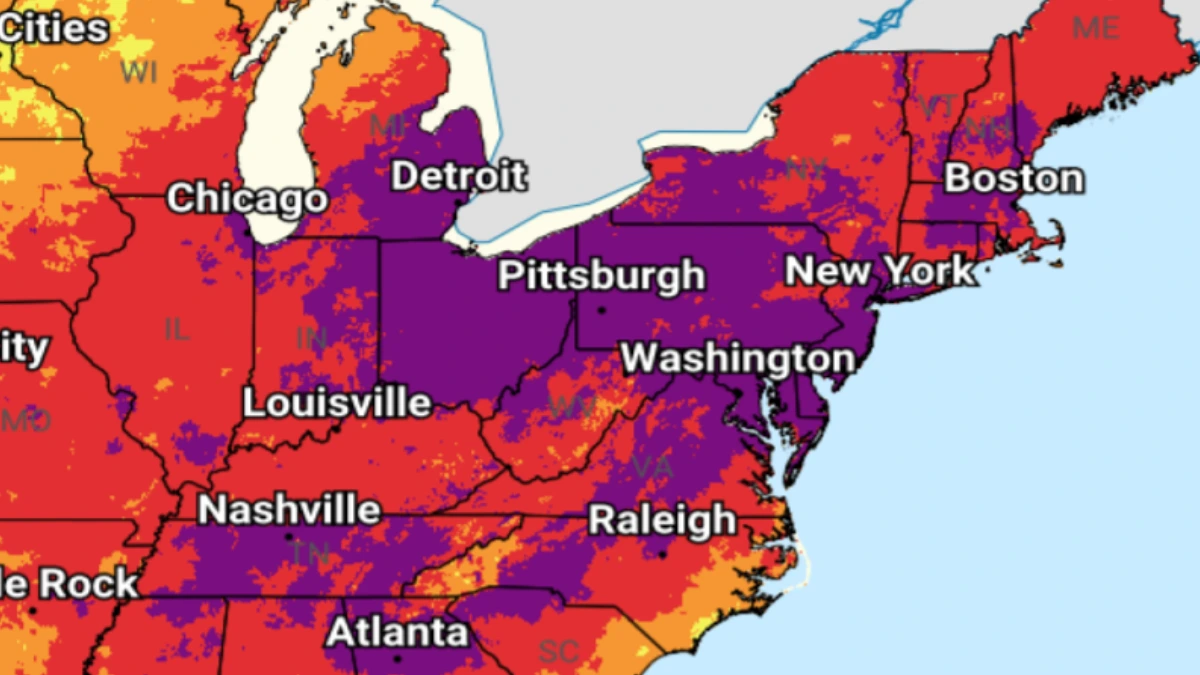
NWS extreme heat risk map for Northeast U.S. on July 4, 2026. Credit: NWS/WPC
A dangerous heat wave continued to intensify across much of the central and eastern United States on Friday, July 3, threatening Fourth of July celebrations as the National Weather Service (NWS) warned that numerous temperature records are likely to be broken during one of the busiest holiday weekends of the year.
Dangerous, record-breaking heat will persist across most of the central and eastern United States through Friday before intensifying over the eastern states during the Independence Day holiday weekend, according to the NWS.
Heat index values could reach 46°C (115°F), producing widespread Major to Extreme HeatRisk conditions from the Midwest to the East Coast. The agency warned that numerous daily temperature records are expected through Saturday, with some locations also facing the possibility of consecutive-day, monthly, and all-time records.
Multiple heat records were broken across the country on Thursday, with Newark setting a new daily high temperature record, reaching 40°C (104°F), breaking the previous daily high temperature record of 38.9°C (102°F) set in 1966.
Philadelphia recorded a high temperature of 39.4°C (103°F), tying the previous daily record set in 1901. Boston set a new daily record, reaching 38.3°C (101°F) on Thursday, surpassing the previous record of 36.7°C (98°F) set in 1963.
New York City’s Central Park reached 37.8°C (100°F), marking the city’s first triple-digit temperature since July 2012.
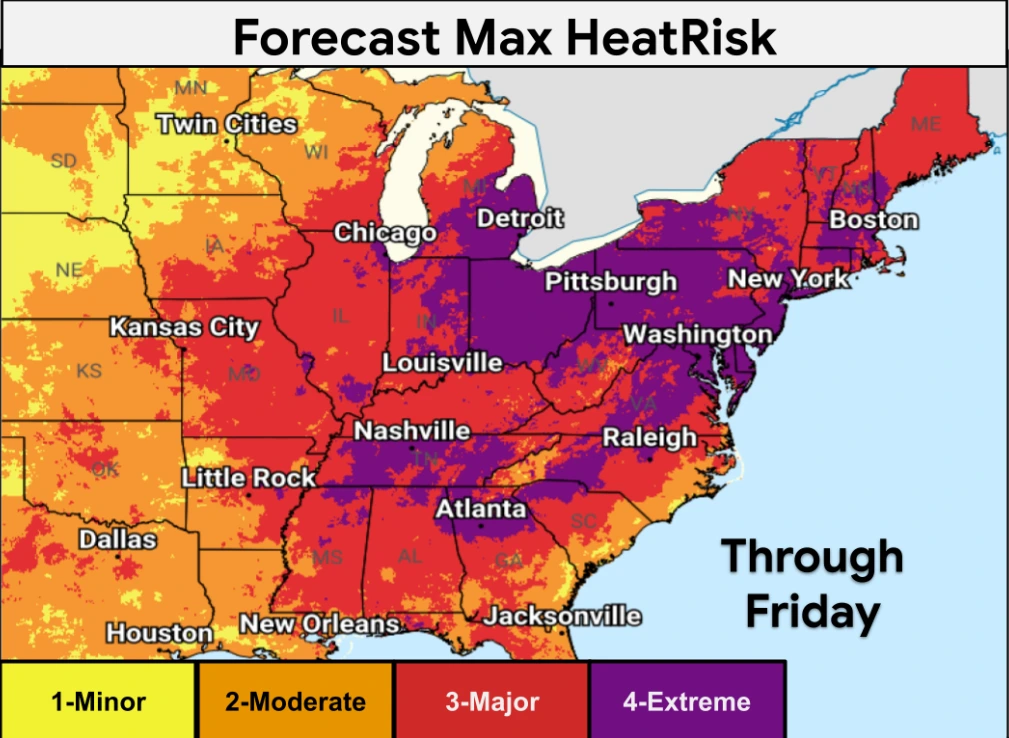
More daily heat records remain possible through the holiday weekend as exceptionally warm overnight temperatures provide little relief, increasing the cumulative impacts of prolonged heat exposure.
The timing of the heat wave coincides with Independence Day celebrations and the nation’s year-long America250 commemorations, prompting governments and event organizers to implement extensive heat safety measures.
Washington, D.C. Mayor Muriel Bowser urged residents and visitors to consider the dangerous conditions when making July 4 plans and to follow weather alerts and public safety guidance.
The National Park Service also advised visitors attending events on the National Mall to stay hydrated, seek shade whenever possible, wear sunscreen, and recognize their physical limits.
In New York City, officials expanded emergency heat operations by opening hundreds of cooling centers and deploying mobile cooling vans staffed by medical personnel to distribute water, sunscreen, and electrolyte supplements while assisting vulnerable residents.
New York Governor Kathy Hochul also urged residents to conserve electricity to help reduce strain on the power grid during periods of peak demand.
The dangerous conditions have already disrupted holiday celebrations in several communities. Philadelphia shortened its Salute to Independence Parade because of the heat, while other municipalities postponed or canceled outdoor events as officials weighed public safety concerns.
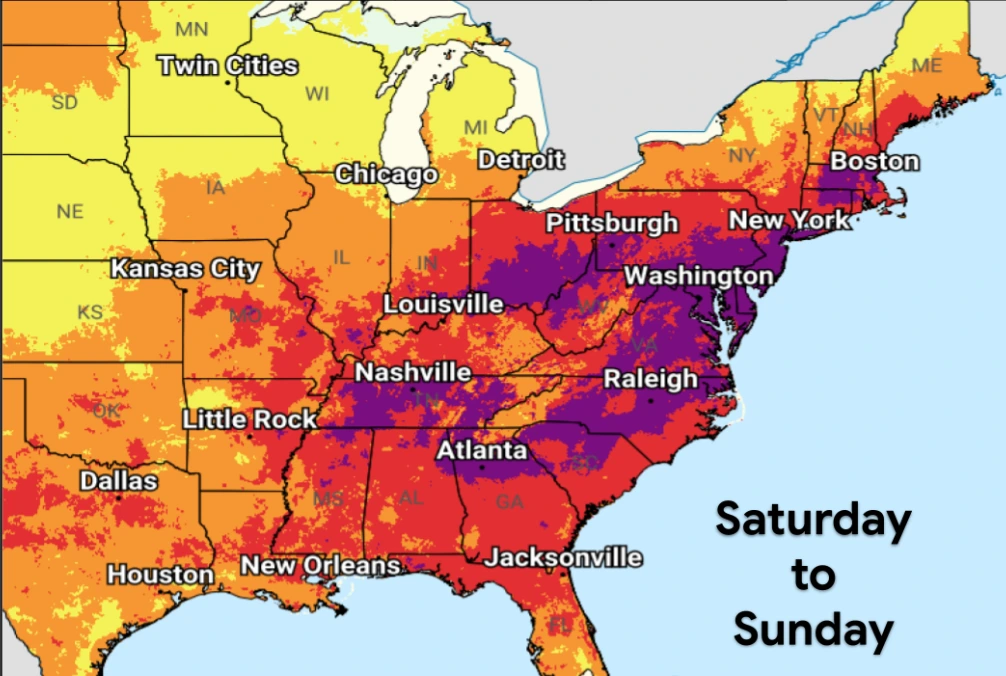
Forecasters expect the heat to remain widespread through Saturday before gradually easing across parts of the Northeast later in the weekend. However, scattered thunderstorms developing along the northern edge of the heat dome could bring locally severe weather to portions of the Mid-Atlantic and Northeast, potentially affecting some outdoor Fourth of July celebrations.
Extreme heat remains the deadliest weather hazard in the United States. According to NWS data, the 10-year average stands at 273 fatalities per year, more than double the average of 114 fatalities attributed to floods, the second-deadliest weather hazard. In 2024 alone, extreme heat claimed 529 lives, compared to 149 fatalities from flooding.
NWS data also show that heat-related fatalities have increased in recent years. The agency recorded 350 heat-related deaths in 2020, while the annual total exceeded 555 deaths in 2023 for the first time since 1999.
The highest annual heat-related death toll on record remains 1 021 fatalities in 1995, the only year in the agency’s records from 1986 through 2024 to exceed 1 000 deaths. More than 700 of those fatalities were attributed to the historic Chicago heat wave between July 12 and 16, 1995.
Authorities continue to urge residents to avoid strenuous outdoor activity during the hottest part of the day and seek relief in air-conditioned buildings or public cooling centers whenever possible.
Authorities have urged residents to avoid activity during the hottest part of the day and use air-conditioned buildings or public cooling centers whenever possible.
References:
1 Key messages for the early July Heatwave – NWS/WPC – July 2, 2026
2 80-year list of severe weather fatalities – NWS – Accessed on July 3, 2026
3Heat records broken from DC to Boston, more to come Friday – CNN – July 3, 2026
4 Extreme heat wave threatens U.S. power grids and July 4 travel – The Guardian – July 3, 2026

I am an Assistant Editor and Severe Weather & Science Journalist at The Watchers, specializing in real-time severe weather coverage, geophysical event reporting, and research-driven scientific analysis. You can reach me at rishav(at)watchers(.)news.

To avoid death by heatwave wildfires fires tornadoes floods tornadoes lightnings strong earthquakes more mag 7 earthquake tsunami volcan meteor non-Muslims to convert to Islam and Muslims to apply the Quran 100% in Us and in Europe immediately July 4,2026.