
At least one dead as Typhoon Halong passes near Izu Islands, Japan
At least one person was reported dead as Typhoon Halong passed near Japan’s Izu Islands on Thursday, October 9, 2025. The typhoon brought record-breaking rainfall and strong winds across the islands, prompting multiple alerts from authorities.
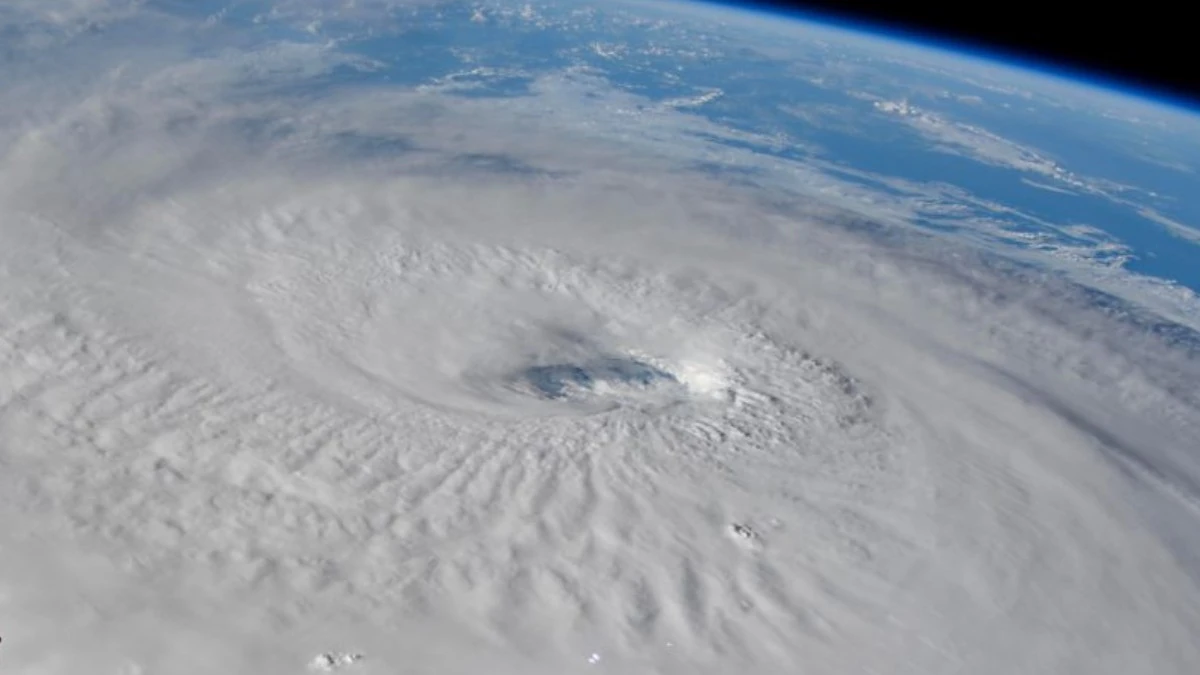
Typhoon Halong seen from ISS on October 9, 2025. Credit: ISS, Astronaut Yui Kimiya
Typhoon Halong brought heavy rain and strong winds on Thursday as it passed near Japan’s Izu Islands. Peak wind speeds of 197 km/h (122 mph) were recorded at 05:24 JST on Thursday (20:24 UTC on Wednesday).
The islands experienced record-breaking downpours, with 92 mm (3.6 inches) of rain falling in the hour before 06:00 local time.
By 07:20 LT, Hachijojima Island had received 284.5 mm (11.2 inches) of rainfall within six hours — the highest six-hour total on record for the region since records began in 2003, according to NHK.
Halong also broke the 12-hour rainfall record after totals reached 349 mm (13.74 inches) by 10:30 LT on Hachijojima Island.
Areas around Hachijo Town were estimated to have received more than 120 mm (4.7 inches) of rain in the hour through 05:30 LT, and about 100 mm (3.9 inches) in the hour through 07:00 LT.
経過。当然寝れないので定点観測を続けます
— れいな@八丈 (@Reina_8jo) October 8, 2025
え、、最後らへんで発火してない? pic.twitter.com/vCM6ka6JOx
Local police reported that three men who were fishing in Oiso, Kanagawa Prefecture, facing the Pacific Ocean, were swept away by waves, leaving one dead. Local authorities said advisories for high waves and strong winds had been issued for the town at the time.
The Japan Meteorological Agency (JMA) warned citizens of waves up to 10 meters (33 feet) along the coastal areas.
The JMA initially issued its highest-level emergency alert for Hachijojima due to heavy rain from the powerful storm and urged residents to evacuate immediately. However, the warning was downgraded at 14:30 LT on Thursday after the rain had passed.
 Typhoon Halong seen from space on October 9, 2025. Credit: Astronaut Yui Kimiya
- Typhoon Halong seen from space on October 9, 2025. Credit: Astronaut Yui Kimiya
- Typhoon Halong seen from space on October 9, 2025. Credit: Astronaut Yui Kimiya
- Eye of typhoon Halong as seen from space. Credit: Astronaut Yui Kimiya


As of 09:00 UTC (18:00 JST) on Thursday, October 9, Typhoon Halong was centered about 404 km (251 miles) east-southeast of Yokosuka, Japan. Maximum sustained winds (averaged over 1-minute) reached 175 km/h (109 mph), with significant wave heights around 14 m (45 feet).
The typhoon was moving east-northeast at 41 km/h (25 mph), while rounding the northwestern periphery of a subtropical ridge centered to its southeast.
Halong is forecast to continue heading east-northeast along the north side of the ridge, moving into cooler waters and interacting with a 200 mb jet streak to the north.

The system’s core is forecast to stay well east of Japan, but outer bands and rough seas have already affected the Pacific coast of Honshu.
According to the JTWC, Halong will cross the 26°C (79°F) isotherm around 21:00 JST (12:00 UTC) on October 9 and complete extratropical transition by 18:00 JST (09:00 UTC) on October 10,with maximum winds near 100 km/h (62 mph).
ECMWF and GFS ensemble guidance agree on this timing and show the remnant low fully embedded in the mid-latitude westerlies.
Deterministic and ensemble track models remain in tight agreement through 36 hours, and both track and intensity forecasts carry high confidence.
As Halong moves into the central North Pacific by the morning of October 10 (JST), it will be embedded within the mid-latitude jet stream and produce strong winds north of its center during transition. No further direct impacts on Japan are expected after its departure from the region.

I am an Assistant Editor and Severe Weather & Science Journalist at The Watchers, specializing in real-time severe weather coverage, geophysical event reporting, and research-driven scientific analysis. You can reach me at rishav(at)watchers(.)news.

Commenting rules and guidelines
We value the thoughts and opinions of our readers and welcome healthy discussions on our website. In order to maintain a respectful and positive community, we ask that all commenters follow these rules.