
Severe floods destroy nearly 10 000 homes, kill 22 in southern Chad
Flooding in southern Chad has killed 22 people and affected approximately 123 000 across 549 villages in Mandoul and Moyen-Chari provinces, according to the United Nations Office for the Coordination of Humanitarian Affairs (UN OCHA) on October 8, 2025. The floods destroyed more than 9 800 houses, injured 19 people, and displaced around 720 residents as heavy rains continued across the region.
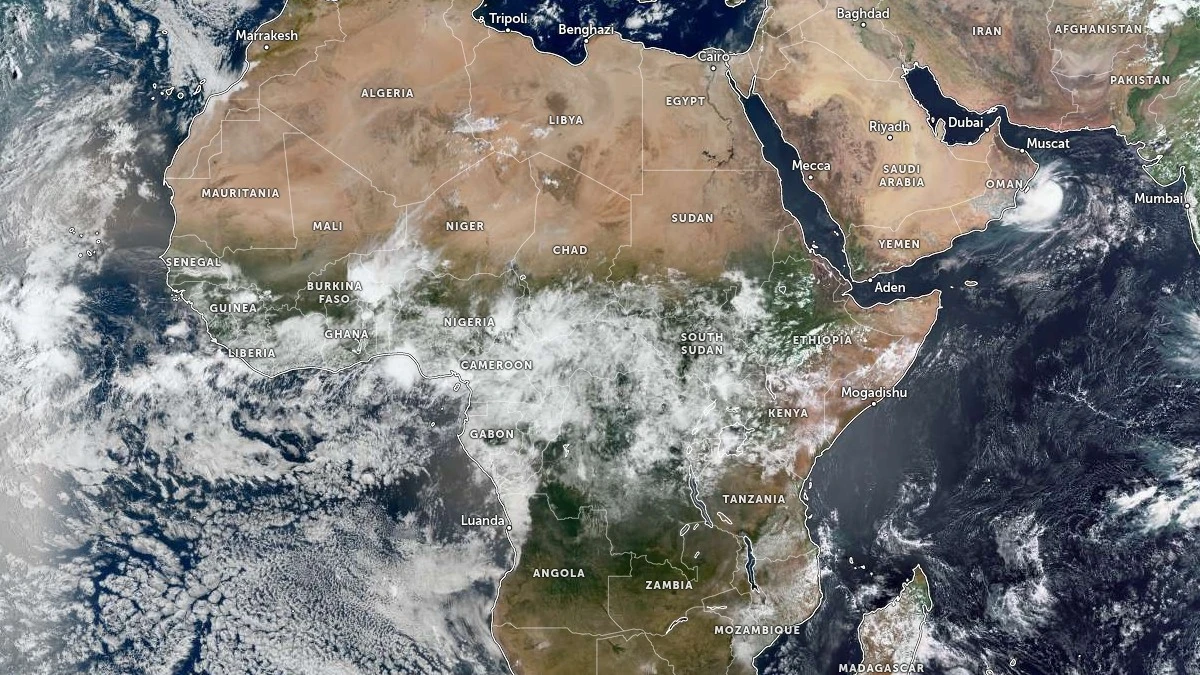
Satellite image acquired at 09:30 UTC on October 5, 2025. Credit: EUMETSAT/Meteosat, Zoom Earth, The Watchers
Heavy rainfall during late September and early October 2025 triggered extensive flooding across southern Chad, primarily in Mandoul and Moyen-Chari provinces.
According to the United Nations Office for the Coordination of Humanitarian Affairs (UN OCHA), as of October 8, at least 22 people have died and 19 others were injured. The floods have displaced approximately 720 residents, destroyed more than 9 800 houses, and affected around 123 000 people in 549 villages.
UN OCHA reported that the majority of damage occurred in low-lying rural communities where seasonal rivers overflowed after persistent rainfall. Local authorities, supported by humanitarian partners, are conducting impact assessments and delivering emergency assistance, including shelter materials and food supplies, to affected households.
Floodwaters have damaged roads and farmland, isolating several villages in Mandoul Province.
Regional authorities warned that continued rainfall may further hinder access to remote communities and delay aid delivery.
Data from Météo Tchad indicate that southern Chad has experienced above-average rainfall since mid-September, consistent with broader late-season precipitation anomalies observed across the Sahel region. Although flooding is recurrent during this period, this year’s impacts are among the most severe recorded in recent seasons.
UN OCHA stated that coordination with the Chadian Red Cross and local disaster committees is ongoing to identify additional needs and ensure the delivery of essential relief items.
The floods in southern Chad are part of a wider regional pattern of intense late-season rainfall and river overflow affecting large areas of West and East Africa. Flooding continues across wide stretches of the continent, from the Atlantic coast to the Horn of Africa, as persistent heavy rainfall sustains swollen rivers and saturated ground conditions.
In western coastal regions, heavy rains have caused flooding in Liberia, Sierra Leone, Guinea-Bissau, Guinea-Conakry, northwestern Côte d’Ivoire, The Gambia, Senegal, and southwestern Mauritania.
Moderate to heavy precipitation remains forecast for the western Gulf of Guinea, maintaining elevated flood potential in low-lying areas. In South Sudan, floodwaters continue to expand through the Sudd wetlands, particularly across the Sobet–Akobo–Pibor catchment, where extensive standing water and saturated soils have been observed.
Heavy rainfall has also triggered widespread flooding across Nigeria’s Bauchi, Plateau, and Niger states, extending into southern Niger, northern Burkina Faso, central and southeastern Mali, and along the Niger River basin.
Flooding caused by sustained rainfall persists along the Logone and Chari Rivers in Chad and continues to spread downstream into northern Cameroon, while Nigeria’s four major river systems remain above flood stage.
Across the Horn of Africa, heavy rainfall continues to maintain high flood risks throughout central and northern Ethiopia, Eritrea, and Djibouti. Flooding also persists along the Blue Nile in Sudan and has been reported in northeastern Ghana, northern Togo and Benin, southwestern and central Sudan, and northern South Kivu Province in eastern Democratic Republic of the Congo.
In contrast, below-average rainfall since late May has led to dryness in southeastern Mali and parts of Liberia, while poor rainfall since mid-April has maintained dry conditions across southwestern South Sudan, northeastern Democratic Republic of the Congo, and northwestern Uganda.

I'm a dedicated researcher, journalist, and editor at The Watchers. With over 20 years of experience in the media industry, I specialize in hard science news, focusing on extreme weather, seismic and volcanic activity, space weather, and astronomy, including near-Earth objects and planetary defense strategies. You can reach me at teo /at/ watchers.news.

Commenting rules and guidelines
We value the thoughts and opinions of our readers and welcome healthy discussions on our website. In order to maintain a respectful and positive community, we ask that all commenters follow these rules.