
State of Emergency declared after extreme rainfall floods Stonewall, Manitoba
The Town of Stonewall, Manitoba, declared a State of Emergency on June 11, 2026, after approximately 255 mm (10 inches) of rain fell over a seven-hour period on June 9, causing widespread flooding.
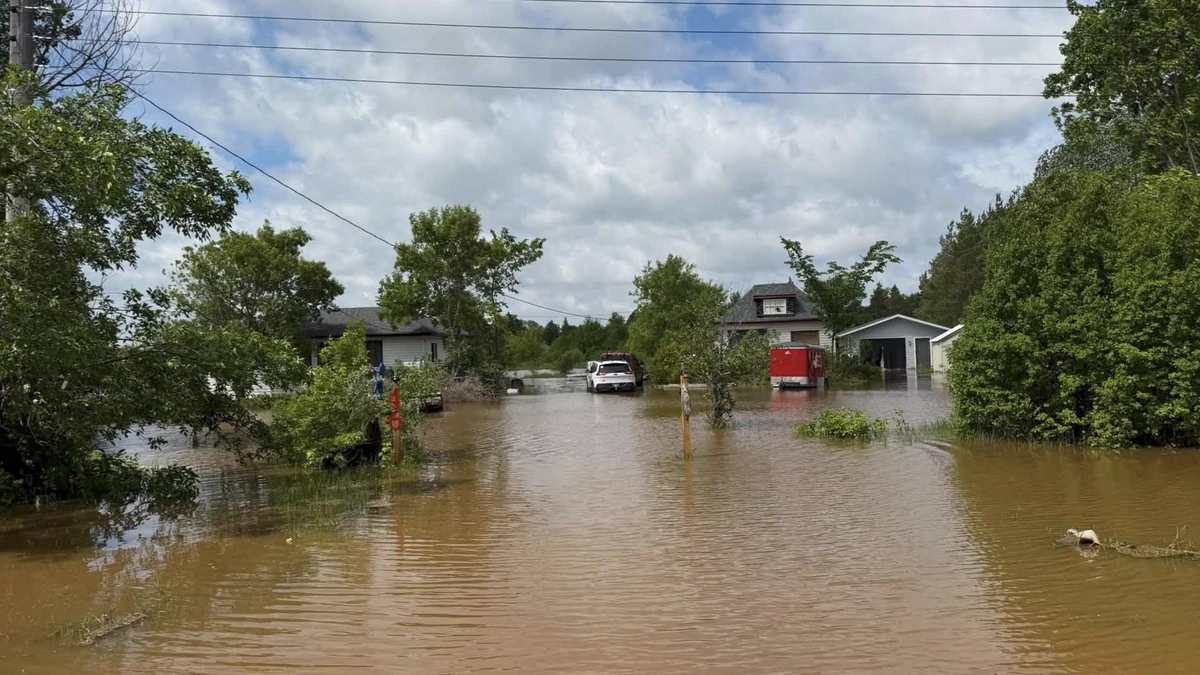
Flooding in Manitoba on June 11, 2026. Credit: Derek Johnson
The Town of Stonewall Council declared a State of Emergency on June 11 after heavy rain caused widespread flooding throughout the community on June 9.
Stonewall received 255 mm (10 inches) of rain by 09:30 local time (LT) on June 10 through observations submitted to the Community Collaborative Rain, Hail and Snow Network (CoCoRaHS), a volunteer monitoring network from which Environment and Climate Change Canada gathers precipitation reports.
Nearby Petersfield received 229 mm (9 inches) and Clandeboye 220 mm (8.7 inches), while more than 121 mm (4.8 inches) fell in Woodlands. Winnipeg recorded 122 mm (4.8 inches) of rainfall at The Forks.

Municipal officials said the volume and intensity of rainfall exceeded the capacity of local drainage systems and created conditions that threatened public safety, property, and critical infrastructure.
Residents were advised to delay laundry, limit dishwasher use, take shorter showers, and ensure sump pumps were not connected to sanitary sewer lines.
Access roads serving the town’s lagoon facilities were significantly damaged, along with the entrance to Quarry Park, forcing the closure of both the entrance and the park itself for public safety reasons.
The State of Emergency enables the municipality to implement emergency measures, support response and recovery operations, regulate access and travel where necessary, and seek available emergency resources and assistance under Manitoba’s Emergency Measures Act.

The flooding occurred during a broader severe-weather outbreak across southern Manitoba that brought extreme rainfall, damaging winds, large hail, power outages, and at least one confirmed tornado.
The storm system also produced wind gusts reaching 130 km/h (81 mph) near Deloraine, with gusts exceeding 100 km/h (62 mph) reported elsewhere across southern Manitoba. Brandon recorded a peak gust of 100 km/h (62 mph), while Winnipeg reached 94 km/h (58 mph).

Manitoba Hydro reported approximately 1 000 separate outages across southern Manitoba. More than 25 000 customers remained without power as of noon on June 10, including about 17 000 customers in Winnipeg. The utility described the event as one of the worst summer storm events in recent memory.
Environment Canada confirmed a tornado near Ste. Anne, southeast of Winnipeg, and was investigating additional possible tornadoes elsewhere in the region.
Read more:
References:
1 State of Local Emergency Declared – Stonewall Town Council – Jun 11, 2026
2 Southern Manitoba drenched in wild night of stormy weather, possible tornadoes – CBC – June 10, 2026

Rishav Kothari is Editor-in-Chief of The Watchers, where he runs the newsroom and covers earthquakes, volcanoes, severe weather and space weather.
Published in the last 24 hours
- In 1943, a flight instructor in Texas flew a two-seat training plane into the eye of a hurricane because he was curious, then landed and took the base weatherman up for a second pass Epicenter
- A soy sauce maker used fire to guide villagers through Japan’s 1854 tsunami, then funded a seawall that protected most of Hiro in 1946 Epicenter
- In 2013 a landslide fell onto Svínafellsjökull in southeast Iceland, leaving thicker ice at the foot of the slope; that ice is now moving away and the mountainside has shifted 1 to 3 cm. Epicenter
- Kīlauea's north vent threw lava about 660 feet (200 m) high for six hours on 5 November 2026; the summit is now reinflating, with the next episode forecast for 16 to 21 November. Epicenter
