
Atmospheric rivers disrupt ENSO-based precipitation forecasts in the southwestern U.S.
A recent study from UC San Diego’s Scripps Institution of Oceanography found that atmospheric rivers were responsible for 70% of years when precipitation deviated from ENSO-based expectations.

Satellite image atmospheric river January 30, 2025 at 19:40 UTC. Credit: NOAA/GOES-West, RAMMB/CIRA, The Watchers
- The study found that ARs significantly influence precipitation patterns in the southwestern United States, often deviating from the expected effects of El Niño and La Niña events.
- In some years, ARs were responsible for up to 65% of Northern California’s annual precipitation and 40% in Southern California.
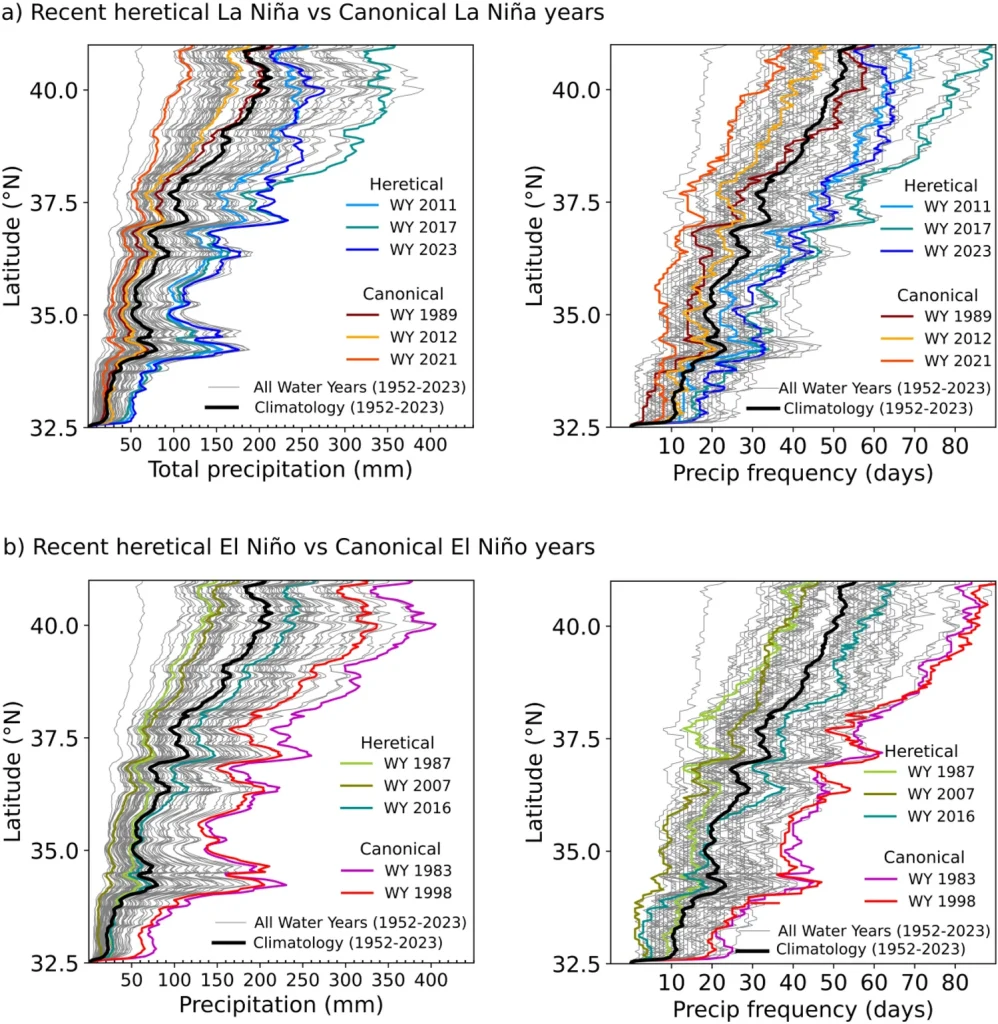
- While ENSO events traditionally indicate wet conditions during El Niño and dry conditions during La Niña, ARs can disrupt these expectations, as seen in 2023 when California had its 10th wettest year despite being in a La Niña phase.
A new study has challenged the traditional reliance on seasonal El Niño-Southern Oscillation (ENSO) patterns for predicting precipitation in the southwestern United States.
The research analyzed discrepancies between expected and recorded precipitation patterns in the southwestern United States. ENSO events typically result in wetter conditions during El Niño and drier conditions during La Niña. However, 2023—a La Niña year—ranked as California’s 10th wettest year on record.
Atmospheric rivers (ARs) are transient jets of water vapor that transport moisture from the tropics to higher latitudes. On average, an AR carries more than twice the water flow of the Amazon River, the largest river in the world.
When ARs reach a mountainous coastline, they produce heavy orographic precipitation in the form of rainfall and high-elevation snow.
According to the study, ARs accounted for 70% of anomalous years—periods when precipitation did not align with ENSO expectations—and, in some years, contributed up to 65% of annual precipitation in Northern California and 40% in Southern California.
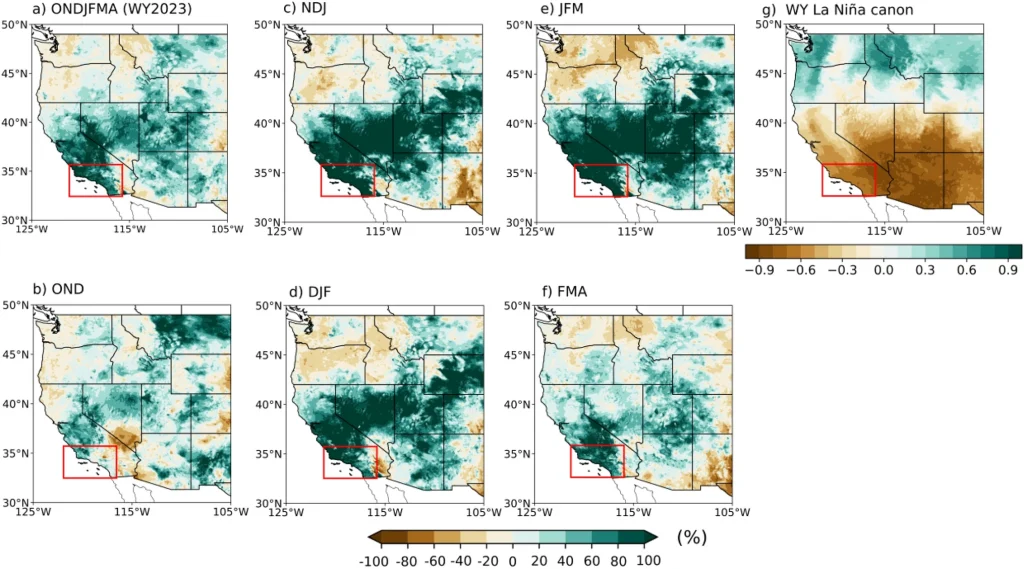
In 2023, nine atmospheric rivers delivered substantial rainfall to the region, counteracting the typically dry conditions associated with La Niña.
While ENSO patterns can be predicted months in advance, atmospheric rivers can currently only be forecast about three weeks ahead, making it more challenging to anticipate their impact on annual precipitation patterns.
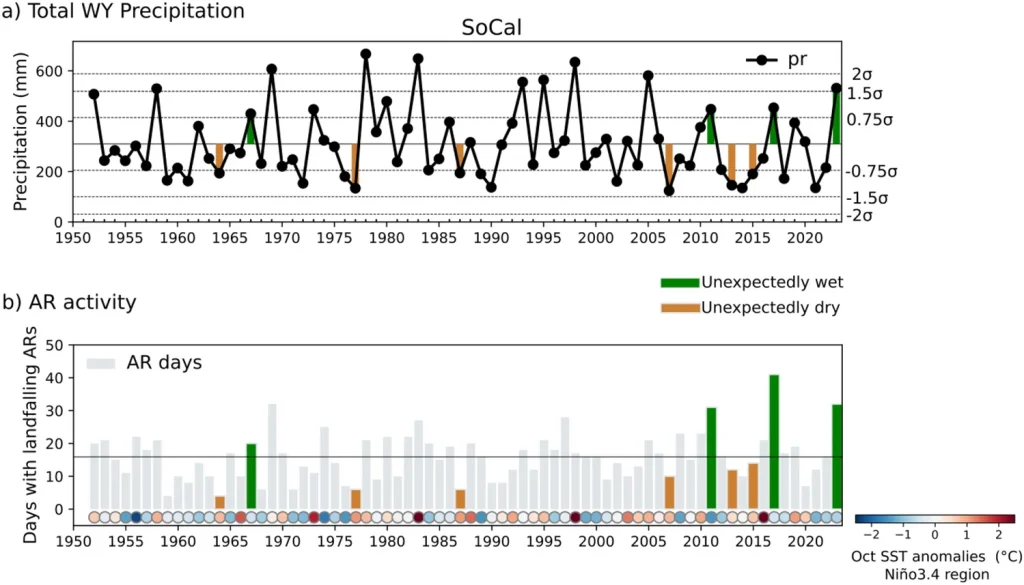
The study found that ARs can amplify or diminish the precipitation patterns typically linked to ENSO phases. Strong AR activity was identified as the primary factor behind unusually high precipitation in years such as 2011, 2017, and 2023, despite occurring during the typically dry La Niña phase.
Certain El Niño years—such as 1964, 1977, 1987, 2007, 2013, and 2015—experienced unexpectedly dry conditions, which correlated with low AR activity during those periods.
The study also noted that ARs do not have a uniform impact. Some regions, particularly in Southern California, are more affected by AR activity than other parts of the western United States.
References:
1 Heresy in ENSO teleconnections: atmospheric rivers as disruptors of canonical seasonal precipitation anomalies in the Southwestern US – Rosa Luna-Niño et al. – Springer Nature Link – February 7, 2025 – https://link.springer.com/article/10.1007/s00382-025-07583-1

I am an Assistant Editor and Severe Weather & Science Journalist at The Watchers, specializing in real-time severe weather coverage, geophysical event reporting, and research-driven scientific analysis. You can reach me at rishav(at)watchers(.)news.

Commenting rules and guidelines
We value the thoughts and opinions of our readers and welcome healthy discussions on our website. In order to maintain a respectful and positive community, we ask that all commenters follow these rules.