
Spectacular eruption at Popocatepetl volcano, heavy ash up to 8.5 km (28 000 feet) a.s.l., Mexico

Image credit: CENAPRED
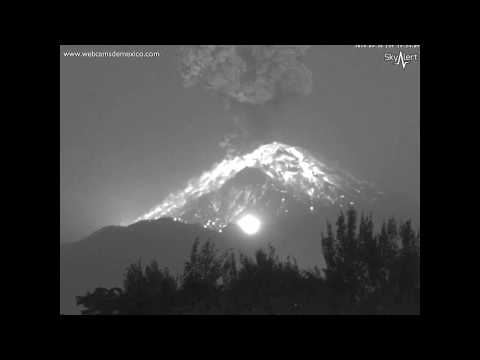
A spectacular explosive eruption started at Mexico's Popocatepetl volcano at 01:23 UTC on March 27 (19:23 LT, March 26). Volcanic ash column reached 8.5 km (28 000 feet) a.s.l.
The eruption produced a thick column of ash up to 3 km (1.8 feet), drifting northeast, CENAPRED said.
Incandescent material was thrown up to 2 km (1.2 miles) from the crater, sparking fires on the slopes of the volcano.
Washington VAAC reported heavy ash emission moving ESE from the summit. Volcanic ash column reached an altitude of 8.5 km (28 000 feet) above sea level. Ash is expected to dissipate within 12 hours, the center said 02:12 UTC.

Over the past 24 hours, monitoring systems of the volcano detected 155 exhalations, CENAPRED reported 17:00 UTC, March 26. The exhalations were accompanied by water vapor, volcanic gases and low ash content. In addition, 5 minutes of low amplitude tremor and two volcano-tectonic earthquakes were recorded – M2.1 at 12:48 LT, March 25 and M3.0 at 09:15 LT, March 26.
The Alert Level remains at Yellow, Phase Two (middle level on a three-color scale).
A strong eruption at 03:38 UTC on March 19, 2019 (21:38 local time, March 18), ejected a column of water vapor, gas and ash up to 4 km (13 123 feet) and threw incandescent material 2.5 km (1.5 miles) from the crater.


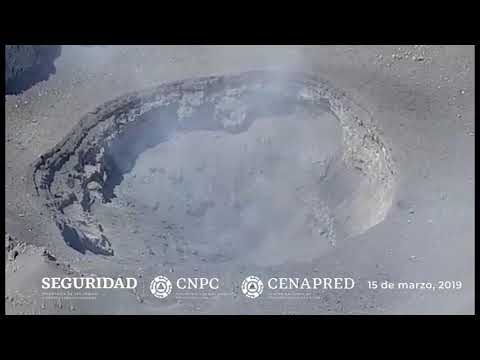
The March 15th overflight confirmed that the lava dome 82 has been totally destroyed during March 13 and 14 explosions. The internal crater remains 300 m (984 feet) wide and 130 m (426 feet) deep.
Similar eruptive activity was observed in previous eruptive episodes, particularly since February 14, 2019, CENAPRED said at the time.

Authorities urged residents not to approach the volcano (safety radius 12 km / 7.4 miles) and be attentive to the information issued by the National Coordination of Civil Protection through its channels and official accounts.

Teo Blašković founded The Watchers in 2011 and edited it until 2026, covering seismic and volcanic activity, extreme weather, space weather and near-Earth objects. Articles on this page are his archive.
Published in the last 24 hours
- In 1920, a man out hunting on a farm in Namibia sat down on a strange black rock, scratched it with his knife and saw metal shine underneath. It was Hoba, a 60-ton meteorite, the largest ever found, and there is no crater around it Epicenter
- On December 26, 2004, a 10-year-old British girl on a Phuket beach recognized the frothing sea from a recent geography lesson, and her warning helped clear the beach before the tsunami struck Epicenter
