
Shallow seismic swarm underway in the Michoacán–Guanajuato Volcanic Field, Mexico
More than 440 earthquakes have been recorded since June 17, 2025, within the Michoacán–Guanajuato Volcanic Field, specifically in the Tancítaro–Parícutin region of Michoacán, Mexico, in an ongoing seismic swarm associated with magmatic activity. The last eruptive period in the field occurred from 1943 to 1952 (VEI 4).
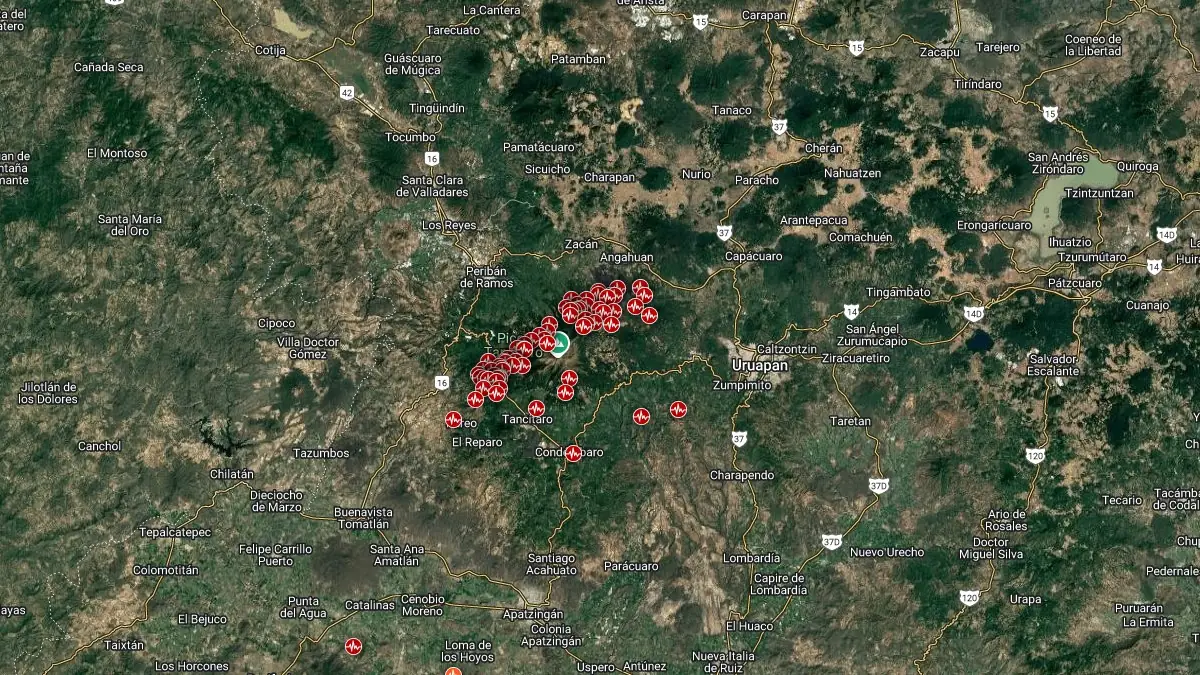
Michoacán–Guanajuato Volcanic Field earthquake swarm June/July 2025. Image credit: TW/SAM, Google
More than 440 earthquakes have been recorded since June 17, 2025, in the Tancítaro–Parícutin region of Michoacán, Mexico, in an ongoing seismic swarm associated with magmatic activity.
According to the Servicio Sismológico Nacional (SSN), the earthquakes range in magnitude from 2.5 to 3.8 and are concentrated at depths of less than 20 km (12 miles).
The seismic swarm is occurring in the Michoacán–Guanajuato Volcanic Field (MGVF), a densely populated monogenetic volcanic zone comprising more than 1 000 individual cones. Similar swarms were documented in 1997, 1999, 2000, 2006, 2020, and 2021. These previous events were attributed to subsurface magma intrusions but did not culminate in surface eruptions.
On June 27, the State Civil Protection Coordination of Michoacán confirmed that the phenomenon corresponds to a seismic swarm associated with either structural adjustments or magmatic and hydrothermal processes.
The region is under continuous observation through a multiparametric monitoring network composed of four stations. This network is operated jointly by the United States Geological Survey (USGS), the National Center for Disaster Prevention (CENAPRED), the Michoacán University of San Nicolás de Hidalgo (UMSNH), and the National Autonomous University of Mexico (UNAM) through its Morelia Unit.
As of July 8, the SSN has logged 441 seismic events since June 17. The strongest event was M3.8. No signals of an imminent volcanic eruption, such as volcanic gas emissions, steam release, or surface deformation, have been detected. However, scientists acknowledge that the seismicity is consistent with shallow dike intrusions in the crust, which may or may not lead to the formation of a new monogenetic cone.
Authorities have advised the public to remain calm and follow updates from official sources. Emergency services remain active and accessible via the national 911 emergency line.
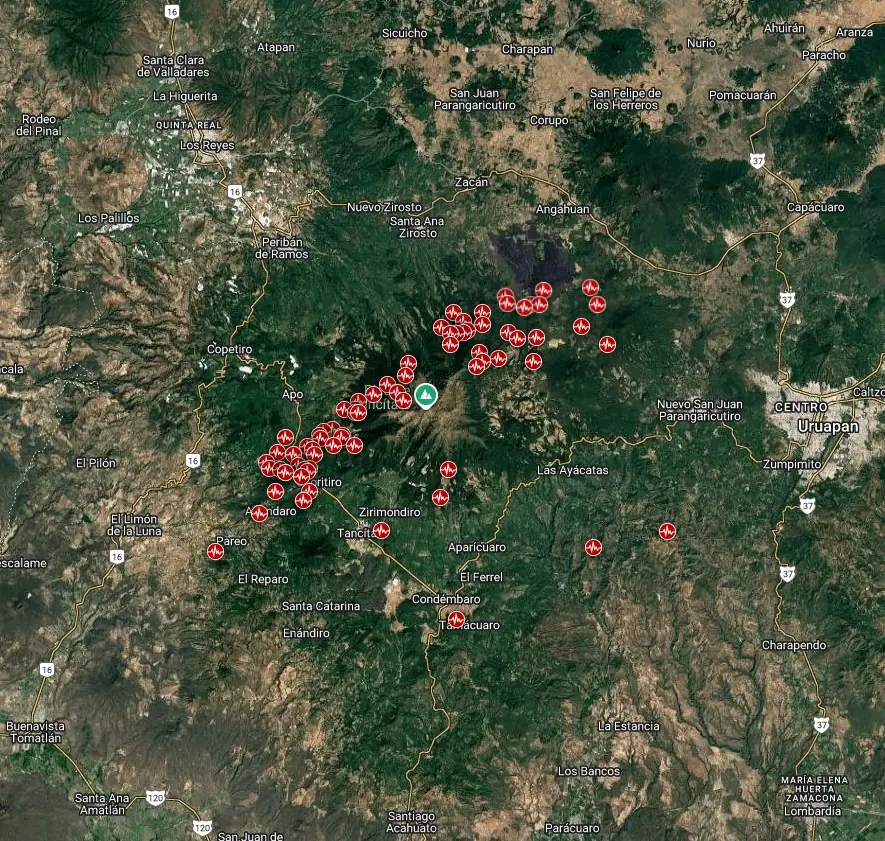
The field spans approximately 200 km × 250 km (124 miles × 155 miles) across the states of Michoacán and Guanajuato in west-central Mexico and contains over 1 400 volcanic vents. It is dominated by cinder cones but also includes small shield volcanoes, lava domes, maars, tuff rings, especially in the Valle de Santiago area, and coneless lava flows.
The shield volcanoes are mostly Pleistocene in age, although the cinder cones typically exhibit steeper slopes and smaller basal diameters.
Notable historic eruptions in the region include Jorullo in the 18th century and Parícutin, which erupted from 1943 to 1952 (VEI 4) after emerging in a cornfield.

I'm a dedicated researcher, journalist, and editor at The Watchers. With over 20 years of experience in the media industry, I specialize in hard science news, focusing on extreme weather, seismic and volcanic activity, space weather, and astronomy, including near-Earth objects and planetary defense strategies. You can reach me at teo /at/ watchers.news.

Commenting rules and guidelines
We value the thoughts and opinions of our readers and welcome healthy discussions on our website. In order to maintain a respectful and positive community, we ask that all commenters follow these rules.