
Tropical Storm Boris forms off Guerrero coast, flooding rains threaten southern Mexico
Tropical Storm Boris formed just offshore of Guerrero, Mexico, at 09:00 UTC on June 8, 2026. Tropical storm warnings are in effect along portions of the southern coast, with heavy rainfall capable of producing life-threatening flooding and mudslides being forecast.
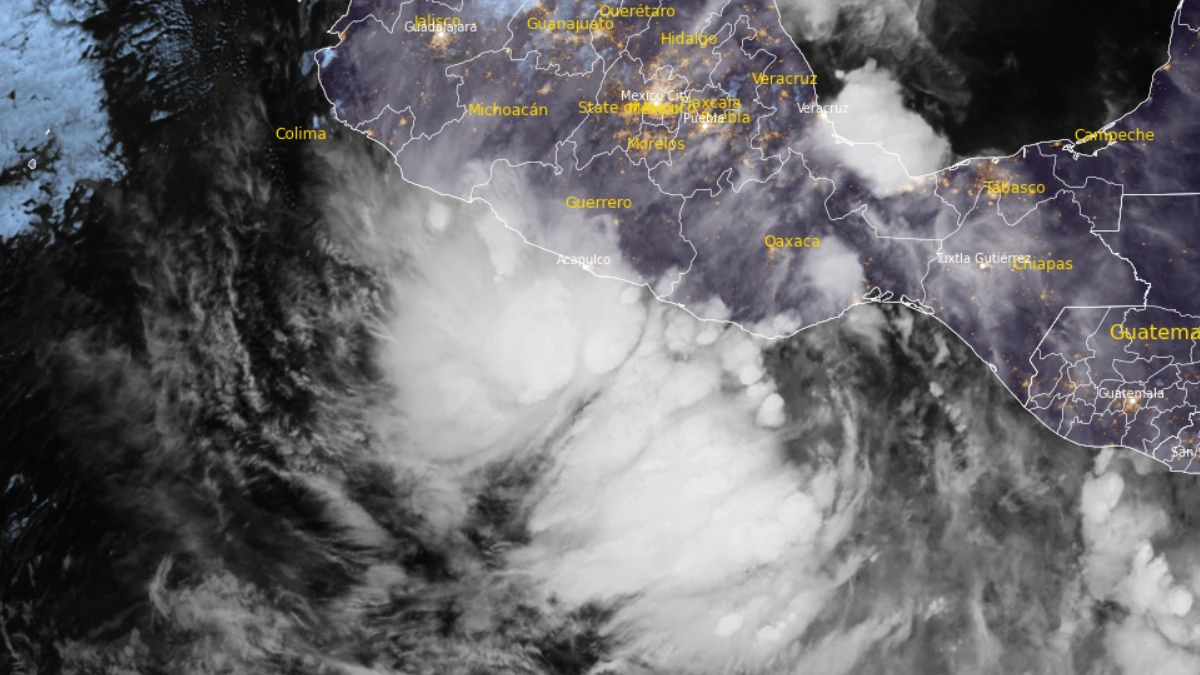
Satellite image of tropical storm Boris at 1110 UTC in June 8, 2026. Credit: NOAA/GOES-19, RAMMB/CIRA The Watchers
Tropical Storm Boris formed just offshore of Guerrero, Mexico, as the second named storm of the 2026 Eastern Pacific hurricane season at 09:00 UTC on June 8, according to the National Hurricane Center (NHC).
At the time, the system was located approximately 135 km (85 miles) southeast of Acapulco and 80 km (50 miles) southwest of Punta Maldonado, with 1-minute maximum sustained winds of 65 km/h (40 mph) and higher gusts. It had an estimated minimum central pressure of 1002 hPa, while tropical storm force winds extended outward up to 55 km (35 miles)
Boris was moving toward the northeast at 7 km/h (5 mph). Forecasters expect the storm to turn northward later on June 8 before bending northwestward as a mid-level ridge strengthens over northern Mexico.
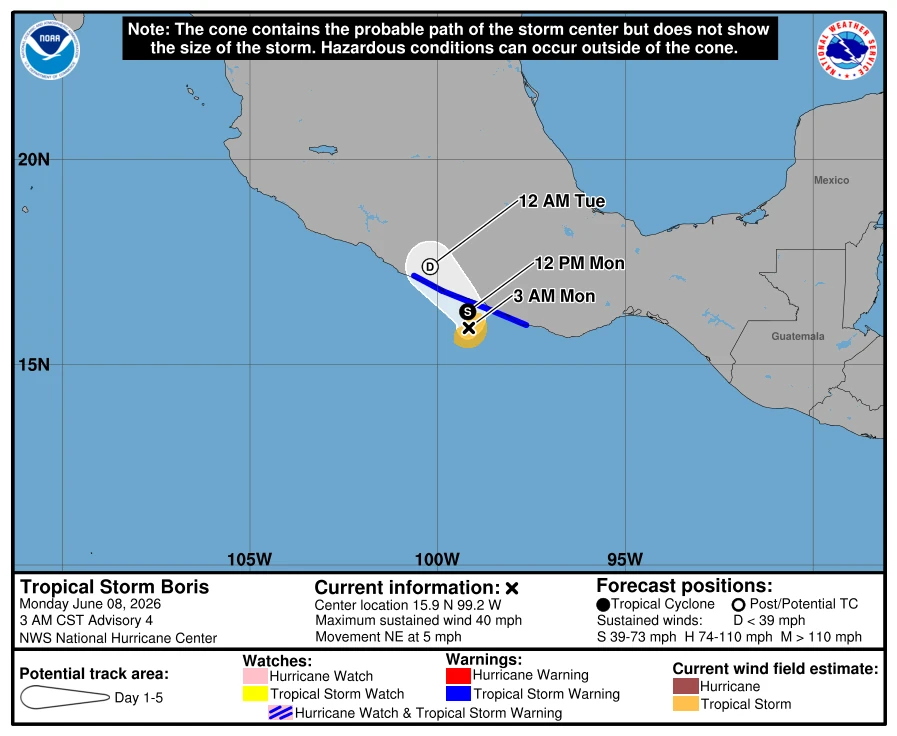
On the current forecast track, the center is expected to reach the coast of Guerrero during the afternoon or evening hours on June 8.
A Tropical Storm Warning remained in effect from Laguna de Chacahua to Tecpan de Galeana, meaning tropical-storm conditions were forecast within the warning area over the next 24 hours.
While additional strengthening remains possible before landfall, Boris remains broad and elongated, and forecasters expect persistent east-southeasterly wind shear to limit significant intensification before the cyclone reaches the coast.
Heavy rainfall associated with the storm will be the main concern across southern Mexico. Boris may trigger flash flooding and mudslides, particularly in mountainous terrain where runoff can rapidly concentrate in valleys and drainage basins.
Once Boris reaches land, interaction with the mountainous terrain of southern Mexico is expected to rapidly weaken the cyclone. The NHC forecast indicates the low-level circulation should dissipate within roughly 36 hours after landfall.
References:
1 Tropical Storm Boris Advisory Number 4 – NHC – June 8, 2026
2 Tropical Storm Boris Discussion Number 4 – NHC – June 8, 2026

Rishav Kothari is Editor-in-Chief of The Watchers, where he runs the newsroom and covers earthquakes, volcanoes, severe weather and space weather.
Published in the last 24 hours
- Scientists directly observe how submarine landslides unfold in western Canada Epicenter
- Odisha evacuated 983,642 people before Phailin crossed near Gopalpur on 12 October 2013 with winds of 200-210 km/h gusting to 220, and 44 died, against 9,885 in the 1999 super cyclone. Cyclone Akvan crossed the same coast on 20 November 2026. Epicenter
- Lava fountains reached 1,900 feet (580 m) at Kīlauea Iki in 1959, the highest ever recorded at Kīlauea, as USGS forecasts episode 57 fountaining at Halemaʻumaʻu for November 22-26. Epicenter
- Novarupta in Alaska erupted about 3 cubic miles of magma in roughly 60 hours from 6 June 1912, 30 times Mount St. Helens in 1980, and strong northwesterly winds lifted that same loose ash on 16 November 2026, prompting an NWS SIGMET. Epicenter
