
Large sandstorm impacts southern Xinjiang as cold-air outbreak strengthens over northern China
A large-scale sandstorm affected southern Xinjiang, China, on March 13, 2026, as strong winds associated with a regional cold wave mobilized desert dust across the southern edge of the Taklamakan Desert.
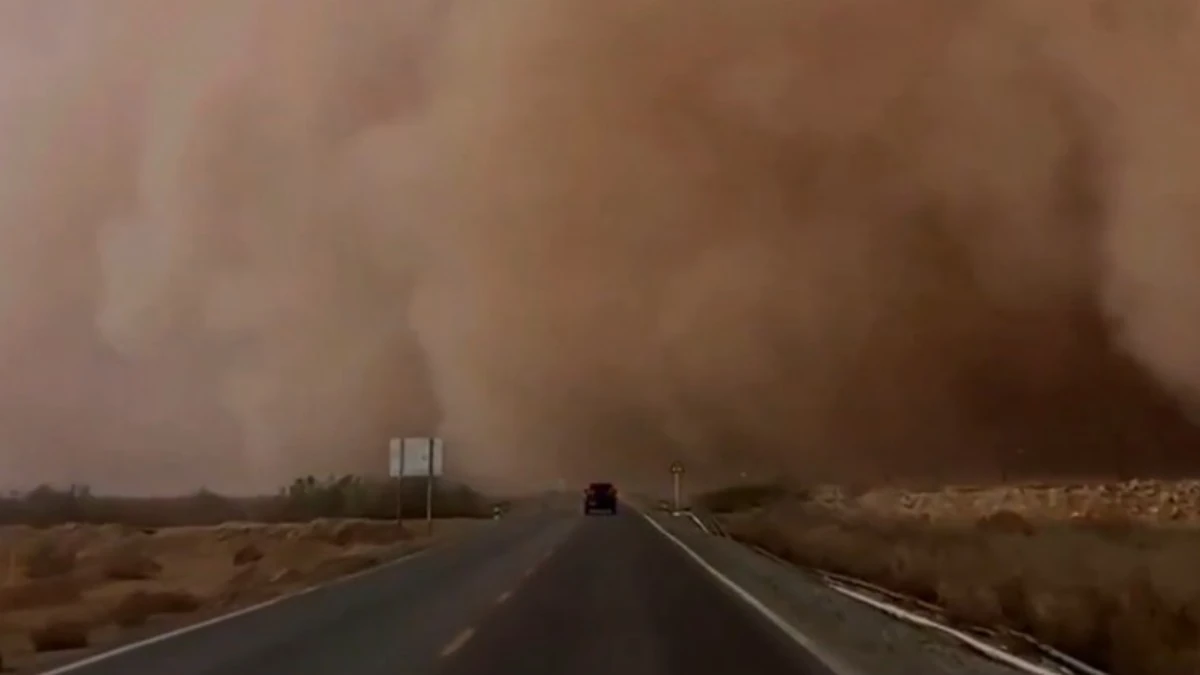
Large dust storm sweeps over southern Xinjiang, China on March 13, 2026. Credit: Jim Yang
Strong winds associated with a cold-air outbreak produced a large-scale sandstorm across southern Xinjiang on March 13, affecting desert regions along the southern edge of the Taklamakan Desert, including areas of Hotan Prefecture.
Unconfirmed reports circulating on Chinese social media platforms mentioned PM10 concentrations in Hotan reaching up to 5 170 μg/m³ during the peak of the event. For context, the World Meteorological Organization notes that severe dust storms commonly produce PM10 concentrations between 1 000 and 3 000 μg/m³, while extreme events can occasionally exceed 5 000 μg/m³.
If confirmed, a value near 5 170 μg/m³ would indicate exceptionally high atmospheric dust loading, several dozen times higher than typical urban air-quality standards.
Affected by the cold wave, a large-scale sandstorm hit the southern desert of Xinjiang today, with PM10 concentration in Hotan soaring to 5170. pic.twitter.com/0PbiQpivZ6
— Jim (@yangyubin1998) March 13, 2026
Hotan Prefecture lies along the southern rim of the Taklamakan Desert, where communities are directly exposed to wind-driven dust during such events. Blowing dust can disrupt transportation, degrade air quality, and create hazardous conditions for road travel due to sharply reduced visibility.
China’s National Meteorological Center (NMC) issued a blue sandstorm warning, forecasting blowing dust and localized sandstorms across southern Xinjiang during the March 13–14 period as a cold-air mass moved across the northwestern parts of the country. Regional meteorological authorities in Xinjiang also warned that the southern basin areas could experience dust storms under the influence of the same cold-air system.
The event occurred within the climatological dust season for northwestern China. During late winter and early spring, strong temperature gradients associated with cold-air outbreaks frequently produce pressure patterns capable of generating high winds across desert basins of Central and East Asia.
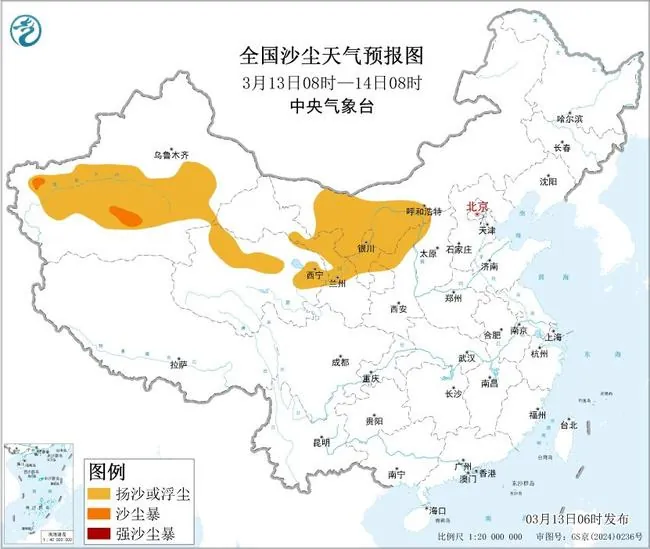
The Taklamakan Desert is one of the world’s largest shifting-sand deserts, occupying much of the Tarim Basin and frequently serving as a major source of atmospheric mineral dust when strong winds develop across the region.
Large quantities of desert sediment from the Taklamakan Desert are transported across regional and sometimes continental scales.

I'm a dedicated researcher, journalist, and editor at The Watchers. With over 20 years of experience in the media industry, I specialize in hard science news, focusing on extreme weather, seismic and volcanic activity, space weather, and astronomy, including near-Earth objects and planetary defense strategies. You can reach me at teo /at/ watchers.news.

Commenting rules and guidelines
We value the thoughts and opinions of our readers and welcome healthy discussions on our website. In order to maintain a respectful and positive community, we ask that all commenters follow these rules.