
Severe storms and Saharan dust batter Greece, leaving widespread disruption and 1 dead
A multi-day severe storm system, named Storm Erminio in Greek media, affected Greece in early April 2026, bringing heavy rainfall, strong winds, and Saharan dust that caused flooding, one fatality, multiple rescues, and widespread disruption to maritime and air transport. The hardest-hit areas included Attica, the Aegean islands, Crete, and parts of the Peloponnese.
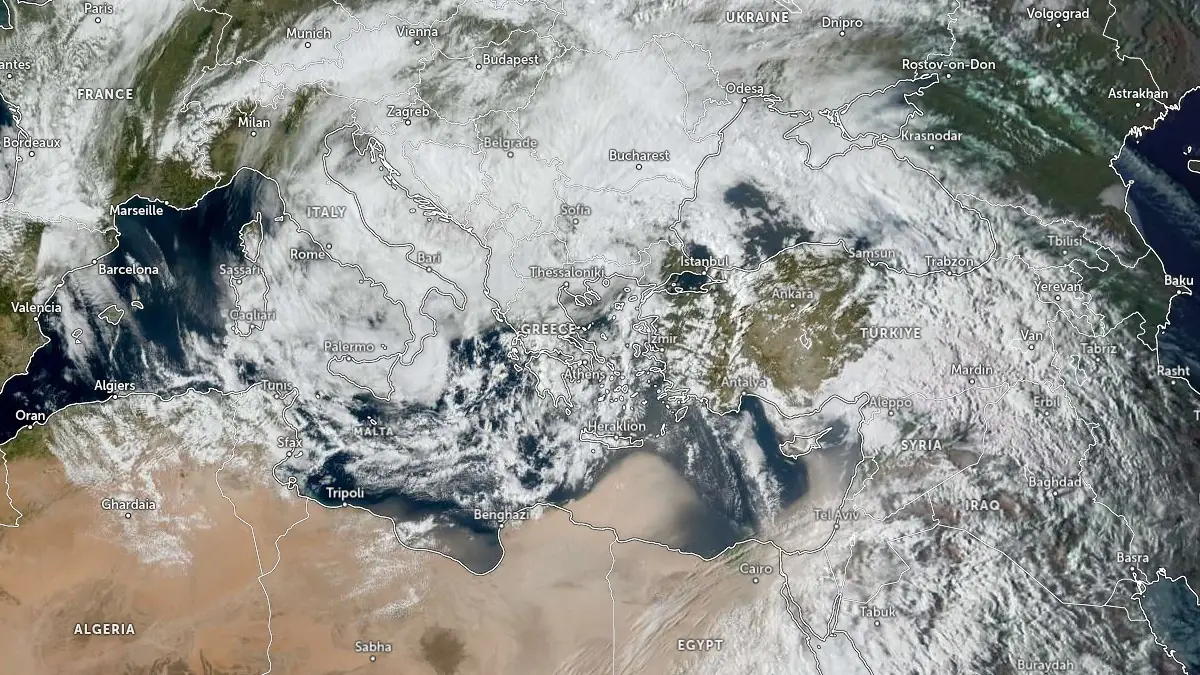
Satellite image of Greece at 14:00 UTC on April 2, 2026. Credit: EUMETSAT/Meteosat, Zoom Earth, The Watchers
The event developed under the influence of two low-pressure systems over the central and eastern Mediterranean, according to the National Observatory of Athens. One system formed over southern Italy while a second developed over the southwestern Aegean Sea, driving the transport of Saharan dust toward southern Greece.
The highest daily rainfall up to 20:40 on April 1 was registered in Oxia, Karditsa, where it exceeded 84 mm (3.3 inches). The strongest winds on April 1 were recorded in Crete, the Ionian Islands, Attica, South Evia, and the Dodecanese, with the maximum wind gust registered in Amorgos at 115 km/h (71 mph).

On April 1 and 2, until 10:00 local time, 50 stations recorded rainfall amounts over 80 mm (3.1 inches) while the highest two-day total was recorded in Embonas, Rhodes, at 167 mm (6.6 inches).
During the same period Apidia, Karditsa, registered 155 mm (6.1 inches), Thelo, Karditsa, 147 mm (5.8 inches), Kymi 146 mm (5.7 inches), Simonopetra 146 mm (5.7 inches), Hydra 142 mm (5.6 inches), Kastania, Karditsa, 128 mm (5.0 inches), and Agios Stefanos, Attica, 128 mm (5.0 inches).

Eastern Attica experienced some of the most severe flooding, particularly in areas around Nea Makri and Rafina, where intense rainfall over a short period led to rapid runoff and water accumulation in streets and residential zones.
One fatality was confirmed in Nea Makri, east of Athens, on April 1, where a Polish man in his 50s was swept away by rapidly rising floodwaters inside a basement apartment and became trapped beneath a vehicle. Floodwaters in the area were reported as deep as 1 m (3.3 feet).
Fire services in the greater Athens area responded to approximately 500 calls during the peak of the event, primarily involving flooded homes, vehicles trapped in water, and fallen trees blocking roads.
At least 33 people were rescued, many from vehicles or ground-level properties affected by rapidly rising water. Emergency response activity expanded across other regions, with total calls exceeding 1 100 nationwide.


Strong winds over the Aegean Sea led to widespread disruption of maritime transport, with ferry services from major ports, including Piraeus, Rafina, and Lavrio, suspended.
Additional routes connecting mainland Greece with island regions were halted. The Rio–Antirrio ferry link was also temporarily closed as wind and wave conditions intensified in the Gulf of Corinth.
In Crete, strong southerly winds transported large quantities of Saharan dust across the island between April 1 and April 3, significantly reducing visibility and giving the sky a deep orange to reddish-brown appearance.
The reduced visibility affected aviation operations at Heraklion and Chania airports, diverting and delaying several inbound flights.
Temporary school closures were implemented in several island communities as a precaution, while localized damage, including the collapse or impairment of small bridges and road sections, was reported in areas such as Paros.
References:
1 Μεγάλα ύψη βροχής το διήμερο 01-02/04/2026 – 50 μετεωρολογικοί σταθμοί κατέγραψαν πάνω από 80 mm – Meteo.gr – April 2, 2026
2 Κορυφώνεται την Τετάρτη 01 Απριλίου 2026 η κακοκαιρία στη χώρα μας – Επεισόδιο βροχόπτωσης κατηγορίας 5 (Ακραία) – Meteo.gr – March 31, 2026
3 Storm batters Greece, killing one, flooding homes and disrupting travel – Reuters – April 2, 2026

I'm a dedicated researcher, journalist, and editor at The Watchers. With over 20 years of experience in the media industry, I specialize in hard science news, focusing on extreme weather, seismic and volcanic activity, space weather, and astronomy, including near-Earth objects and planetary defense strategies. You can reach me at teo /at/ watchers.news.

Commenting rules and guidelines
We value the thoughts and opinions of our readers and welcome healthy discussions on our website. In order to maintain a respectful and positive community, we ask that all commenters follow these rules.