
In 1954, a grapefruit-sized meteorite crashed through a roof in Sylacauga, Alabama, and struck Ann Hodges as she napped on her couch
On November 30, 1954, a grapefruit-sized meteorite crashed through the roof of a rented house near Sylacauga, Alabama, struck a wooden console radio and ricocheted into Ann Hodges as she napped on a couch, leaving her badly bruised. Scientists examined the recovered stone shortly after the fall, establishing one of the best-documented cases of a person being injured by a meteorite.
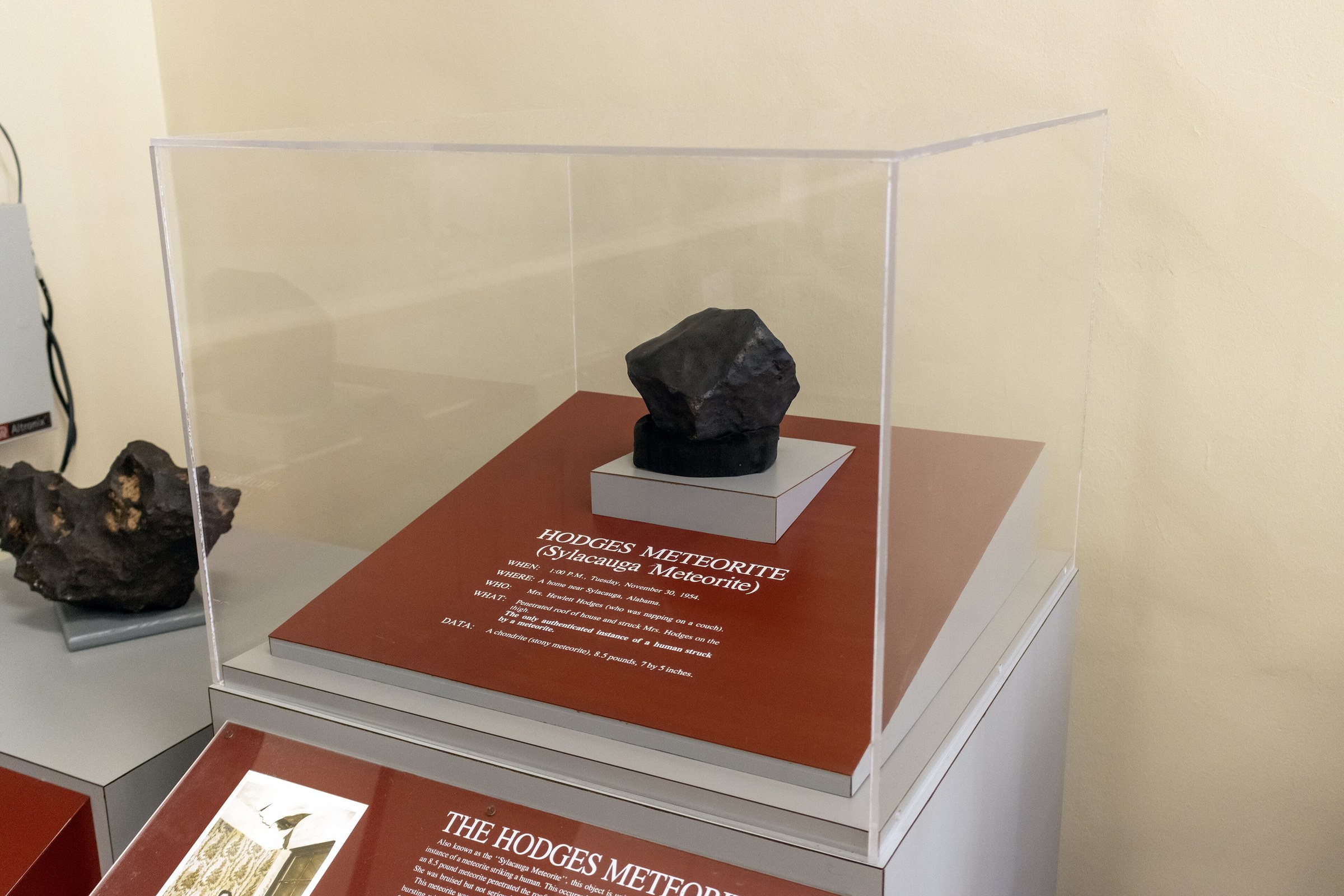
People across parts of Alabama saw a bright fireball in the daytime sky on November 30, 1954. Explosive sounds accompanied its passage, leading some witnesses to believe an aircraft had crashed. The original scientific investigation placed the fall at about 13:00 Central Standard Time (19:00 UTC), while a later reconstruction based on witness reports estimated 12:46 CST (18:46 UTC).
Inside the rented house in an unincorporated community near Sylacauga, later incorporated as Oak Grove, the last part of the meteorite’s descent left a physical trail. It punched through the roof and ceiling, struck a large Philco console radio and ricocheted into Ann Hodges as she rested on the couch. The stone hit her left hip and side, leaving a substantial bruise and swelling. Physician Moody Jacobs examined her and found no serious physical damage.

The incident was investigated by geologists George W. Swindel Jr. and Walter B. Jones, who published their findings in the journal Meteoritics in 1954. Their paper recorded the circumstances of the fall, the injury and the recovery of two meteorite fragments. The larger stone, which entered the Hodges house, weighed approximately 3.86 kg (8.5 lb). It was irregular and angular, with a dark coating produced during passage through Earth’s atmosphere.
A second fragment was recovered separately on December 1 by farmer Julius K. McKinney. It weighed approximately 1.7 kg (3.7 lb) and was found in the same general area, rather than inside the Hodges house. McKinney subsequently sold his specimen to the Smithsonian Institution. The distinction between the two fragments matters because later accounts sometimes describe the weight of the Hodges stone as though it represented the entire recovered meteorite.
The Meteoritical Society’s official database lists Sylacauga as an observed fall with a total known mass of 5.56 kg (12.26 lb). Some mineralogical records give a slightly different combined mass of 5.54 kg (12.21 lb), reflecting the individual fragment weights recorded in those sources. Both totals describe the recovered fall, not the single stone that struck Hodges.

The Sylacauga meteorite is classified as an H4 ordinary chondrite. Ordinary chondrites are stony meteorites containing minerals formed during the early history of the Solar System. The H designation refers to a chemical group with relatively high iron content, while the number 4 describes the extent to which the material was heated and altered inside its parent asteroid.
Chondrites contain small, rounded grains known as chondrules, which formed before the larger rocky bodies of the Solar System were fully assembled. Type 4 chondrites retain abundant chondrules, although heating has recrystallized much of their surrounding fine-grained material. Those structures help scientists identify how the parent material formed and changed long before it reached Earth.
In a 2022 University of Alabama account, planetary scientist Julia Cartwright, then a geochemist at the university, described the Sylacauga meteorite as approximately 4.5 billion years old. Its minerals preserve evidence of processes that operated during the Solar System’s earliest stages. Meteorites of this type are generally thought to originate from asteroidal material, most likely from the main asteroid belt between Mars and Jupiter.

The meteorite’s age does not establish how long it traveled toward Earth. Ancient chondritic material can remain inside an asteroid for billions of years before a collision or another orbital disturbance releases a fragment into space. Scientists can study the Sylacauga stone’s minerals directly, but reconstructing its exact pre-impact orbit is more difficult because the 1954 fall was not recorded by a modern network of atmospheric cameras.
Harold Povenmire revisited the event in a 1995 study of the impact locations, atmospheric trajectory and strewn field. He used historical eyewitness observations and the locations of the two recovered stones to reconstruct the incoming direction. His analysis placed the fireball in the southern sky and proposed a path through the atmosphere, but the result remained a reconstruction from historical reports rather than an instrumentally measured orbit.

Scientific interest was only one consequence of the fall. Almost immediately, the meteorite became the subject of a dispute involving local officials, military authorities and the people who had occupied the house. Sylacauga police chief W. D. Ashcraft and mayor Ed Howard responded to the incident, and the stone was initially examined by Swindel before it was transferred to officers from Maxwell Field.
Air Force intelligence personnel arranged further examination of the specimen, which was eventually sent to the Smithsonian Institution. The Encyclopedia of Alabama records that the Smithsonian initially resisted returning it to the state. Alabama congressman Kenneth Roberts intervened, and the stone was returned, but the question of ownership had not been resolved.
Hodges and her husband, Hewlett, rented the house from Birdie Guy, who argued that the meteorite belonged to her as the property owner. The disagreement became public, with Guy seeking possession of the stone and the Hodges family asserting its own claim. The dispute was eventually settled, and Guy relinquished her claim. By then, much of the initial commercial interest in the meteorite had faded.

The publicity did not make Hodges wealthy. University of Alabama collections manager Brooke Bogan said museum transaction records showed that money received by the Hodges family reimbursed debts associated with the meteorite incident. Hodges made no profit from the stone. She eventually transferred the specimen to the Alabama Museum of Natural History, where it became part of the institution’s scientific and historical collections.
Its later value was considerably greater than the money involved in the original dispute. Before a loan to an exhibition in Paris in 2018, the museum assigned the meteorite an insurance value exceeding USD 1 million. That figure represented an insurance valuation for a historically exceptional museum object. It was not a sale price and did not represent money received by Hodges.
The consequences for Hodges extended well beyond her physical injury. The Encyclopedia of Alabama reports that approximately 200 reporters and sightseers gathered at the property on the evening of the fall. Attention continued through newspaper, radio and television coverage, while the ownership dispute prolonged the family’s exposure to public scrutiny.
Hodges and her husband separated in 1964. According to the state encyclopedia, both later identified the disruption surrounding the meteorite as a contributing factor in their separation. Hodges died in 1972. These accounts document a significant personal aftermath, although they do not establish that every subsequent difficulty in her life was caused by the meteorite.
Hodges is often described as the only person ever struck by a meteorite, but that absolute claim is not supported by the broader historical record. Her case is exceptionally well documented because scientists examined the recovered rock and recorded the circumstances of the impact soon after it occurred. Other direct strikes involving people have nevertheless been reported.
On August 14, 1992, during the Mbale meteorite fall in Uganda, a small fragment weighing approximately 3 g (0.11 oz) struck a boy after being slowed by banana leaves. NASA has included the case in its discussions of meteorites striking people, noting that the boy was not injured. The event is distinct from Sylacauga because Hodges was struck by a much heavier stone that had already passed through a building.
Historical evidence extends further back. A 2020 study in Meteoritics & Planetary Science examined Ottoman archival documents describing a reported death and serious injury associated with a meteorite fall in 1888 in what is now Iraq. The documents provide evidence that such incidents were reported before 1954, although the researchers could not link a surviving meteorite specimen directly to those reported injuries.
Other major meteoritic events have injured people without a stone directly striking them. On February 15, 2013, an asteroid exploded in the atmosphere over Chelyabinsk, Russia, generating a shock wave that shattered windows and injured more than 1 500 people, mainly through broken glass. The Chelyabinsk airburst demonstrated the danger of an atmospheric explosion, whereas the Sylacauga injury resulted from a recovered meteorite physically reaching an occupied room.
In July 2024, a meteorite struck a walkway at a home in Marshfield, Prince Edward Island, Canada. A security camera recorded both the impact and its sound, providing unusually direct evidence of a small meteorite reaching the ground. The Charlottetown meteorite recording became widely reported in January 2025, but the homeowner had stepped away before the stone struck and no person was injured.
The Sylacauga specimen remains on display at the Alabama Museum of Natural History in Tuscaloosa, together with the 1941 Philco radio it struck. The museum has also supported scientific work on the meteorite. In its 2022 account, the University of Alabama reported that Cartwright had examined a thin section loaned from the museum, allowing its mineral composition and structure to be studied under a microscope without extensively sampling the main specimen.
The importance of the Sylacauga fall rests on both its physical evidence and its documented human consequences. Scientists can examine a surviving H4 chondrite containing material from the early Solar System, while the historical record establishes how the stone reached an occupied house and injured a person. Modern meteorite camera networks can reconstruct many atmospheric trajectories more precisely than was possible in 1954, but few preserved specimens are accompanied by such a direct record of their effect on an individual household.
References:
1 Swindel, G. W., Jr., & Jones, W. B. (1954). The Sylacauga, Talladega County, Alabama, aerolite: A recent meteoritic fall that injured a human being. Meteoritics, 1(2), 125–132. DOI: 10.1111/j.1945-5100.1954.tb01323.x
2 Povenmire, H. (1995). The Sylacauga, Alabama meteorite: The impact locations, atmospheric trajectory, strewn field and radiant. Lunar and Planetary Science Conference XXVI, 1133–1134. Lunar and Planetary Institute
3 Meteoritical Bulletin Database: Sylacauga – The Meteoritical Society / Lunar and Planetary Institute – official meteorite record
4 Sylacauga meteorite (Hodges; McKinney), Sylacauga, Talladega County, Alabama, USA – Mindat – mineralogical locality record
5 Recommended Classifications – Meteoritical Bulletin Database – H4 classification definition
6 A Gift Like No Other: Ann Hodges and the Meteorite – The University of Alabama – November 29, 2022
7 Hodges Meteorite Strike (Sylacauga Aerolite) – Encyclopedia of Alabama – August 17, 2007; updated December 1, 2023
8 Cooke, B. (2021). Space Debris: Overview and Hazard. NASA Technical Reports Server – presentation, including meteorite strikes involving people
9 Unsalan, O., Bayatlı, A., & Jenniskens, P. (2020). Earliest evidence of a death and injury by a meteorite. Meteoritics & Planetary Science, 55(4), 886–894. DOI: 10.1111/maps.13469
10 Exhibits – Alabama Museum of Natural History – museum collection and exhibit information
11 5th anniversary of Chelyabinsk event, the biggest asteroid airburst since 1908 – The Watchers – February 15, 2018

I’m a science journalist and researcher at The Watchers, contributing to the Epicenter edition, where I cover peer-reviewed scientific research and emerging discoveries across Earth and space sciences. With a background in astronomy and a passion for environmental science, I’ve worked in shark and coral conservation in Fiji, conducting reef and shark-behavior research, contributing to mangrove restoration, and earning PADI Open Water and Coral Reef Certifications. I bring a blend of scientific rigor and storytelling to illuminate the discoveries shaping our planet and beyond.
Published in the last 24 hours
- A meteorite blew a crater beside a village near Lake Titicaca in 2007, and dozens of villagers who went to see it got headaches and nausea, though tests found nothing the rock had added to the water Epicenter
- The people who pay closest attention to the weather are the ones storms have already cost the most, a study of 946 students found, with one damaging storm making little difference to how much attention a student paid, but two or more making a clear one Epicenter
- The sea is falling in Juneau, Alaska, because land freed from melted glaciers is rising about 0.6 inches a year Epicenter
- A dam above Los Angeles collapsed just before midnight on March 12, 1928, and the flood killed more than 400 people, hours after the engineer who built it had spent two hours looking at a new leak and decided there was no danger Epicenter
