
ENSO-neutral persists, NOAA issues La Niña Watch for late 2025
ENSO remains neutral, and NOAA’s Climate Prediction Center has issued a La Niña Watch, assigning a 71 % probability of La Niña development during October–December 2025.
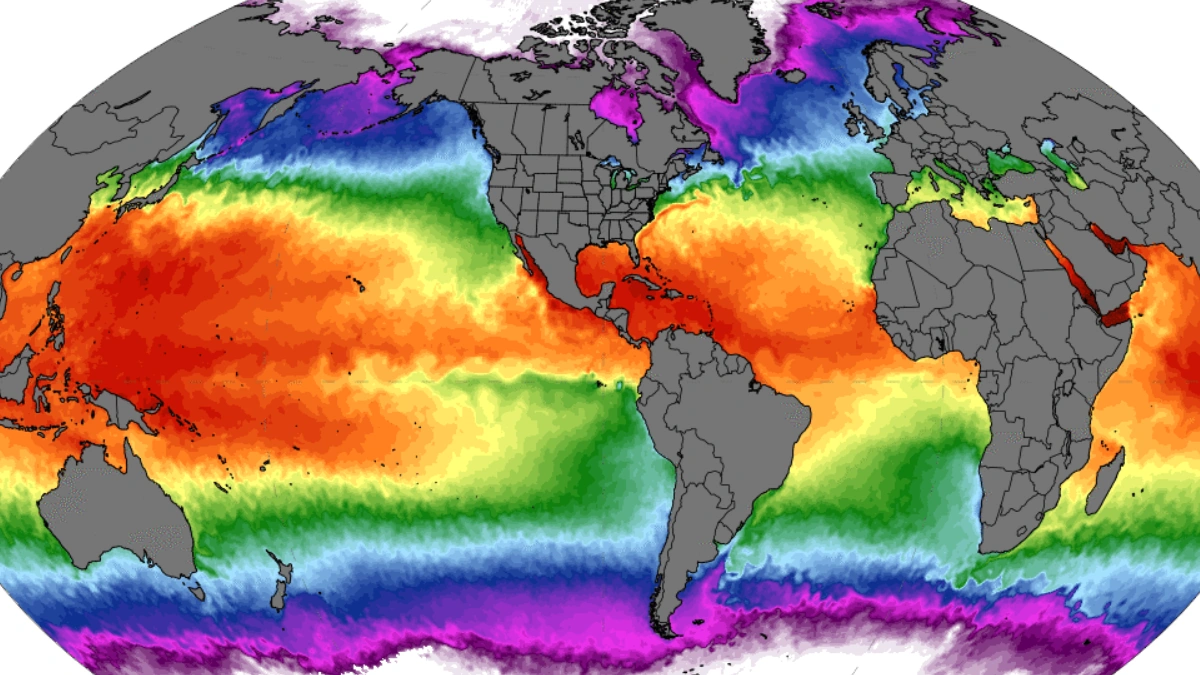
Image credit: NOAA
ENSO is presently neutral, according to the Climate Prediction Center (CPC) diagnostic discussion issued in early October 2025.
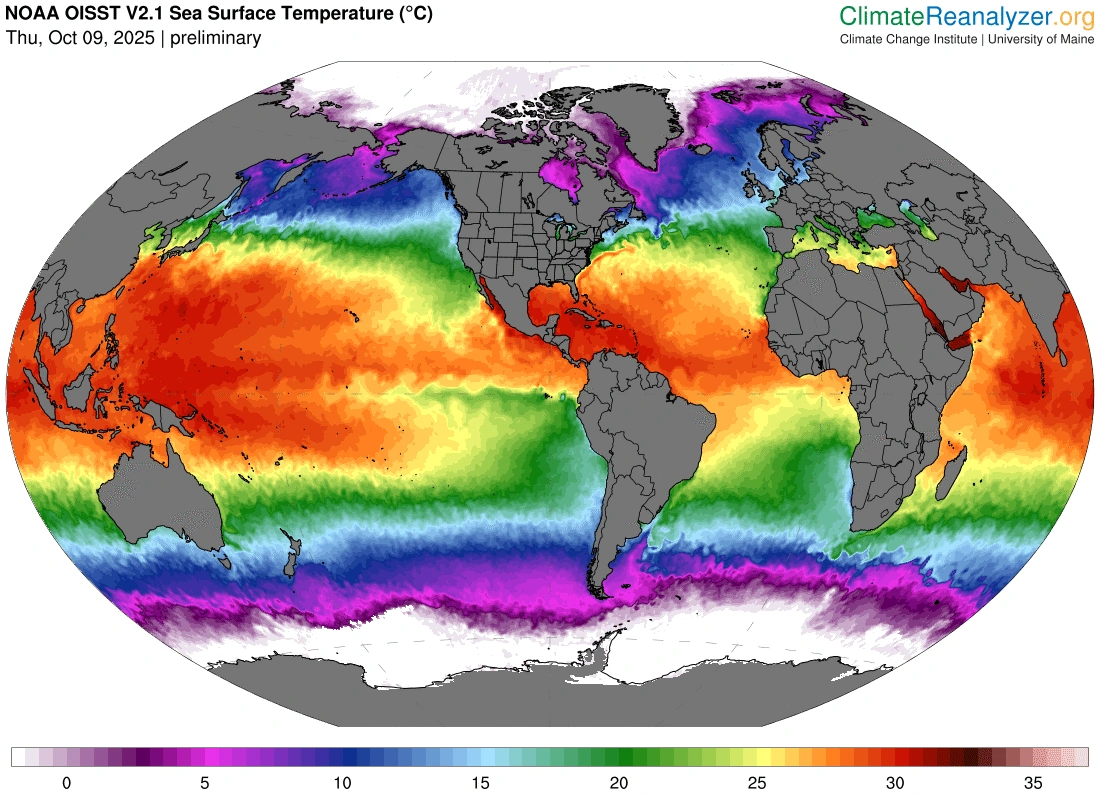
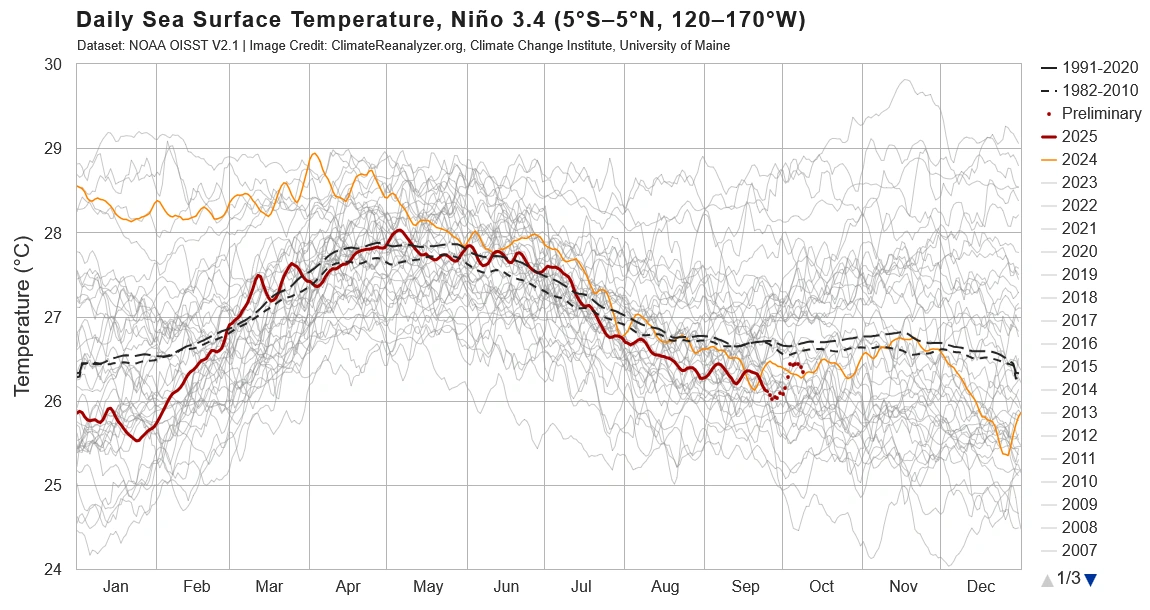
Weekly CPC analyses show sea-surface temperature (SST) anomalies (°C) averaged for the week centered on 11 September 2025 as:
- Niño 4 = –0.3°C (31.46°F)
- Niño 3.4 = –0.1°C (31.82°F)
- Niño 3 = 0.2°C (32.36°F)
- Niño 1 + 2 = 1.2°C (34.16°F)
This pattern, with a slightly cooler central Pacific and a warmer eastern Pacific, keeps the basin in an overall neutral state.
CPC subsurface analyses for late September 2025 indicate a broad region of 0.5–2°C (32.9–35.6°F) cooler-than-average water at depths of 100–200 m (330–660 feet) across the central Pacific, a configuration typical of pre-La Niña conditions.
Thermocline depth anomalies show a shallower-than-average layer in the east and a deeper layer in the west, confirming the gradual re-establishment of the La Niña-type tilt.
Atmospheric conditions remain near climatology: outgoing long-wave radiation (OLR) and low-level winds show no strong coupling yet. Slightly enhanced easterlies were observed in late September, but convection near the dateline remained near normal.
In the CPC ENSO Diagnostic Discussion issued October 2025, the ENSO Alert System is at La Niña Watch.
Forecasters place the probability of La Niña at:
- 71% for October–December 2025,
- 54% for December 2025–February 2026.
These values derive from the CPC consolidated forecast combining dynamical and statistical model ensembles.
The IRI/CPC multi-model plume released September 19, 2025, gives:
- around 56% probability of La Niña for September–November 2025,
- around 60% for October–December 2025,
- around 59% for November–January 2026,
- declining to roughly 50% by December–February 2026.
Model spread remains large, with some statistical systems keeping neutral conditions through the boreal winter. While CPC notes the differences, it agrees that most evidence suggests a cooling trend.
Forecast uncertainty stems from inter-model spread and initialization differences, limited predictability across the boreal spring barrier, variable coupling strength between subsurface anomalies and atmospheric response, and intraseasonal drivers such as the Madden–Julian Oscillation (MJO).
IRI skill statistics show that multimodel means maintain useful correlation skill, around 0.7 for lead times up to nine months, but single-model forecasts may deviate substantially.
Based on historical data, if La Niña develops in late 2025, enhanced rainfall will occur over northern Australia, Indonesia, and southern Asia, while drier conditions could appear over the central and eastern equatorial Pacific.
La Niña phases are also associated with increased Atlantic hurricane activity potential due to reduced vertical wind shear, and cooler, wetter winters in parts of northern South America. These patterns are tendencies rather than deterministic forecasts; local variability and background ocean–atmosphere states will influence actual outcomes.
Most ensemble means indicate a moderate La Niña, with anomalies around -0.8°C (30.56°F) in the Niño-3.4 region. CPC probabilities drop toward neutrality by January–March 2026, suggesting a short-lived or moderate-strength event.
Continued monitoring through autumn 2025 will focus on the expansion of subsurface cold anomalies, the strengthening of easterly trades and negative OLR anomalies near 170° W, and convergence of dynamical and statistical guidance
References:
1 ENSO Diagnostic Discussion – NOAA/CPC – October 9, 2025

I am an Assistant Editor and Severe Weather & Science Journalist at The Watchers, specializing in real-time severe weather coverage, geophysical event reporting, and research-driven scientific analysis. You can reach me at rishav(at)watchers(.)news.

Commenting rules and guidelines
We value the thoughts and opinions of our readers and welcome healthy discussions on our website. In order to maintain a respectful and positive community, we ask that all commenters follow these rules.