
El Niño forecast in 2026 as La Niña weakens and Pacific subsurface heat increases
La Niña conditions persisted across the equatorial Pacific Ocean during February 2026, but forecasters expect the pattern to transition to ENSO-neutral within the next month. The Climate Prediction Center said on March 12, 2026, that El Niño is likely to emerge during June–August 2026 with a probability of 62% and could persist through at least the end of the year.

Image credit: NASA
La Niña conditions continued across the equatorial Pacific during February 2026, with below-average sea surface temperatures remaining across the east-central Pacific, according to the Climate Prediction Center (CPC) of the National Oceanic and Atmospheric Administration.
The ENSO Alert System currently remains in a “La Niña Advisory / El Niño Watch” status. This means La Niña conditions are still present, while forecasters are monitoring signals that could lead to El Niño development in the coming months.
The latest weekly ENSO indices show a weakening but still active cold phase. The Niño-3.4 index measured −0.5°C (−0.9°F), while the Niño-4 region registered −0.2°C (−0.4°F) and the Niño-1+2 region reached +0.6°C (+1.1°F), indicating modest warming in the eastern Pacific near South America.
Atmospheric conditions remain consistent with La Niña. Low-level wind anomalies across the east-central Pacific were easterly, while upper-level wind anomalies were westerly. Convection remained suppressed near the Date Line and enhanced over Indonesia, and both the traditional and equatorial Southern Oscillation Index values were positive.
The observations indicate that the coupled ocean–atmosphere system continues to reflect La Niña conditions.
At the same time, changes beneath the ocean surface indicate that the cold phase is weakening. The equatorial subsurface temperature index averaged across 180°–100°W has increased in recent months, reflecting strengthening warm anomalies beneath the central and eastern Pacific Ocean.
Subsurface warming is often an early signal of El Niño development. Warm water stored beneath the thermocline can move eastward along the equator through oceanic Kelvin waves, eventually reaching the surface and raising sea surface temperatures in the Niño-3.4 region.
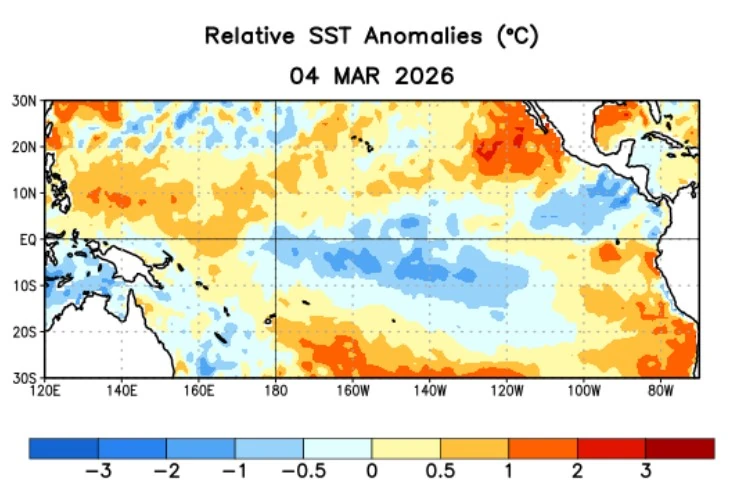
on March 4, 2026. Anomalies are computed with respect to the 1991-2020 base period weekly
means. Credit: NOAA
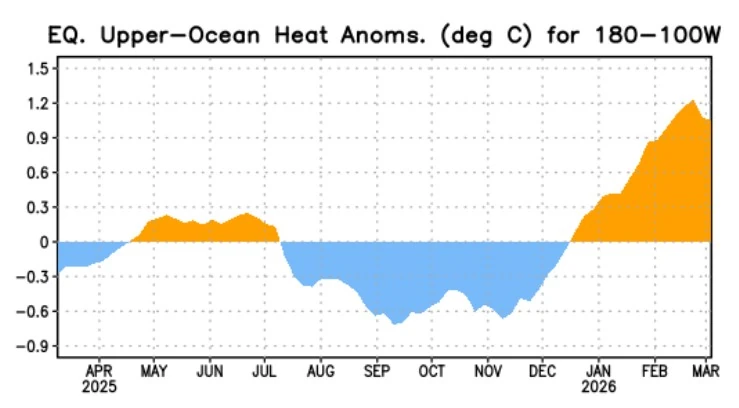
Pacific (5°N-5°S, 180º-100ºW). The heat content anomaly is computed as the departure from the
1991-2020 base period pentad means. Credit: NOAA
Meteorologist Andrej Flis of Severe Weather Europe notes that several recent westerly wind bursts across the equatorial Pacific may be contributing to this process. These wind anomalies weaken the trade wind circulation that maintains La Niña and can trigger Kelvin waves that transport warm water eastward beneath the surface.
According to his analysis, the warm subsurface pool currently spans depths of roughly 100–250 m (328–820 feet) across parts of the western and central equatorial Pacific, gradually propagating eastward.
Seasonal climate models monitored by CPC support a transition away from the current cold phase. The North American Multi-Model Ensemble, including the NCEP Climate Forecast System version 2, indicates that ENSO-neutral conditions are expected to develop within the next month and are favored through May–July 2026 with a probability of 55%.
Following that transition, forecast models increasingly favor El Niño development. CPC estimates a 62% probability that El Niño will emerge during June–August 2026 and persist through at least the end of the year.
The eventual strength of the event remains uncertain. Current probabilistic outlooks indicate roughly a one-in-three chance that El Niño could reach strong intensity during October–December 2026, defined as a three-month Niño-3.4 sea surface temperature anomaly of at least +1.5°C (+2.7°F).
NOAA’s official outlook emphasizes uncertainty, while some independent long-range analyses suggest that the combination of subsurface warming and repeated westerly wind bursts could favor a stronger event later in 2026. Severe Weather Europe has pointed to Kelvin wave activity and rapid subsurface warming as signals that could support stronger warming if the ocean–atmosphere coupling continues to intensify.
Forecast confidence remains limited during this time of year because ENSO predictions issued during boreal spring face the so-called spring predictability barrier, when seasonal transitions reduce forecast reliability.
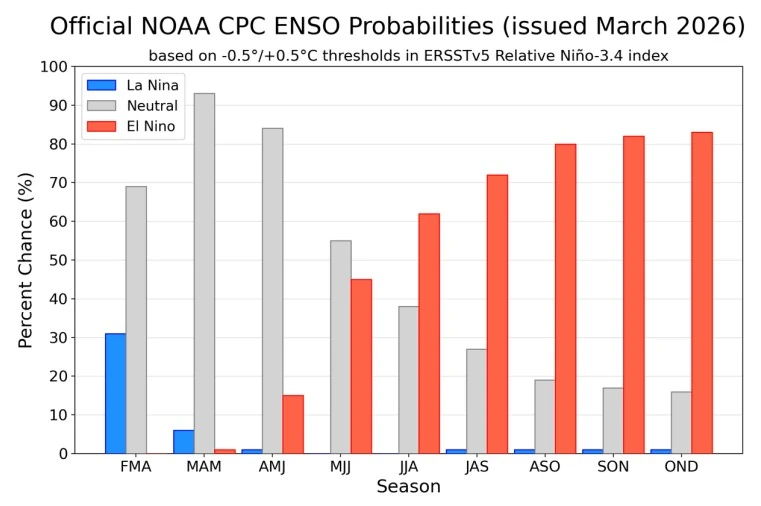
(5°N-5°S, 120°W-170°W minus tropical mean (20°N-20°S). Relative index is re-scaled to match
variance of the traditional index). Figure updated March 12, 2026. Credit: NOAA
If El Niño develops later this year, it could influence global weather patterns through late 2026 and into early 2027. El Niño events alter the Walker circulation and shift tropical rainfall patterns, which can in turn modify jet stream positions and storm tracks across many parts of the world.
Typical impacts include increased rainfall along the west coast of South America, particularly in Peru and Ecuador, and drier conditions across Indonesia and parts of Australia. During Northern Hemisphere winter, El Niño often brings wetter conditions to the southern United States while contributing to warmer temperatures across northern North America.
El Niño also tends to influence tropical cyclone activity. Atlantic hurricane activity typically decreases during El Niño years due to stronger vertical wind shear across the tropical Atlantic basin, while cyclone activity in the eastern and central Pacific often increases.
Scientists will continue monitoring sea surface temperatures, subsurface heat content, and atmospheric circulation across the tropical Pacific in the coming months to determine whether the current warming signals develop into a fully established El Niño event during the second half of 2026.
References:
1 EL NIÑO/SOUTHERN OSCILLATION (ENSO) DIAGNOSTIC DISCUSSION – CPC – March 12, 2026

I’m a science journalist and researcher at The Watchers, contributing to the Epicenter edition, where I cover peer-reviewed scientific research and emerging discoveries across Earth and space sciences. With a background in astronomy and a passion for environmental science, I’ve worked in shark and coral conservation in Fiji, conducting reef and shark-behavior research, contributing to mangrove restoration, and earning PADI Open Water and Coral Reef Certifications. I bring a blend of scientific rigor and storytelling to illuminate the discoveries shaping our planet and beyond.

Commenting rules and guidelines
We value the thoughts and opinions of our readers and welcome healthy discussions on our website. In order to maintain a respectful and positive community, we ask that all commenters follow these rules.