
Historic March blizzard buries parts of Michigan’s Upper Peninsula under up to 132 cm (52 inches) of snow
A late-season blizzard affected northern Michigan between March 15 and 17, 2026, dropping up to 132.1 cm (52 inches) of snow in parts of the Upper Peninsula and breaking snowfall records at the National Weather Service office in Marquette. Governor Gretchen Whitmer declared a state of emergency on March 17 for seven counties in the Upper Peninsula and northern Lower Peninsula as heavy snow, ice, and strong winds disrupted travel and power service.
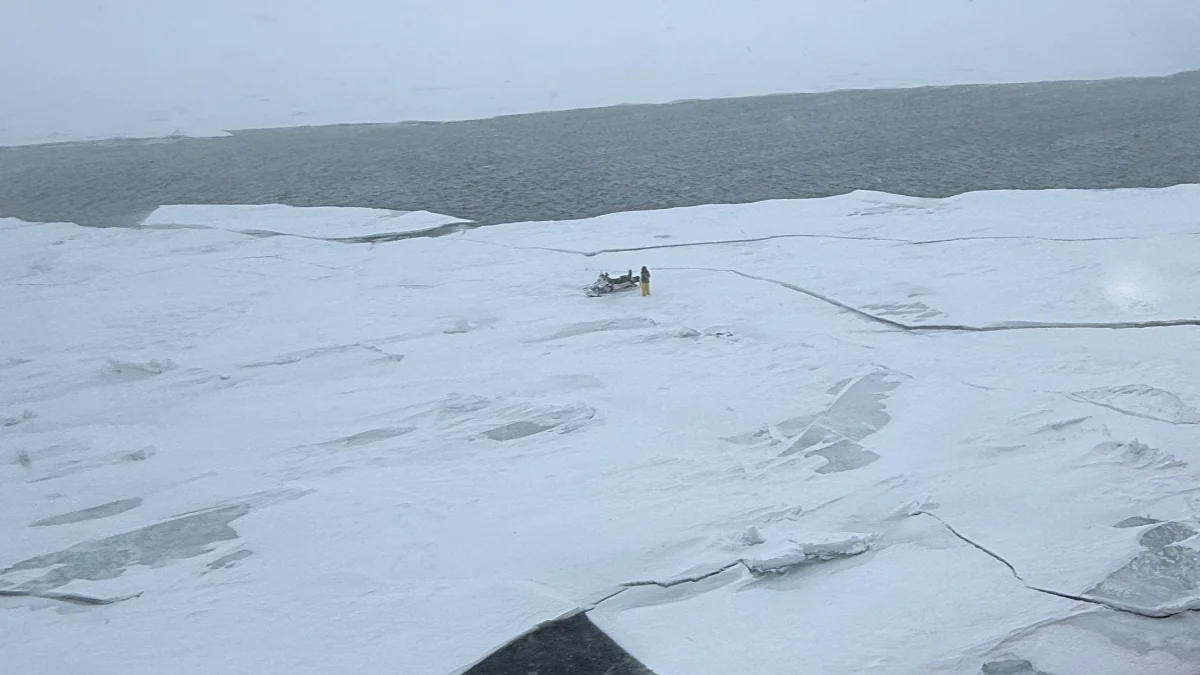
Snow mobile stuck in ice on Lake Michigan on March 16, 2026, amid historic blizzard. Credit: USCG Great Lakes
A late-season blizzard affected northern Michigan between March 15 and 17, with the heaviest snowfall focused on the Upper Peninsula. Storm-total snowfall reached 132.1 cm (52 inches) near Wetmore in Alger County, while several locations in Alger, Baraga, and Marquette counties recorded more than 100 cm (40 inches) of snow.
The highest reported total was 132.1 cm (52 inches) at Wetmore 12.7 S in Alger County. Other major totals included 123.2 cm (48.5 inches) near Shingleton, 107.9 cm (42.5 inches) near Munising, 114.3 cm (45 inches) near Herman in Baraga County, and 98 cm (38.6 inches) near Ishpeming in Marquette County.
At the National Weather Service office in Negaunee Township, 92.2 cm (36.3 inches) of snow was measured over March 15 and 16, setting a new two-day snowfall record for the site. The previous record was 81 cm (31.9 inches), set on March 13 and 14, 1997.


The office also broke daily snowfall records on both March 15 and 16. Snowfall reached 37.1 cm (14.6 inches) on March 15, exceeding the previous record of 32.5 cm (12.8 inches) from 2002, and 55.1 cm (21.7 inches) on March 16, surpassing the previous record of 19.6 cm (7.7 inches) set in 2013.
Across Marquette County, additional storm totals included 95.5 cm (37.6 inches) near Negaunee, 91.4 cm (36 inches) near Gwinn, 85.3 cm (33.6 inches) near Big Bay, and 69.9 cm (27.5 inches) at Clarksburg.
Snowfall totals decreased sharply farther west, with Gogebic County generally reporting 15 to 36.8 cm (5.9 to 14.5 inches) and Houghton County mostly between 4.6 and 18 cm (1.8 and 7.1 inches).


Elsewhere in the Upper Peninsula, Delta County reported up to 85.1 cm (33.5 inches) near Escanaba, Dickinson County up to 61.2 cm (24.1 inches) near Iron Mountain, Iron County up to 61 cm (24 inches) at Crystal Falls, Menominee County up to 86.4 cm (34 inches), Luce County 72.1 cm (28.4 inches) near Newberry, and Schoolcraft County up to 68.3 cm (26.9 inches) near Manistique.
Governor Gretchen Whitmer declared a state of emergency on March 17 for seven counties in the Upper Peninsula and northern Lower Peninsula after the storm caused widespread disruption, including road blockages, downed power lines, and prolonged outages.
The declaration covered Alcona, Alpena, Delta, Missaukee, Ogemaw, Roscommon, and Wexford counties.
On March 15, Whitmer ordered the closure of nonessential state office buildings across all 15 Upper Peninsula counties and 13 northern Lower Michigan counties due to extreme winter conditions. The State Emergency Operations Center was activated the same day at 10:00 local time to coordinate response efforts.
References:
1 Public Information Statement – NWS – March 17, 2026

Rishav Kothari is Editor-in-Chief of The Watchers, where he runs the newsroom and covers earthquakes, volcanoes, severe weather and space weather.
Published in the last 24 hours
- The Leonid meteor shower peaks on the night of November 17, exactly 60 years after the 1966 storm, when some observers reported meteors falling at up to 40 a second, though this year’s show should be closer to 15 an hour
- When Arctic air reached South Florida in January 2020, Miami fell to 40°F and the National Weather Service warned residents to watch for cold-stunned iguanas dropping out of the trees Epicenter
- In May 2024, the strongest solar storm in 20 years put northern lights over the southern US, and across the Plains, GPS-guided tractors built to plant within an inch drifted about 10 feet off their rows Epicenter
- In 1943, a flight instructor in Texas flew a two-seat training plane into the eye of a hurricane because he was curious, then landed and took the base weatherman up for a second pass Epicenter
