
Spain records deadliest May for heat-related deaths since monitoring began in 2015
Spain recorded 101 heat-related deaths during May 2026, making it the deadliest May since national monitoring began in 2015, while health authorities warned that heat extremes are arriving earlier in the year and increasing mortality risks across the country.
Image credit: Tsuyoshi Kozu
Spain has recorded 101 heat-related deaths through May, making this the deadliest May since the daily mortality monitoring system (MoMo) began keeping records in 2015. This was 3.6 times the average for May over the last decade.
At least 27 564 high-temperature-related deaths were recorded across Spain between 2015 and 2025, according to the MoMo system. 2022 was the worst with 4 789 deaths, followed by 2025 with 3 832 deaths.
“The problem is no longer just that it is hotter; it is that the heat is arriving earlier and earlier, and our bodies have not yet acclimatized,” said the health minister, Mónica García, as she presented the 2026 National Plan for Preventive Action on the Health Effects of Excessive Temperatures.
The risk of mortality rises by between 9.1% and 10.7% for every degree by which temperatures exceed the threshold considered hazardous to health, according to calculations by the health ministry.
Forecast models show a strong El Niño forming soon. Although El Niño is only one factor affecting global temperature and precipitation patterns, the phenomenon has historically been associated with elevated global temperatures and an increased likelihood of heat extremes in some regions.
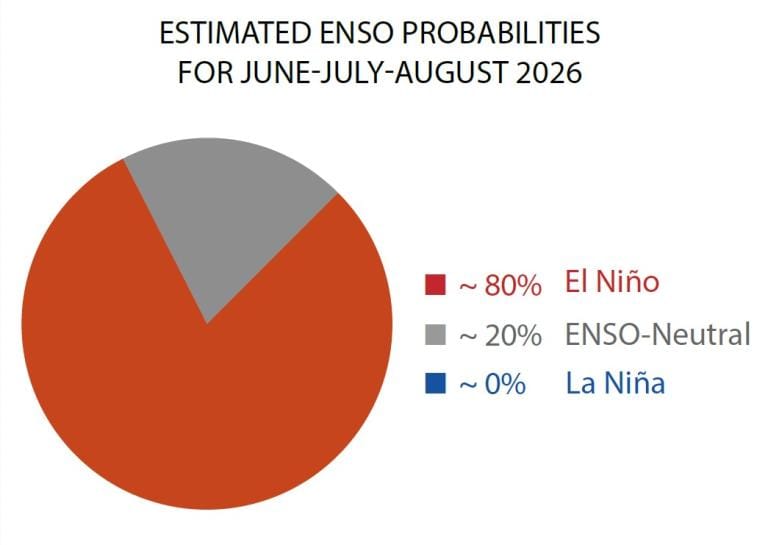
A new World Meteorological Organization (WMO) El Niño/La Niña Update indicates an 80% likelihood of an El Niño event during June–August 2026. Probabilities for this to continue until at least November are near or above 90%.
Although some uncertainty remains about El Niño peak strength and timing, most forecast models suggest it will be at least moderate – and possibly strong.
The WMO also forecasts an overheating Arctic that warms nearly 1.66°C (34.98°F) between now and 2030, and a dangerous drought with potential wildfires for the Amazon.
Long-range climate outlooks released by the WMO and the UK Met Office indicate a 75% probability that average global temperatures during the 2026-2030 period will exceed 1.5°C (2.7°F) above pre-industrial levels. The agencies also project continued rapid warming across the Arctic over the coming years.
The latest ENSO Diagnostic Discussion from NOAA’s Climate Prediction Center (CPC) shows an 82% chance that El Niño will develop between May and July 2026.
NOAA also forecasts a 96% chance that El Niño conditions will continue through the Northern Hemisphere winter of 2026–27.
The strongest early El Niño signal currently appears across parts of Canada and the northern United States, where forecast guidance increasingly supports warmer conditions during June and early summer.
Read more:
References:
1 Spain records highest number of May heat-related deaths – Reuters – June 3, 2026
2 El Niño/La Niña Update (May 2026) – WMO – June 2, 2026

I am an Assistant Editor and Severe Weather & Science Journalist at The Watchers, specializing in real-time severe weather coverage, geophysical event reporting, and research-driven scientific analysis. You can reach me at rishav(at)watchers(.)news.

Commenting rules and guidelines
We value the thoughts and opinions of our readers and welcome healthy discussions on our website. In order to maintain a respectful and positive community, we ask that all commenters follow these rules.