
Researchers identify South Atlantic fireball as likely interstellar meteor
A fireball detected over the South Atlantic Ocean at 02:13 UTC on April 1, 2026, has emerged as a candidate interstellar meteor following an orbital analysis by Avi Loeb and Richard Cloete, who argue that its trajectory is inconsistent with an origin within the Solar System. The object, designated Polar-IM, is described by Loeb and Cloete as the strongest interstellar meteor candidate yet identified in the NASA Center for Near Earth Object Studies (CNEOS) fireball database, with a confidence level above 99.9997% under the researchers’ uncertainty model.
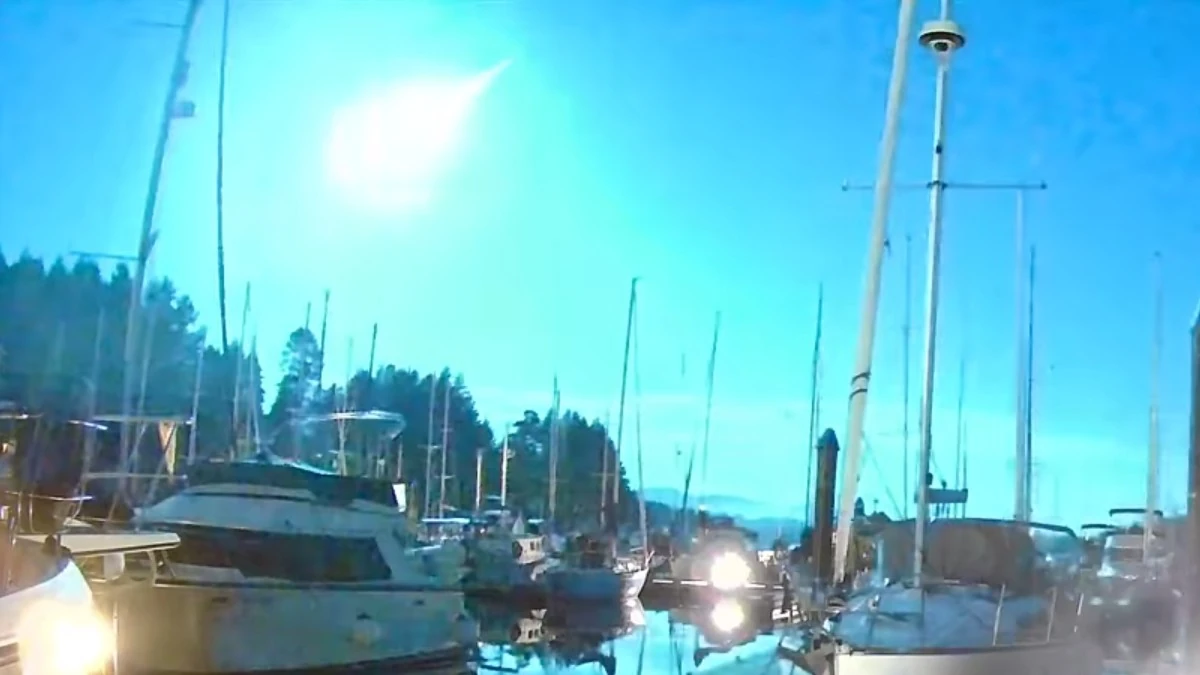
Bright fireball over British Columbia, Canada at 07:12 UTC on April 29, 2026. Credit: Michael Roth
A fireball detected over the South Atlantic Ocean at 02:13 UTC on April 1, 2026, has emerged as a candidate interstellar meteor following an orbital analysis by Avi Loeb and Richard Cloete, who argue that its trajectory is inconsistent with an origin within the Solar System.
The object, designated Polar-IM, is described by Loeb and Cloete as the strongest interstellar meteor candidate yet identified in the NASA Center for Near Earth Object Studies (CNEOS) fireball database, with a confidence level above 99.9997% under the researchers’ uncertainty model.
The event reached peak brightness at an altitude of 90.5 km (56.2 miles) near 41.9°S and 54.7°W, east of Argentina. Data released through the CNEOS fireball database list Earth-fixed velocity components of +3.6 km/s, -34.6 km/s, and +59.8 km/s, along with a reported radiated energy of 2.4 × 10¹⁰ J and a calculated impact energy of 0.086 kt. The database notes that the measurements are derived from U.S. Government sensor detections and should be used with caution because CNEOS does not independently verify or reanalyze the reported events.
After transforming the Earth-fixed velocity vector into heliocentric coordinates and accounting for Earth’s gravitational influence, Loeb and Cloete calculated a heliocentric speed of 51.73 km/s (32.14 miles/s) and a heliocentric excess speed of 30 km/s (18.6 miles/s). Their calculations produced an orbital inclination of 89.4 degrees, placing the trajectory nearly perpendicular to the plane of the Solar System. They also found that the velocity component perpendicular to the Solar System plane exceeded the local solar escape speed on its own.
To test the result, the researchers ran 1 million Monte Carlo simulations using an empirical post-2018 CNEOS error model developed in an earlier study. According to the researchers, none of the simulated trajectories produced a bound heliocentric orbit. The team reported a margin-to-scatter ratio of 12.82 sigma under their uncertainty model.
The event was already present in the publicly available CNEOS database. Loeb and Cloete’s analysis identified it as a candidate interstellar meteor based on its reconstructed trajectory. Based on the event’s reported impact energy and inferred velocity, Loeb estimated that Polar-IM had a mass of about 150 kg (331 lb) and a diameter of roughly 0.5 m (1.6 feet).
Polar-IM would join a short list of known interstellar visitors that includes 1I/’Oumuamua, 2I/Borisov, and 3I/ATLAS. Unlike those objects, which were identified telescopically while passing through the Solar System, Polar-IM was identified through analysis of a fireball recorded during atmospheric entry.
Loeb compared the event with the 2014 interstellar meteor candidate IM1, which was the focus of a 2023 ocean expedition that recovered metallic spherules from the seafloor that he and collaborators have argued are associated with the object. Polar-IM presents a different challenge. Its reported impact energy was modest and its altitude unusually high, conditions that may have allowed fragmentation high in the atmosphere and complicated efforts to determine whether recoverable material survived.
For that reason, the immediate priority is not a recovery expedition but a more detailed reconstruction of the trajectory. Planned follow-up work includes refining the velocity solution, reconstructing the orbit with a more complete Earth-Moon-Sun gravitational model, and modeling the atmospheric entry to determine whether a potential fall footprint can be identified.
The study calls for independent verification using optical observations, infrasound detections, seismic records, radar measurements, satellite data, or regional fireball-network observations obtained around 02:13:14 UTC on April 1. Such observations could test the reported velocity measurement and the proposed interstellar interpretation, which remains unconfirmed.
If future analyses support the reported trajectory and velocity measurements, Polar-IM would rank among the strongest interstellar meteor candidates identified in the CNEOS catalog and one of the few potential interstellar objects detected during atmospheric entry.
References:
1 Fireballs – CNEOS – Accessed on June 4, 2026
2 Discovery of a Polar Interstellar Meteor (Polar-IM) from April 1, 2026 – Avi Loeb – June 3, 2026

I’m a science journalist and researcher at The Watchers, contributing to the Epicenter edition, where I cover peer-reviewed scientific research and emerging discoveries across Earth and space sciences. With a background in astronomy and a passion for environmental science, I’ve worked in shark and coral conservation in Fiji, conducting reef and shark-behavior research, contributing to mangrove restoration, and earning PADI Open Water and Coral Reef Certifications. I bring a blend of scientific rigor and storytelling to illuminate the discoveries shaping our planet and beyond.

An ‘outlier’, one to label ‘Polar-IM’ for our grey box, re-visit when more data. With deepest gratitude to our author.