
Slovakia sets all-time temperature record as heat wave brings record June nights
Slovakia set a new national all-time temperature record of 41°C (105.8°F) at Turňa nad Bodvou on June 29, 2026, as a late-June heat wave brought record daytime and overnight warmth to the country. The minimum temperature at Bratislava–Koliba fell only to 26.3°C (79.3°F) on June 27, the highest June minimum recorded within the Slovak Hydrometeorological Institute (SHMÚ) network since 1951.
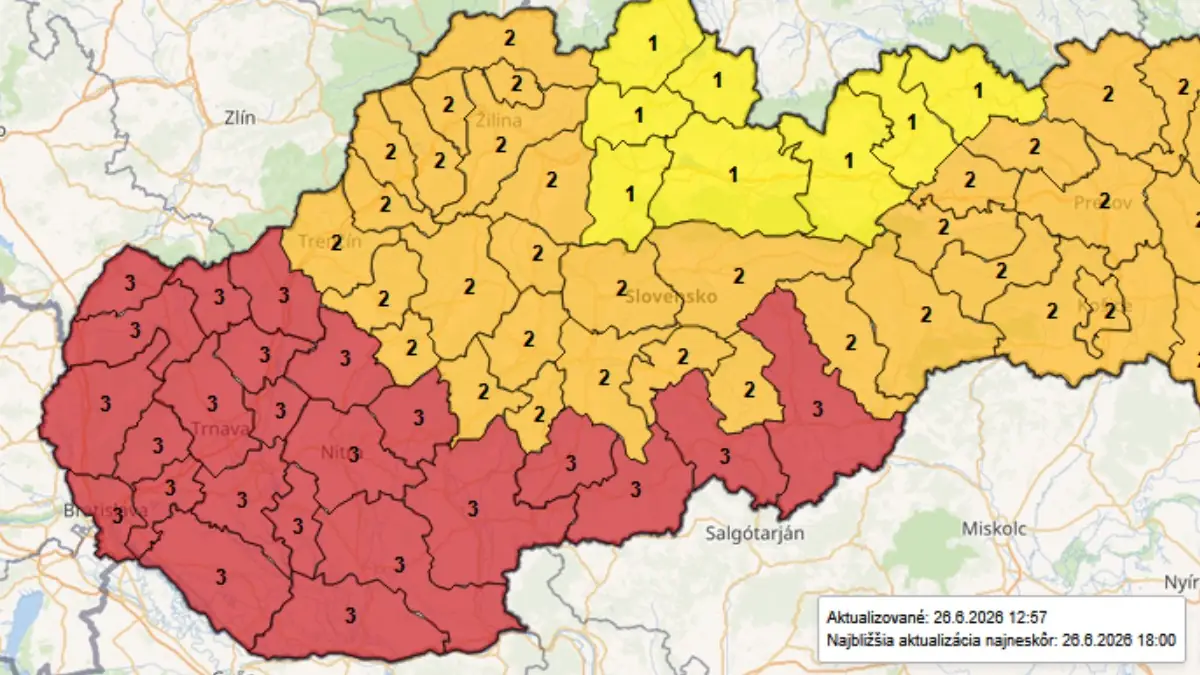
Meteorological warnings issued across Slovakia for June 28, 2026, with third-level heat warnings in effect across parts of western and southern Slovakia. Credit: SHMÚ
The 41°C (105.8°F) measurement surpassed the previous national maximum of 40.3°C (104.5°F), recorded at Hurbanovo on July 20, 2007. Tropical air moved from southwestern and western Europe into Central Europe during the final 10 days of June, with the heat peaking in Slovakia on June 29 ahead of a cold front advancing from the west.
The 26.3°C (79.3°F) minimum at Bratislava–Koliba exceeded the previous national June record of 25°C (77°F), measured at Kuchyňa on June 25, 2016. On the same day, Malý Javorník recorded a minimum of 24.9°C (76.8°F), the sixth-highest June minimum in the SHMÚ network since at least 1951.
Exceptionally warm nights continued on June 29. Bratislava–Koliba recorded a minimum of 25.8°C (78.4°F), the second-highest June minimum in the SHMÚ network since at least 1951, while Malý Javorník recorded 25.6°C (78.1°F), the third-highest June minimum in the network and the station’s highest June minimum on record.
The heat wave also generated an unusual number of tropical nights, defined as nights with a minimum temperature of at least 20°C (68°F). By June 29, Bratislava–Koliba had recorded 11 tropical nights, its highest June total since at least 1951, Malý Javorník recorded seven, while Bratislava Airport and Veľké Lovce each recorded six.
Stations in eastern Slovakia, including Somotor, Michalovce, and Milhostov, generally recorded one or two tropical nights. Banská Štiavnica, located at a higher elevation in central Slovakia, also recorded a tropical night on June 29.
As of June 29, at least one tropical night had been recorded at 33 meteorological stations during June. SHMÚ said records for June mean daily air temperature were also set during the heat episode, and that it would publish a separate detailed analysis of daily maximum temperatures.
On June 26, SHMÚ warned that increasingly hot tropical air moving eastward from western Europe would push daytime temperatures above 35°C (95°F) across several regions, with the warmest locations forecast to approach or exceed 40°C (104°F). Forecast guidance also indicated that temperatures could locally reach 41°C (105.8°F) as the event peaked on June 29 ahead of an advancing cold front.
Forecasters also warned that the previous June maximum temperature record of 38.8°C (101.8°F), measured at Somotor on June 30, 2022, was likely to be exceeded and that Slovakia’s all-time maximum temperature record of 40.3°C (104.5°F), measured at Hurbanovo on July 20, 2007, was under threat.
By June 30, SHMÚ confirmed that the heat wave had produced not only record-breaking overnight temperatures but also new June records for average daily air temperature. The institute reported that maximum daily temperatures measured on June 29 reached the highest values in the history of meteorological observations in Slovakia, adding that a detailed analysis of those records would be presented separately.
The event was characterized by persistent tropical air and limited overnight cooling, particularly across southwestern Slovakia, allowing exceptionally high nighttime temperatures to continue for several consecutive days while contributing to one of the country’s most significant June heat episodes on record.
References:
1 Najteplejšie noci v histórií meteorologických meraní na Slovensku – v júni 2026 boli zaznamenané rekordy minimálnej teploty vzduchu – SHMU – June 30, 2026
2 Vlna horúčav vyvrcholí v najbližších dňoch – SHMU – June 26, 2026

I’m a science journalist and researcher at The Watchers, contributing to the Epicenter edition, where I cover peer-reviewed scientific research and emerging discoveries across Earth and space sciences. With a background in astronomy and a passion for environmental science, I’ve worked in shark and coral conservation in Fiji, conducting reef and shark-behavior research, contributing to mangrove restoration, and earning PADI Open Water and Coral Reef Certifications. I bring a blend of scientific rigor and storytelling to illuminate the discoveries shaping our planet and beyond.

Commenting rules and guidelines
We value the thoughts and opinions of our readers and welcome healthy discussions on our website. In order to maintain a respectful and positive community, we ask that all commenters follow these rules.