
Rare positive Southern Annular Mode event shifts Australia’s winter weather, boosts eastern rainfall
A rare, exceptionally strong positive phase of the Southern Annular Mode (SAM) is influencing Australia’s winter weather, enhancing rainfall across parts of eastern Australia while reducing natural snowfall in alpine regions as the Southern Hemisphere’s belt of westerly winds shifts farther south.
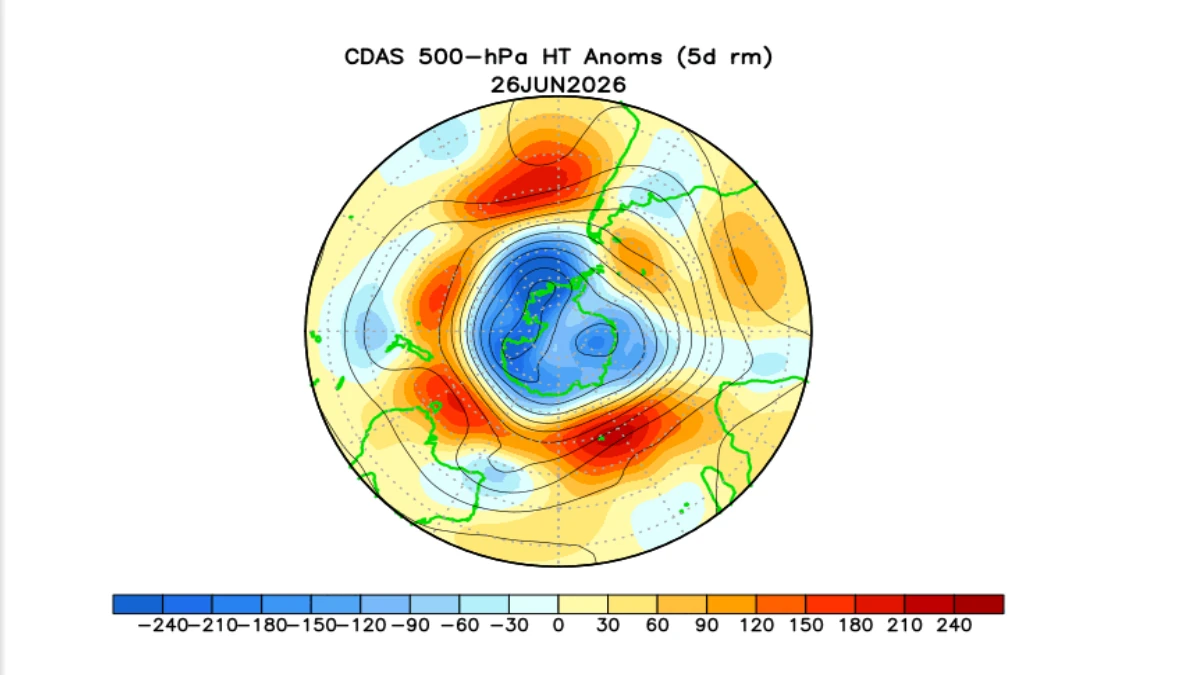
Image credit: NOAA/CPC
A rare, exceptionally strong positive phase of the Southern Annular Mode (SAM) is influencing Australia’s winter weather by displacing the Southern Hemisphere’s belt of westerly winds toward Antarctica.
The circulation pattern has increased moisture transport into eastern Australia while reducing the frequency of cold fronts reaching southern parts of the continent, contributing to widespread rainfall in the east and limited natural snowfall across the Australian Alps.
The daily SAM index exceeded +5 during late June and reached +5.06 on June 26, Weatherzone reported.
The Australian Bureau of Meteorology (BOM) confirms that the SAM remained in a positive phase and notes that positive winter SAM conditions typically increase rainfall over eastern Australia while reducing rainfall and snowfall across parts of southern Australia.
Two rain bands are delivering widespread rain to Australia’s eastern and southeast inland this week. This wet weather is due in part to moisture-laden easterly winds flowing over eastern Australia, which is associated with a positive SAM, according to Weatherzone.
The Australian alpine region is also being starved of early-winter snow due to the ongoing positive SAM. Australia’s ski resorts are currently relying on artificially made snow in the absence of any decent natural falls.
The Southern Annular Mode, also known as the Antarctic Oscillation, is the north-south movement of the belt of strong westerly winds that circles Antarctica.
During positive phases, atmospheric pressure decreases over Antarctica while pressure increases across the southern mid-latitudes, causing the westerly wind belt to contract poleward.
During the Australian winter, this circulation generally directs fewer cold fronts across southern Australia while strengthening easterly airflow that transports moisture toward eastern parts of the continent.
References:
1 Southern Annular Mode exceeds +5.0 in rare atmospheric event – Weatherzone – June 30, 2026
2 Southern Annular Mode and the Australian climate – BOM – accessed on July 1, 2026

Rishav Kothari is Editor-in-Chief of The Watchers, where he runs the newsroom and covers earthquakes, volcanoes, severe weather and space weather.
Published in the last 24 hours
- The storms drenching California this week are fed by a river in the sky, a band of water vapor that can carry up to 15 times the flow of the Mississippi River, and this winter’s near-record El Niño could keep aiming more of them at the West Coast
- Malawi continues Bris AI weather forecasting tests ahead of operational integration Epicenter
- Right about now, Voyager 1 is crossing a line no human-made object has ever reached, a full light-day from Earth, which means a message NASA sends tonight won't arrive until tomorrow night, and the spacecraft's answer won't make it home until the night after that
- G1 geomagnetic storm watch remains in effect as NOAA forecasts Kp 4.67 late on November 17 and early on November 18
