
Rare Southern Hemisphere stratospheric warming is weakening the polar vortex
A sudden stratospheric warming event is unfolding over Antarctica in early September 2025, rapidly weakening the southern polar vortex. Forecast models indicate potential downstream effects on the Northern Hemisphere jet stream, with implications for winter 2025/26 in the USA and Canada.

Weekly 10 hPa temperature anomaly forecast for September 15–22, 2025, over the Southern Hemisphere, showing strong positive anomalies centered over Antarctica. Credit: ECMWF
- A sudden stratospheric warming (SSW) event has begun over Antarctica in September 2025, causing rapid temperature increases in the stratosphere.
- SSW events, although more common in the Northern Hemisphere, are rare in the south and can have global repercussions on atmospheric circulation.
A rare and powerful SSW event is developing over the Southern Hemisphere and threatening to disrupt the southern Polar Vortex, potentially influencing global weather patterns later this year.
Such events are rare in the Southern Hemisphere, and can weaken the vortex, while sending ripples across the entire atmospheric system.
The polar vortex is a large cyclonic circulation of westerly winds that forms each winter in the stratosphere around both poles. It acts as a barrier, trapping cold polar air and influencing jet stream patterns. During a strong warming episode, stratospheric temperatures can rise by more than 40°C (72°F) within days, weakening or even reversing the vortex circulation.
According to Andrej Flis of the Severe Weather Europe, the current warming has already forced significant distortions in the southern polar vortex, with early model outputs suggesting potential wave propagation into the Northern Hemisphere. Such disruptions can alter the polar jet stream, which governs storm tracks and cold air intrusions.
Recent analyses from the NASA stratospheric monitoring system, show that zonal winds at around 10 hPa level (31 km/18.5 miles altitude) are running below normal, a clear indication that the vortex core is under stress.

At the same time, a strong warming wave is pushing the cold central core off its axis and raising stratospheric temperatures by more than 30°C (86°F) above average.
Forecast models suggest that within two weeks the strength of the vortex could be cut nearly in half, even without a full reversal of winds, a threshold that typically defines a SSW event.
The anomaly is expected to peak by late September, with temperatures in the stratosphere rising as much as 50°C (90°F) above seasonal norms.
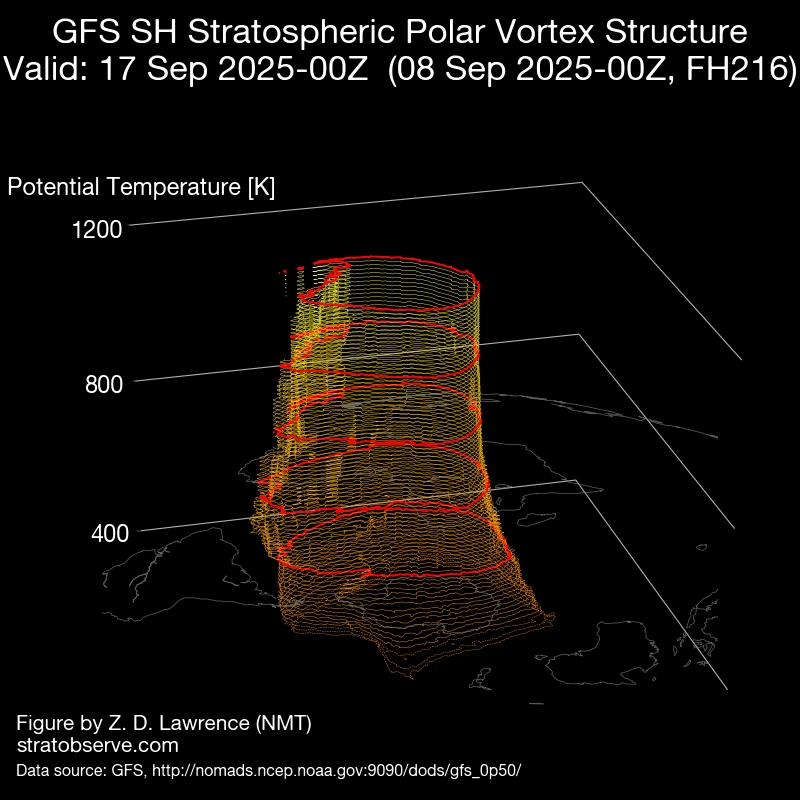
Unusually, this warming is also projected to descend to lower levels of the stratosphere, down to around 19 km (12 miles), which highlights the extraordinary strength of this event. When warming propagates downward in this way, the chances of it influencing surface weather increase significantly.
At the surface, the South Pole pressure index is forecast to turn negative and stay that way, signaling disrupted polar circulation and the development of high-pressure ridging around Antarctica.
Such blocking patterns are known to push cold polar air outward, raising the risk of sudden cold surges into mid-latitude regions. Australia has already seen similar episodes when the polar circulation is disturbed in this manner.
In the Southern Hemisphere, the disruption is expected to affect spring weather in South America, Australia, and New Zealand, potentially altering storm activity, rainfall distribution, and seasonal transitions.
“When the Southern Hemisphere’s tropospheric polar vortex is stronger than usual, cold air and powerful winds surrounding Antarctica typically contract towards the south,” said Ben Domasino of Weatherzone.
“The Southern Hemisphere’s polar vortex always weakens during spring as part of its normal seasonal cycle,” Domasino said.
“However, the stratospheric polar vortex has started to weaken faster than usual over the past week due to abnormally warm air entering the polar stratosphere. Some forecast models suggest that further stratospheric warming could occur through the middle of September as well.”
Domensino added that it is difficult to predict how each stratospheric warming episode will impact weather patterns closer to the ground, because such events are rare in the Southern Hemisphere and no two are the same. However, if the tropospheric polar vortex does weaken in the coming weeks, it will increase the likelihood of more frequent and stronger cold fronts over Australia during mid-to-late spring.
The impacts of this stratospheric warming may not be confined to the Southern Hemisphere as the two poles are connected through the Brewer–Dobson circulation, and disturbances in one can propagate into the other.
A similar event in 2019 was linked to dramatic ionospheric anomalies over the United States and Europe, with total electron content shifting by as much as 40 to 80 percent.
Extended high-pressure anomalies over the South Pole from August to October have also been associated with colder-than-average winters in the United States during December to February, while Europe often experiences the opposite effect, with warmer conditions than usual.
References:
1 A Stratospheric Warming event will Engulf the southern Polar Vortex, with possible far reaching Weather impacts – SWE – September 9, 2025
2 Southern Hemisphere’s polar vortex is weakening – here’s what this means for Australia – Weatherzone – September 9, 2025
3 What is the Polar Vortex? – NASA/GSFC – Accessed on September 10, 2025.

I am an Assistant Editor and Severe Weather & Science Journalist at The Watchers, specializing in real-time severe weather coverage, geophysical event reporting, and research-driven scientific analysis. You can reach me at rishav(at)watchers(.)news.

Commenting rules and guidelines
We value the thoughts and opinions of our readers and welcome healthy discussions on our website. In order to maintain a respectful and positive community, we ask that all commenters follow these rules.