
Large marine heatwave persists off the U.S. West Coast since summer 2025
A large marine heatwave has persisted along the U.S. West Coast since summer 2025, raising sea surface temperatures about 1.7–2.2°C (3–4°F) above average across parts of the Northeast Pacific. In a report published March 3, 2026, the National Oceanic and Atmospheric Administration (NOAA) Fisheries said this is only the third time in the observational record for the California Current ecosystem that such a large portion of coastal waters has remained anomalously warm for so long into winter without El Niño conditions.
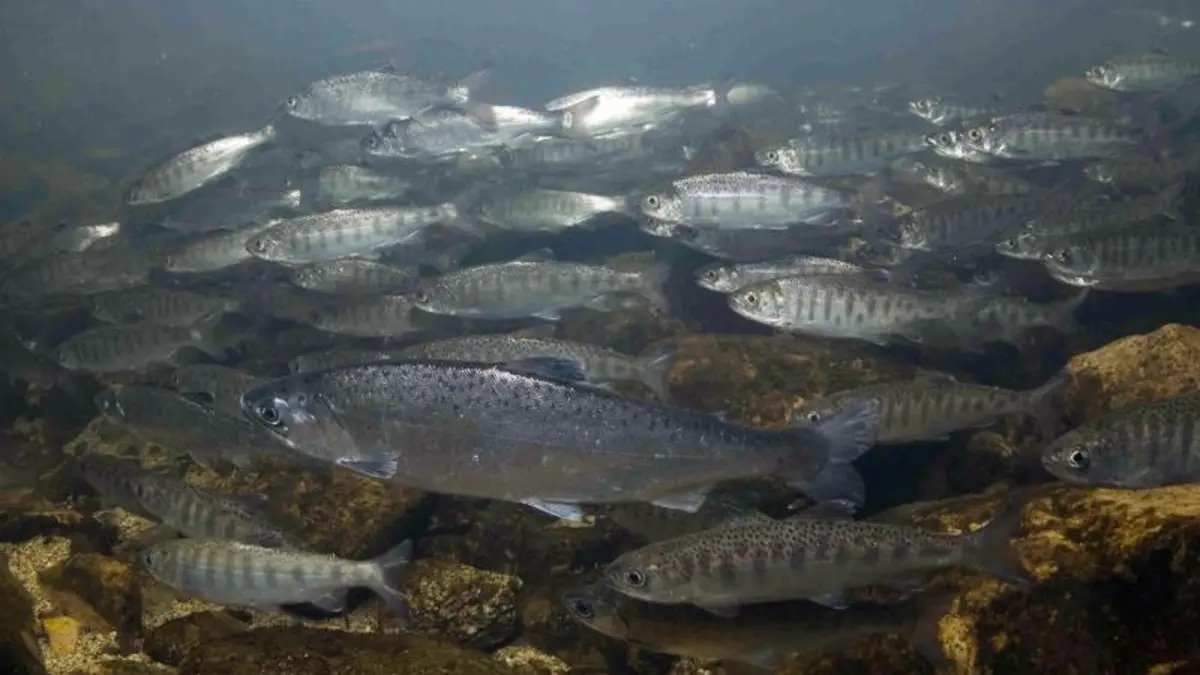
Marine heatwaves can reduce salmon survival in the ocean because warmer waters are typically less productive. Coho salmon, shown here, have been an exception in some places, though, since they often stay closer to the coast, taking advantage of cooler and more productive upwelled waters. Credit: NOAA Fisheries
The event is being monitored by the National Oceanic and Atmospheric Administration (NOAA) Fisheries through the California Current Marine Heatwave Tracker operated by the Southwest Fisheries Science Center. The system, active since 2019, analyzes temperature anomalies using data from satellites, ocean buoys, and research vessels across the California Current ecosystem.
Sea surface temperatures across parts of the northeast Pacific reached approximately 20.6°C (69.1°F) on September 9, 2025, the highest average temperature recorded for the region and nearly 0.5°C (0.9°F) warmer than the previous record. During portions of the event, waters along the West Coast have remained about 1.7–2.2°C (3–4°F) above long-term averages.
At its peak in September 2025, the heatwave rivaled the spatial scale and surface temperatures of the large Northeast Pacific marine heatwave that affected the region between 2013 and 2016, widely known as the Blob. That event caused major ecosystem disruptions across the Northeast Pacific, including widespread shifts in species distribution and extensive marine wildlife mortality.
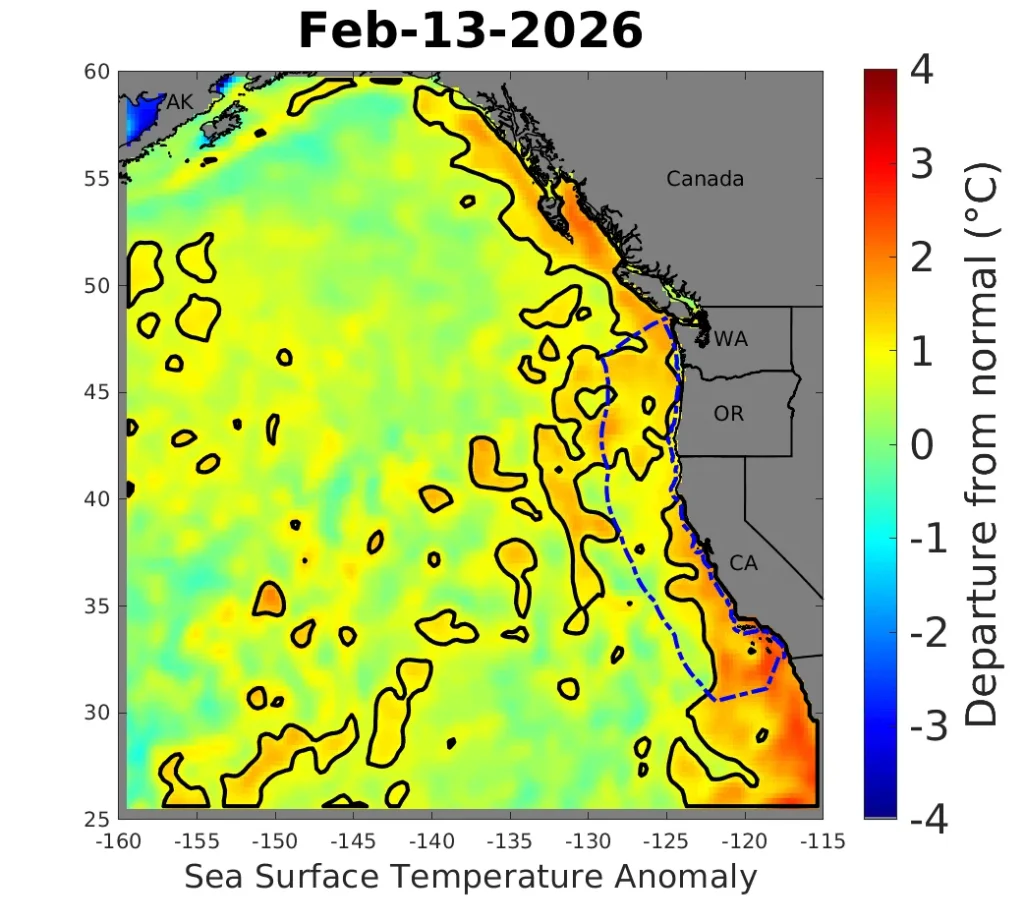
Conditions evolved through autumn 2025. The warm anomaly weakened and moved away from the coast during October and November, a pattern similar to earlier marine heatwaves. Ocean temperatures later increased again, and the anomaly returned toward coastal waters despite the presence of La Niña, which normally favors cooler conditions across the eastern Pacific.
Oceanographers monitoring the event say the temperature pattern differs from what would normally be expected during La Niña.
“We’re in La Niña, but water temperatures along our coast look much different,” said Andrew Leising, a research oceanographer at NOAA Fisheries’ Southwest Fisheries Science Center. “The conditions are hard to reconcile. We want to be cautious in our interpretation, but at the same time, this is not a situation that we have seen before.”
Marine heatwaves can alter ocean ecosystem conditions by strengthening stratification in the upper ocean. When warm surface layers become more stable, the mixing of colder, nutrient-rich water from deeper layers decreases. Reduced nutrient availability can limit plankton growth, affecting the food web that supports fish populations, seabirds, and marine mammals.
Previous marine heatwaves in the Northeast Pacific have been associated with reduced survival of salmon during their ocean phase. Warmer and less productive waters can reduce the availability of prey, leaving fewer fish to return to rivers to spawn.
Coho salmon, for example, have shown more resilience in some areas because they often remain closer to the coast, where upwelling brings cooler and more productive waters to the surface.
Shifts in species distribution have also been reported during the current event. For example, tuna were reported in unusually large numbers in Alaska waters during autumn 2025, indicating a northward movement of warm-water species as ocean temperatures increase.
Warm ocean conditions can also create favorable conditions for harmful algal blooms, which produce toxins that can harm marine mammals, seabirds, and fish, and may lead to the closure of shellfish fisheries when toxins accumulate in shellfish.
An unusually early harmful algal bloom developed off Southern California in 2025, killing hundreds of California sea lions, dolphins, and seabirds. Persistent warm conditions raise the possibility that similar blooms could develop again if ocean temperatures remain elevated.
Despite its large spatial extent, the current heatwave has produced fewer ecosystem impacts than the 2013–2016 Blob event. “Although rivaling the Blob in area, the current marine heatwave has had much less ecological impact so far since it has not penetrated as deeply into the water column, and has not spent as much time near the coast,” Leising said.
Forecast models suggest the anomaly could weaken in the coming months as warm surface layers mix with cooler water below.
“NOAA’s marine heatwave forecasts suggest that the warm waters may dissipate as surface waters mix with cooler water from below,” said Michael Jacox, a research scientist at NOAA Fisheries’ Southwest Fisheries Science Center. One remaining question, he noted, is whether enough warm water will persist to combine with nutrient conditions that could fuel another harmful algal bloom.
“We are in uncharted conditions, so we need to assess the most likely outcome given what we know,” Leising said. “This is what makes the ocean so interesting. We see different pieces of the picture, but ultimately it’s the marine ecosystem that brings those together and demonstrates where the conditions are leading us.”
References:
1 West Coast Waters Experiencing Another Large Marine Heatwave – NOAA Fisheries – March 03, 2026

I’m a science journalist and researcher at The Watchers, contributing to the Epicenter edition, where I cover peer-reviewed scientific research and emerging discoveries across Earth and space sciences. With a background in astronomy and a passion for environmental science, I’ve worked in shark and coral conservation in Fiji, conducting reef and shark-behavior research, contributing to mangrove restoration, and earning PADI Open Water and Coral Reef Certifications. I bring a blend of scientific rigor and storytelling to illuminate the discoveries shaping our planet and beyond.

Commenting rules and guidelines
We value the thoughts and opinions of our readers and welcome healthy discussions on our website. In order to maintain a respectful and positive community, we ask that all commenters follow these rules.