
Magma accumulation beneath Svartsengi reaches 22.5 million m³ after 210 days of recharge, Iceland
Magma continues to accumulate beneath the Svartsengi volcanic system on the Reykjanes Peninsula, Iceland, as of March 3, 2026. The Icelandic Meteorological Office reports that approximately 22.5 million m³ (795 million ft³) of magma have accumulated since the last eruption in July 2025, while ground uplift remains steady and seismic activity above the intrusion is low.

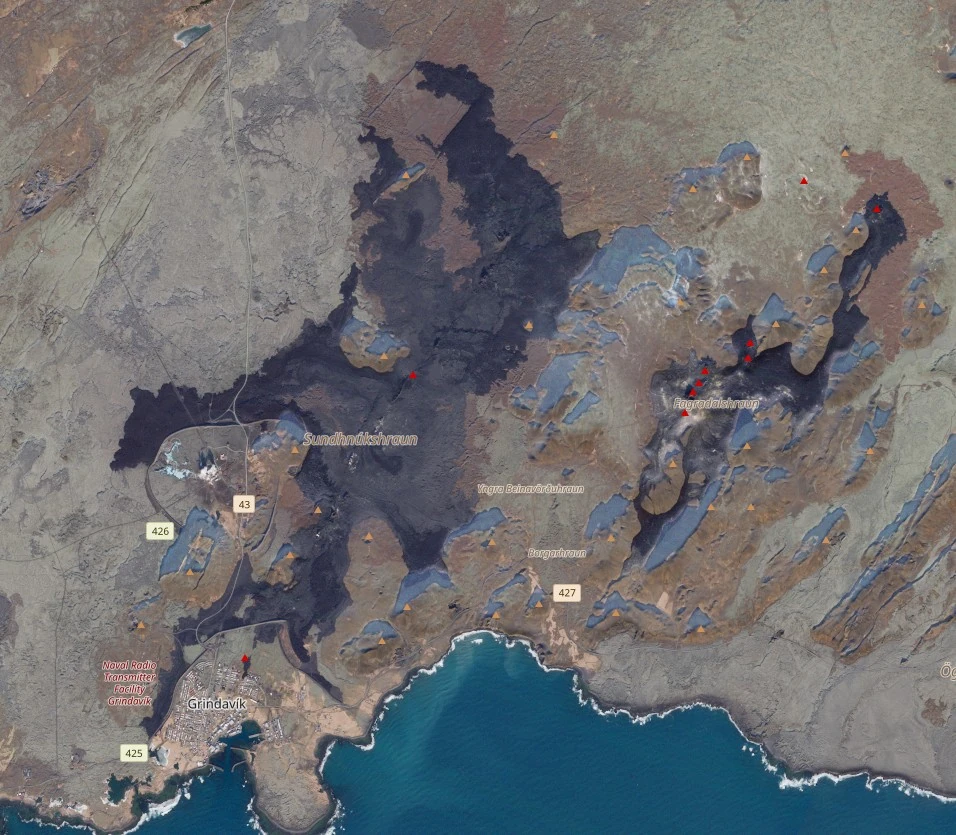
Satellite image of lava fields formed during the 2023–2025 fissure eruptions along the Sundhnúkur crater row on the Reykjanes Peninsula, Iceland. The dark lava flows extend north of Grindavík and across the Svartsengi volcanic area, showing the cumulative extent of recent eruptive activity. The image was acquired on February 20, 2026. Credit: CopernicusEU/Sentinel-2, The Watchers
Magma has been accumulating beneath Svartsengi for about 210 days, according to measurements released by the Icelandic Meteorological Office (IMO) on March 3. This is the longest continuous accumulation period since the eruptive episode along the Sundhnúkur crater row began in December 2023.
If accumulation continues at the current rate, the total volume stored beneath Svartsengi could become the largest recorded between eruptions since the beginning of this eruptive sequence.
Deformation measurements indicate that ground uplift remains concentrated at Svartsengi. Satellite radar observations covering August 9, 2025, to January 30 show that surface deformation is focused around the Svartsengi volcanic system rather than elsewhere on the Reykjanes Peninsula.
Previous monitoring reports indicate that cumulative uplift in the area has approached about 1 m (3.3 feet) since late 2023 as magma continues to recharge the reservoir beneath the geothermal field.
Seismic activity above the magma intrusion remains low. Small earthquakes continue to be recorded in the region, while activity near Vík is interpreted as triggered earthquakes caused by stress changes in the crust as pressure within the system evolves.
A prolonged pause in eruptions does not indicate that the eruptive episode has ended, IMO volcanologists said. Based on current observations, the most likely development remains a magma intrusion propagating from Svartsengi toward the Sundhnúkur crater row that could culminate in an eruption similar to previous events in this ongoing sequence.
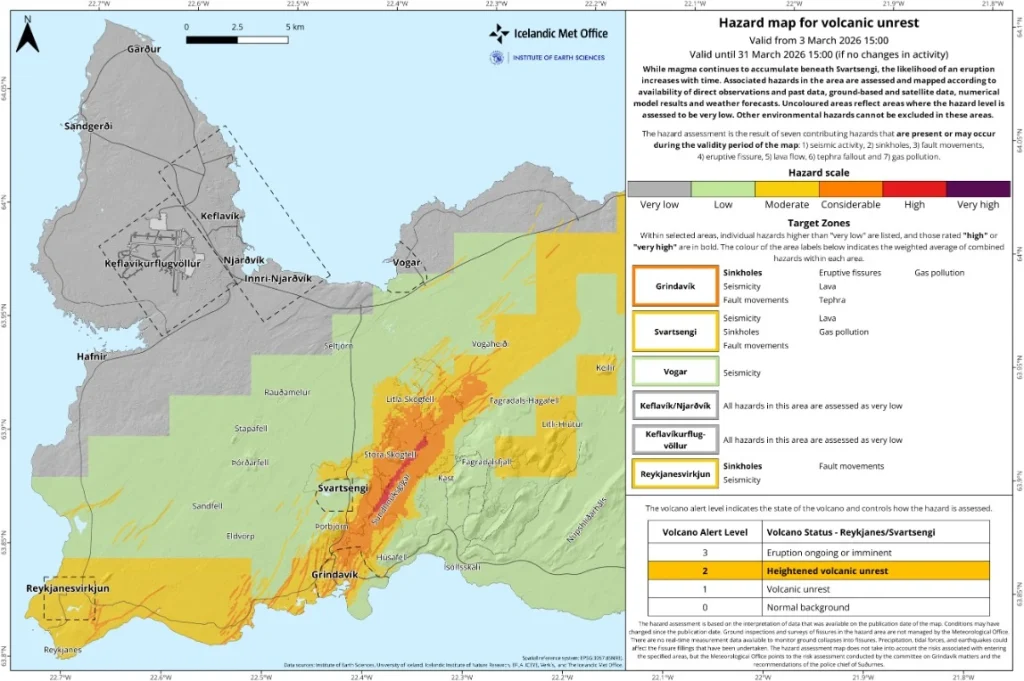
The hazard assessment for the Reykjanes Peninsula remains unchanged and is valid through March 31.
Model calculations indicate that the magma volume accumulated since the July 2025 eruption now approaches the upper range previously observed between eruptions, which has varied between about 17 and 23 million m³ (600 to 812 million ft³).
As magma continues to accumulate and pressure within the system increases, the most likely development remains a magma intrusion propagating toward the Sundhnúkur crater row.
References:
1 Magma accumulation beneath Svartsengi approaches 23 million cubic meters since the last eruption – IMO – March 3, 2026

I’m a science journalist and researcher at The Watchers, contributing to the Epicenter edition, where I cover peer-reviewed scientific research and emerging discoveries across Earth and space sciences. With a background in astronomy and a passion for environmental science, I’ve worked in shark and coral conservation in Fiji, conducting reef and shark-behavior research, contributing to mangrove restoration, and earning PADI Open Water and Coral Reef Certifications. I bring a blend of scientific rigor and storytelling to illuminate the discoveries shaping our planet and beyond.

Commenting rules and guidelines
We value the thoughts and opinions of our readers and welcome healthy discussions on our website. In order to maintain a respectful and positive community, we ask that all commenters follow these rules.