
Nuclear-linked iodine-129 detected in the West Philippine Sea
Elevated concentrations of iodine-129 were detected in seawater samples collected recently from the West Philippine Sea during a nationwide marine radioisotope survey conducted by the University of the Philippines Marine Science Institute. The concentrations were higher than those measured in other Philippine marine areas, despite the Philippines having no active nuclear power plant or nuclear weapons program.
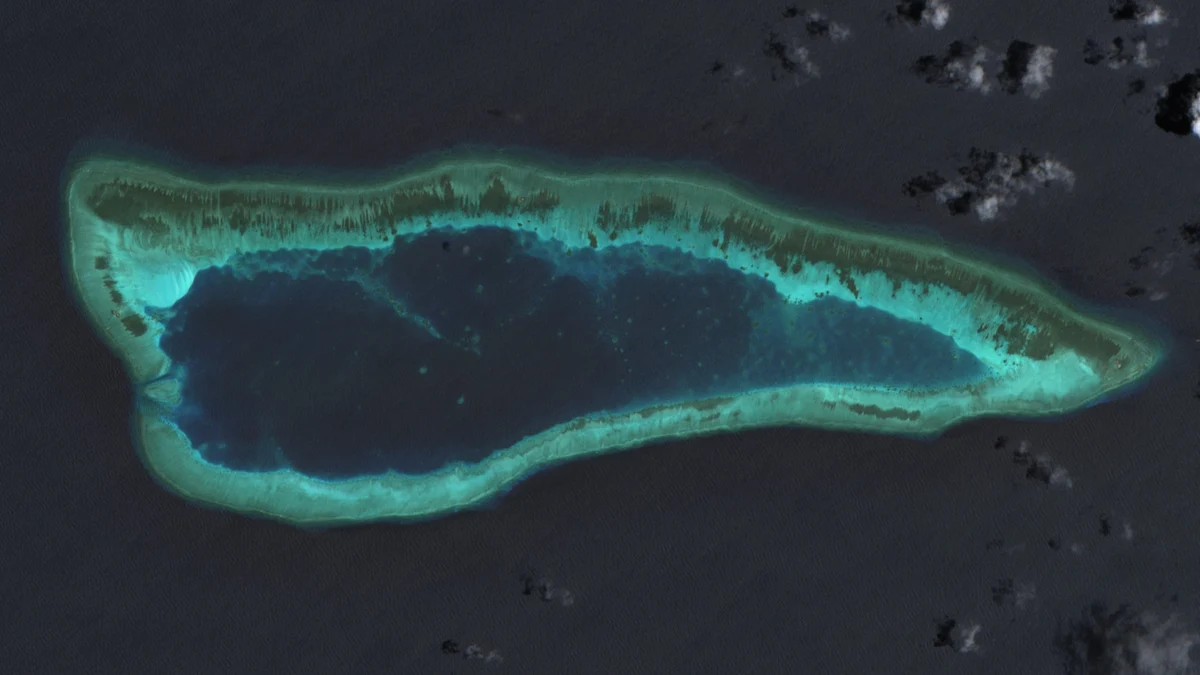
East London Reef. Credit: Sentinel Hub EO Browser (ESA)
Elevated concentrations of iodine-129 were identified in seawater samples collected from the West Philippine Sea during a nationwide marine radioisotope survey conducted by the University of the Philippines Marine Science Institute. The findings were published on November 5, 2025, following laboratory analysis of samples obtained from multiple marine regions across the Philippine archipelago.
The study analyzed 119 seawater samples collected from the West Philippine Sea, the Philippine Rise, the Sulu Sea, and other surrounding waters. Results showed that iodine-129 concentrations in the West Philippine Sea were approximately 1.5–1.7 times higher than levels measured at other sampling sites within Philippine waters.
Iodine-129 is a long-lived radioactive isotope with a half-life of about 15.7 million years and is commonly used in environmental and oceanographic studies as a tracer of nuclear activity. It is primarily released into the environment through atmospheric nuclear weapons testing and nuclear fuel reprocessing. The Philippines does not operate nuclear power plants and does not have a nuclear weapons program, ruling out domestic sources.
The research was conducted by scientists from the Department of Science and Technology–Philippine Nuclear Research Institute, the Geological Oceanography Laboratory of UP MSI, and the University of Tokyo. Based on isotopic patterns and regional comparisons, the team identified the Yellow Sea as the most likely upstream source region of the iodine-129 detected in the West Philippine Sea.
According to the researchers, the findings are consistent with recent studies from China that link iodine-129 in the Yellow Sea to historical atmospheric nuclear weapons tests and releases from nuclear fuel reprocessing facilities in Europe. These releases, which occurred decades ago, introduced iodine-129 into the environment, where it was transported through soils and river systems into marginal seas of northeastern Asia.
The study suggests that iodine-129 reached Philippine waters via large-scale ocean circulation, particularly the Yellow Sea Coastal Current and the Chinese Coastal Current. These currents are known to transport water masses southward along the East Asian continental margin. However, the researchers noted that detailed oceanographic and numerical modeling is still required to confirm the exact transport pathways and residence times.
Despite its radioactive nature, the measured concentrations of iodine-129 in the West Philippine Sea were assessed to be far below thresholds considered harmful to human health or marine ecosystems. The researchers stated that the detected levels do not pose an environmental or public health risk.
The research emphasizes the transboundary behavior of long-lived radionuclides in the marine environment and highlights the importance of sustained monitoring of radioactive substances that can be transported across national boundaries by ocean circulation. The researchers called for continued regional cooperation and long-term observation to better understand the movement of such isotopes in the western Pacific.
References:
1 Tracing the origin, transport, and distribution of elevated iodine-129 in seawater from the West Philippine Sea – Rachelle Clien G. Reyes et al. – Marine Pollution Bulletin – November 5, 2025 – https://doi.org/10.1016/j.marpolbul.2025.118916 – OPEN ACCESS

I’m a science journalist and researcher at The Watchers, contributing to the Epicenter edition, where I cover peer-reviewed scientific research and emerging discoveries across Earth and space sciences. With a background in astronomy and a passion for environmental science, I’ve worked in shark and coral conservation in Fiji, conducting reef and shark-behavior research, contributing to mangrove restoration, and earning PADI Open Water and Coral Reef Certifications. I bring a blend of scientific rigor and storytelling to illuminate the discoveries shaping our planet and beyond.

Commenting rules and guidelines
We value the thoughts and opinions of our readers and welcome healthy discussions on our website. In order to maintain a respectful and positive community, we ask that all commenters follow these rules.